

Operational Visibility as a Foundation for Reliability Improvement
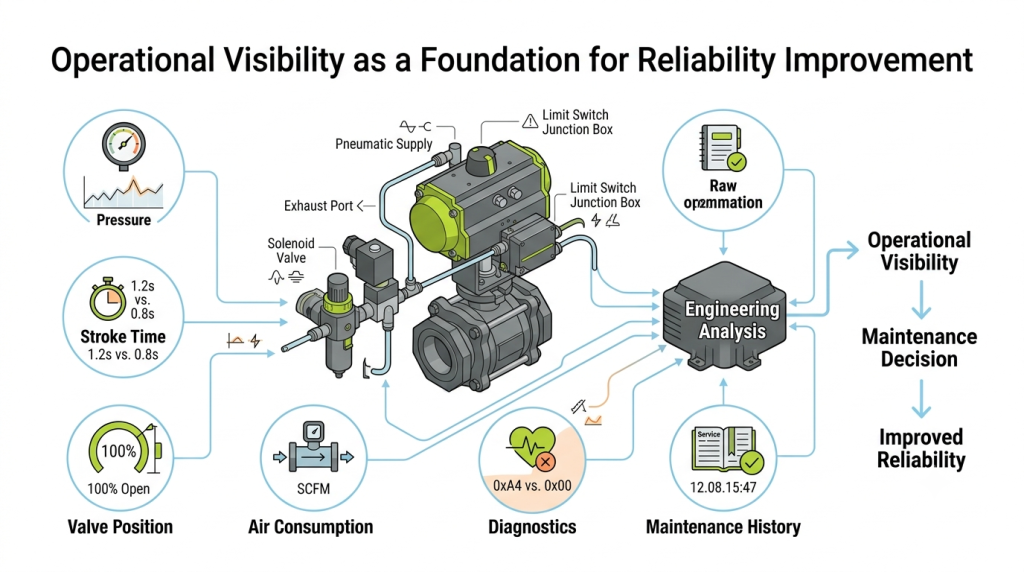
Industrial assets generate an enormous amount of operational data every day. Pressure values, valve positions, actuator movements, alarms, diagnostic messages, and maintenance records all describe how equipment is performing. Yet data alone does not improve reliability. Operational visibility is achieved when this information is interpreted correctly, enabling engineers to recognise degradation early, understand equipment behaviour, and make informed maintenance decisions before failures occur.
Modern industrial facilities have invested heavily in automation, instrumentation, and digital technologies. Despite this, unexpected equipment failures still occur, emergency shutdowns continue to interrupt production, and maintenance teams often discover problems only after performance has already deteriorated.
The issue is rarely a lack of information. More often, it is a lack of visibility into what that information actually means. Thousands of measurements may be available, but without engineering interpretation they become isolated data points rather than indicators of equipment health.
Operational visibility bridges this gap. It transforms operational data into engineering knowledge, helping maintenance and reliability teams understand how assets behave throughout their lifecycle and identify developing problems before they affect safety, production, or equipment availability.
What Is Operational Visibility?
Operational visibility is the ability to understand the real operating condition of industrial equipment through meaningful engineering information. It goes beyond simply collecting process data or displaying values on a control screen. Instead, it focuses on recognising trends, identifying abnormal behaviour, and understanding how equipment performance changes over time.
Consider an actuator operating within a shutdown valve assembly. A pressure reading of 6 bar provides useful information, but by itself it says very little about equipment reliability. However, if engineers observe that operating pressure has gradually become unstable, actuator stroke time has increased, and air consumption is rising, those combined observations provide valuable insight into developing degradation.
Operational visibility therefore connects individual measurements into a broader engineering picture. Rather than reacting to isolated alarms, engineers gain the context needed to understand why equipment behaviour is changing and what actions should be taken.
Why Operational Visibility Matters
Every industrial asset changes throughout its operational life. Mechanical wear increases friction, pneumatic components develop leakage, instruments gradually drift from calibration, and environmental conditions continuously influence equipment performance. These changes rarely occur suddenly. Instead, they develop progressively, often remaining unnoticed until production is affected or maintenance becomes unavoidable.
Operational visibility allows these changes to be identified while they are still manageable. Engineers can observe gradual deterioration, compare current performance with historical behaviour, and investigate abnormal trends before reliability is compromised.
This proactive understanding provides several practical advantages:
- Earlier identification of equipment degradation.
- Reduced uncertainty when planning maintenance activities.
- Improved confidence in the condition of critical assets.
- Better prioritisation of maintenance resources.
- Reduced likelihood of unexpected production interruptions.
- More informed lifecycle management decisions.
Instead of responding to failures after they occur, engineering teams can focus on recognising deterioration while corrective action remains planned, controlled, and cost-effective.
From Data to Engineering Decisions
Collecting operational data is only the first step. The real value lies in converting that data into engineering insight that supports maintenance, reliability, and operational decisions. Raw measurements rarely explain why equipment behaviour is changing; they must be interpreted within the context of process conditions, historical performance, and equipment design.
For example, an increase in actuator stroke time may indicate higher mechanical friction, insufficient air supply, contamination within the pneumatic circuit, or internal seal degradation. The measured value itself does not identify the problem—it simply signals that further engineering evaluation is required.
This distinction separates monitoring from operational visibility. Monitoring answers the question, “What is happening?” Operational visibility helps answer the more valuable question, “Why is it happening, and what should we do next?”
| Available Data | Engineering Interpretation |
|---|---|
| Pressure = 6 bar | Pressure remains stable within the expected operating range. |
| Stroke time increased by 15% | Possible mechanical wear, increased friction, or pneumatic restriction. |
| Higher air consumption | Potential leakage or deteriorating actuator seals. |
| Repeated diagnostic warning | Emerging degradation requiring engineering assessment. |
| Valve position deviation | Possible calibration drift, hysteresis, or mechanical backlash. |
Effective reliability programmes combine process measurements, equipment diagnostics, inspection findings, and maintenance history to establish a complete understanding of asset health. This broader perspective enables maintenance decisions to be based on observed equipment behaviour rather than assumptions or fixed maintenance intervals.
Operational Visibility in Valve Automation Systems
Automated valve assemblies provide an excellent example of why operational visibility is essential. A shutdown valve package consists of mechanical, pneumatic, electrical, and instrumentation components working together to perform a single critical function. Although each component can be monitored individually, true operational visibility comes from evaluating the performance of the complete system.
Pneumatic Actuators
Pneumatic actuators rarely fail without warning. Progressive increases in stroke time, unstable operating pressure, or higher compressed air consumption often develop long before the actuator is unable to complete its required movement. Monitoring these trends allows maintenance to be planned while the actuator remains fully operational.
Solenoid Valves
Solenoid valves are critical interfaces between the control system and the actuator. Operational visibility includes monitoring switching performance, electrical status, response consistency, and diagnostic information. Repeated delays or inconsistent switching behaviour may indicate contamination, internal wear, or electrical issues that should be investigated before they affect valve operation.
Valve Positioners
Intelligent positioners provide valuable diagnostic information beyond simple valve position. Changes in travel accuracy, increasing hysteresis, unstable control response, or frequent corrective movements may indicate calibration drift, mechanical wear, or process instability requiring engineering attention.
Partial Stroke Testing
Partial Stroke Testing (PST) demonstrates how operational visibility contributes to functional safety. Rather than confirming only that a shutdown valve can move, repeated test results allow engineers to evaluate movement consistency, response characteristics, and gradual changes in valve behaviour over time. Trending these results increases confidence that the valve will perform correctly when a full emergency demand occurs.
Emergency Shutdown Valve Assemblies
Critical shutdown systems should never be evaluated solely by the condition of individual components. Operational visibility requires engineers to consider the complete assembly—including the valve, actuator, solenoid valve, air preparation equipment, tubing, position feedback, and associated diagnostics—to determine whether the system remains capable of performing its intended safety function.
Reliability is a property of the complete automation system rather than any individual device. A healthy actuator cannot compensate for a contaminated air supply, a sticking solenoid valve, or inaccurate position feedback. Operational visibility therefore depends on understanding how all components perform together throughout the asset lifecycle.
Building Operational Visibility Throughout the Asset Lifecycle
Operational visibility is not created by installing a single smart device or adding more process measurements. It is developed through a systematic approach that combines equipment diagnostics, engineering inspections, operational experience, maintenance history, and condition monitoring into a coherent understanding of asset performance.
As equipment progresses through its lifecycle, each source of information contributes to a more complete picture of asset health. Historical maintenance records reveal recurring issues, diagnostic functions identify abnormal operating behaviour, inspections verify physical condition, and trend analysis highlights gradual changes that would otherwise remain unnoticed.
This integrated approach enables maintenance teams to move beyond reacting to failures. Instead, they gain the confidence to prioritise maintenance activities according to asset condition, operational risk, and equipment criticality.
| Information Source | Contribution to Operational Visibility |
|---|---|
| Equipment Diagnostics | Identifies abnormal operating behaviour and device health. |
| Condition Monitoring | Detects performance trends before functional failure occurs. |
| Engineering Inspections | Confirms the physical condition of critical components. |
| Maintenance Records | Provides historical context for recurring issues and interventions. |
| Operational Experience | Supports engineering judgement and practical decision-making. |
Key Takeaways
Improving reliability begins with improving understanding. Industrial assets continuously provide information about their operating condition, but reliability only improves when that information is transformed into meaningful engineering knowledge.
- Operational visibility extends beyond data collection by providing engineering context.
- Understanding trends is more valuable than observing isolated measurements.
- Early recognition of degradation supports planned maintenance and reduces operational risk.
- Critical valve automation systems should be evaluated as integrated assemblies rather than individual components.
- Combining diagnostics, inspections, maintenance history, and condition monitoring provides a more complete view of asset health.
- Better visibility leads to better engineering decisions, which ultimately improve reliability, availability, and asset lifecycle performance.
Operational visibility is therefore not a technology or a software platform—it is an engineering capability. By understanding how equipment behaves throughout its lifecycle, organisations can reduce uncertainty, improve maintenance effectiveness, and make more informed decisions that enhance both operational performance and process safety.
Frequently Asked Questions
Is operational visibility the same as condition monitoring?
No. Condition monitoring is one source of information that supports operational visibility. Operational visibility combines monitoring data with engineering interpretation, inspections, diagnostics, and maintenance history to provide a complete understanding of asset health.
Why is operational visibility important for shutdown valve systems?
Shutdown valve assemblies consist of multiple interacting components. Evaluating the complete system rather than individual devices helps engineers identify developing issues before they compromise the safety function of the assembly.
Can operational visibility reduce unplanned downtime?
Yes. Early recognition of degradation enables maintenance to be planned before equipment performance deteriorates to the point of causing unexpected failures or production interruptions.
What information contributes to operational visibility?
Typical sources include equipment diagnostics, condition monitoring, inspection findings, maintenance records, operational history, and engineering assessments. Together, these provide the context required for informed maintenance and reliability decisions.
Continue Your Reliability Journey
Explore practical engineering insights and industrial automation solutions that help improve reliability, operational visibility, and lifecycle performance across critical process assets.
Explore Reliability Solutions