
Reliable Solutions
Pneumatic Valve Actuators for Fast and Fail-Safe Operation
Fast and Fail-Safe Operation with Reliable Actuators for different applications
Pneumatic actuators are used when fast valve response and reliable fail-safe operation are required. In safety-critical systems, actuator behavior directly impacts shutdown performance and system reliability.
At Nordenflow, pneumatic actuator solutions are configured based on torque requirements, air supply conditions, and valve behavior to ensure predictable operation under real process conditions.
When Pneumatic Actuators Are the Right Choice
Pneumatic actuators are selected when valve response time, fail-safe behavior, and reliability under continuous operation are critical. However, performance depends strongly on air supply stability and system configuration.
In many applications, choosing pneumatic actuation without evaluating air pressure conditions, control requirements, or valve dynamics can lead to slow response, unstable positioning, or incomplete shutdown.
Fast Response & Shutdown
Suitable for applications where rapid valve movement is required. Response time depends on air volume, piping design, and valve size—not actuator type alone.
Fail-Safe Performance
Spring return actuators provide defined fail-safe positions. However, insufficient spring sizing or pressure variation can result in incomplete closure under load.
ESD & Safety Systems
Commonly used in emergency shutdown systems where actuator response time and reliability directly impact system safety and compliance.
Hazardous or Harsh Environments
Suitable for explosive or corrosive environments where electrical actuation may require additional protection or certification.
High Cycle Operation
Pneumatic actuators are well suited for frequent operation, provided air quality and lubrication are properly managed to avoid wear and performance loss.
When Pneumatic May Not Be Suitable
Not ideal for applications requiring high positioning accuracy or where compressed air supply is unstable, unavailable, or difficult to maintain.
As a result, pneumatic actuators are widely applied in oil & gas, petrochemical, and safety-critical systems where fast and reliable valve movement is required.
What We Supply
We supply pneumatic actuator systems engineered for reliable operation under real process conditions, not standard catalog configurations.
Each system is configured based on valve torque, air supply conditions, and control requirements to ensure stable performance, proper integration, and predictable response.
Actuator Configuration
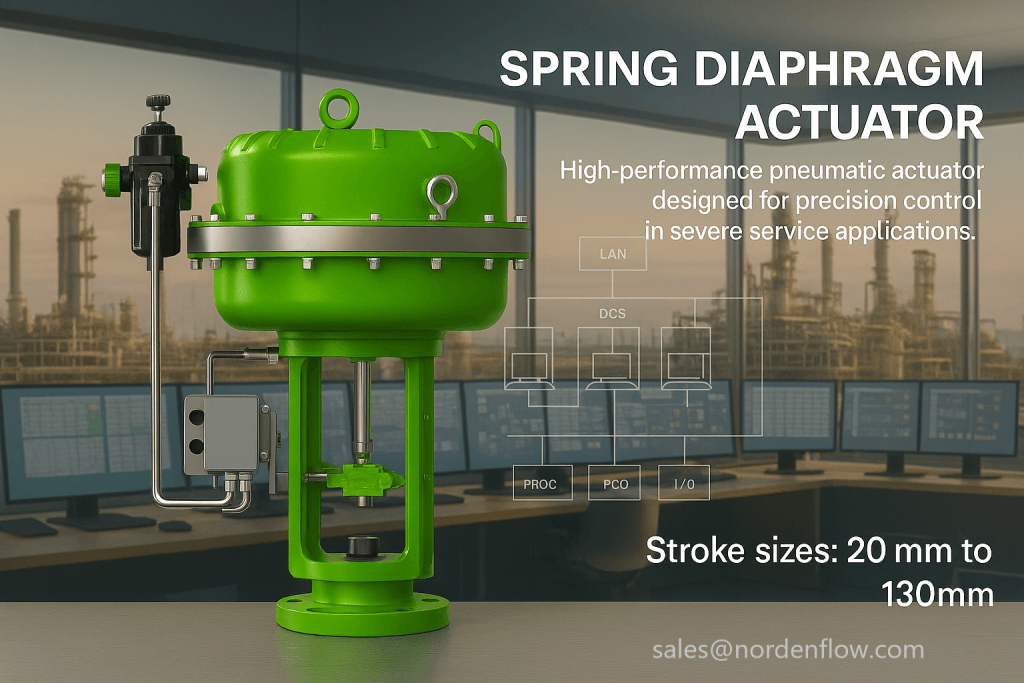
Double-acting and spring-return actuators selected based on fail-safe requirements, operating torque, and system safety functions.
Heavy-Duty & High-Cycle Design
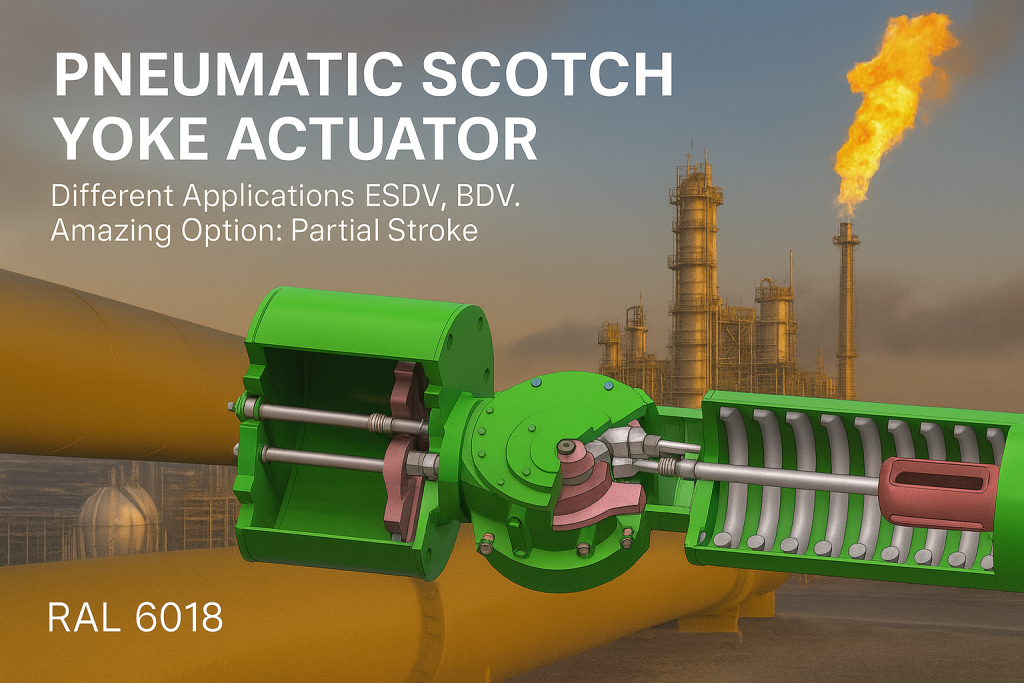
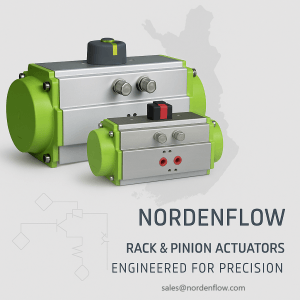
Actuator designs optimized for high cycle frequency, including scotch yoke or rack & pinion configurations depending on torque profile and application.
Control & Automation Integration
Integration with solenoid valves, positioners, limit switches, and control systems to ensure accurate response, feedback, and system compatibility.
Air Preparation & System Stability
Air preparation units (FRL) and piping design are included to maintain pressure stability, air quality, and consistent actuator performance.
Certification & Protection
ATEX-certified and corrosion-resistant solutions for hazardous environments, aligned with project specifications and safety requirements.
Complete Actuation Packages
Delivered as integrated systems including actuator, control components, and air systems to ensure reliable operation and simplified installation.
Each solution is engineered based on actual operating conditions to ensure reliable performance, stable control behavior, and long-term system integration.
Engineering Scope for Pneumatic Actuators
Pneumatic actuator selection depends on torque, air supply conditions, and fail-safe performance under real operating scenarios. In practice, system behavior is strongly influenced by air pressure stability, response time, and valve dynamics.
Incorrect configuration can lead to slow shutdown, incomplete valve movement, or unstable control response, especially in safety-critical or high-cycle applications.
Torque & Air Pressure
Output torque depends directly on air supply pressure. Variations in supply pressure can reduce actuator performance and prevent full valve stroke under load.
Torque validation typically follows EN 15714-3 with safety margins for worst-case pressure conditions.
Fail-Safe Performance
Spring return actuators must ensure full valve closure within defined response time. Insufficient spring force or incorrect sizing can lead to incomplete shutdown.
Critical in ESD systems and typically validated against SIL requirements (IEC 61508 / 61511).
Response Time
Actuator speed is influenced by air volume, piping size, and control components such as solenoid valves. Improper configuration can delay shutdown or create inconsistent response.
Control Stability
In modulating applications, pneumatic actuators require positioners to achieve stable control. Without proper tuning, oscillation or poor positioning accuracy may occur.
Air Quality & Environment
Contaminated or wet air can damage internal components and reduce actuator life. Air preparation units (FRL) are essential for reliable operation.
System Integration
Integration with control systems includes solenoid valves, positioners, and feedback devices. Improper integration can affect response time and reliability.
Pneumatic actuators provide fast and reliable operation, but performance depends heavily on air supply quality, pressure stability, and proper system configuration.
Pneumatic vs Electric Actuators — How to Choose
The choice between pneumatic and electric actuators is not only based on speed or control precision. It depends on fail-safe requirements, response time under real conditions, and system reliability during abnormal situations such as power or air loss.
In many cases, incorrect selection can result in delayed shutdown, unstable control loops, or loss of valve functionality during critical events.
| Criteria | Pneumatic | Electric |
|---|---|---|
| Response Time | Fast, but depends on air supply pressure, volume, and piping design | Moderate, consistent and independent of external fluid systems |
| Fail-Safe Behavior | Reliable with spring return or stored air energy | Requires additional systems (battery, spring modules) to ensure fail-safe |
| Control Stability | Requires positioner; sensitive to air quality and pressure variation | High positioning accuracy with stable feedback and repeatability |
| Infrastructure | Requires compressed air system (FRL, piping, pressure control) | Requires stable electrical power and control interface |
| Reliability in Failure Scenarios | Maintains operation during power loss if air is available or stored | May fail without backup systems during power or signal loss |
| Typical Use Case | ESD systems, isolation valves, high-cycle applications | Modulating control, positioning, remote automation |
Choose pneumatic actuators when fail-safe operation and fast shutdown are critical, especially in ESD or safety systems. Choose electric actuators when precise control, positioning accuracy, and integration with automation systems are the primary requirements.
Selecting the wrong actuation technology can lead to delayed shutdown, unstable control performance, or loss of valve functionality during critical operating conditions.
When Should You Avoid Pneumatic Actuators?
Pneumatic actuators may not be suitable in applications requiring high positioning accuracy, or where compressed air supply is unstable or unavailable.
Define Your Pneumatic Actuator Solution
Submit your valve data and operating conditions to determine the correct actuator type, torque, and fail-safe configuration.
Request Pneumatic Actuator Selection