
PRESSURE PROTECTION
Engineered Pressure Protection for Industrial Systems
Pressure Safety Valves for Industrial Pressure Protection
Pressure safety valves protect pressure-containing equipment against overpressure by releasing fluid when the defined opening conditions are reached. Correct selection depends on the protected equipment, relieving conditions, required capacity, fluid properties, operating temperature and discharge-system backpressure.
NordenFlow provides an industrial pressure safety valve portfolio covering steam safety valves, conventional safety relief valves and balanced-bellows safety relief valves. Each technology must be evaluated against the application requirements and the documented operating limits of the selected model.
Industrial pressure protection solutions for process plants, steam systems, energy facilities and other pressure-containing equipment, subject to product suitability and verified specifications.
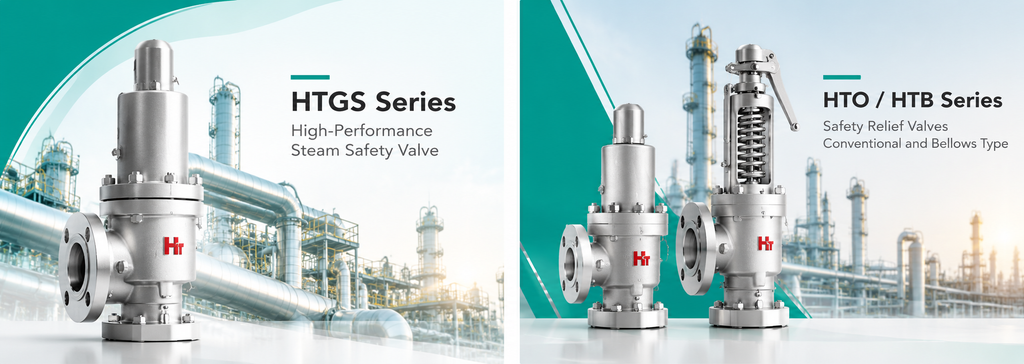
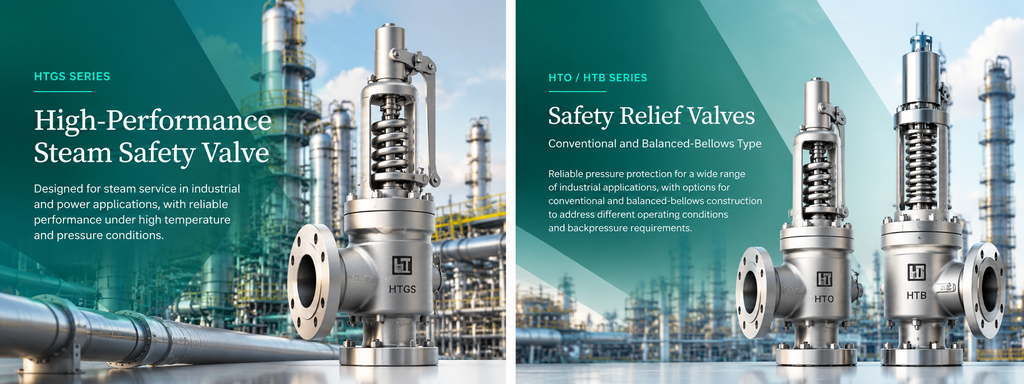
Steam Safety Valves
High-performance safety valves intended for steam pressure protection, with selection based on steam service conditions, required relieving capacity and verified pressure-temperature limits.
→ Explore the HTGS series and its documented configurations.
Conventional Safety Relief Valves
Spring-loaded safety relief valve designs for applications where conventional construction is suitable for the operating pressure, discharge backpressure and process conditions.
→ Explore the HTO family and applicable cooling-spool configurations.
Balanced-Bellows Safety Relief Valves
Safety relief valve designs incorporating balanced-bellows construction to address the influence of backpressure, subject to the specific model’s design limits.
→ Explore the HTB family and applicable cooling-spool configurations.
When Pressure Safety Valves Are Required
Pressure safety valves are used when pressure-containing equipment requires protection against pressure exceeding its allowable limits. The protection strategy must consider credible overpressure scenarios, the characteristics of the process fluid, the equipment design limits and the required relieving capacity.
Valve selection should follow an assessment of the pressure relief duty rather than rely solely on normal operating pressure. The initiating event, relieving conditions, discharge-system configuration and applicable engineering requirements determine the appropriate protection arrangement.
Blocked Outlet and Flow Restriction
A blocked discharge path or downstream restriction can cause pressure to rise when fluid continues to enter an isolated or restricted section of equipment.
Engineering consideration: evaluate the credible inflow, isolation arrangement and maximum pressure that the protected equipment can withstand.
Thermal Expansion of Trapped Liquid
Liquid trapped between closed isolation valves can develop excessive pressure when its temperature increases, even when the temperature rise is relatively small.
Engineering consideration: assess whether a dedicated thermal relief arrangement is required and verify its suitability for the trapped-liquid scenario.
Excessive Heat Input
Boilers, steam systems, heat exchangers and other heated equipment may experience pressure increases due to continued heat input, vapor generation or abnormal operating conditions.
Engineering consideration: establish the governing overpressure scenario and the required relieving capacity under the applicable design basis.
Control or Pressure-Regulation Failure
A pressure regulator, control valve or associated control function may fail in a way that exposes downstream equipment to a pressure higher than its allowable limit.
Engineering consideration: assess regulator failure, upstream pressure, downstream design pressure and the need for independent overpressure protection.
Abnormal Process Conditions
Start-up, shutdown, equipment malfunction, unexpected inflow or changes in process conditions can create pressure scenarios outside the normal operating envelope.
Engineering consideration: identify credible scenarios and determine whether the proposed relief system adequately addresses each governing case.
Relief-System Backpressure
Pressure in a discharge header or relief piping system can influence the opening and relieving performance of a safety relief valve, depending on its construction and operating conditions.
Engineering consideration: evaluate built-up and superimposed backpressure when selecting conventional or balanced-bellows designs.
Overpressure Protection Requires Scenario-Based Engineering
Identifying an overpressure scenario is only the starting point. The relief duty must be established through an appropriate engineering assessment, including the governing scenario, required relieving capacity, set pressure, allowable accumulated pressure, fluid properties, inlet pressure losses and discharge backpressure. The selected valve must be suitable for the documented duty and the applicable equipment and regulatory requirements.
Pressure Safety Valve Technology Comparison
Pressure safety valve selection involves more than choosing a nominal size or pressure rating. Valve construction, fluid service, relieving conditions and discharge-system backpressure all influence the suitability of a particular design.
NordenFlow’s portfolio includes high-performance steam safety valves, conventional safety relief valves and balanced-bellows safety relief valves. These product families serve different selection requirements and must be evaluated against the actual process duty and verified model specifications.
High-Performance Steam Safety Valves
Product family: HTGS
Designed for steam pressure protection, with selection dependent on the steam conditions, required relieving capacity and the documented operating envelope of the selected model.
Primary selection considerations
- Steam service and relieving conditions
- Pressure and temperature limits
- Required certified relieving capacity
- Connection, material and installation requirements
→ Verify HTGS model-specific construction, capacity and performance data before selection.
Conventional Safety Relief Valves
Product families: HTO / HTOA
Conventional spring-loaded designs require evaluation of the relationship between valve performance and the pressure conditions at the discharge connection. Their suitability depends on the allowable backpressure and the specific valve design.
Primary selection considerations
- Superimposed and built-up backpressure
- Set pressure and required relieving capacity
- Process fluid and material compatibility
- Cooling-spool configuration, where applicable
→ Confirm allowable backpressure and the HTO / HTOA configuration limits.
Balanced-Bellows Safety Relief Valves
Product families: HTB / HTBA
Balanced-bellows construction is used to reduce the effect of discharge backpressure on valve operation within the design limits. It can be relevant where discharge pressure varies or where a shared relief header affects valve selection.
Primary selection considerations
- Expected superimposed and built-up backpressure
- Bellows pressure limits and material compatibility
- Discharge arrangement and operating conditions
- Cooling-spool configuration, where applicable
→ Verify allowable backpressure, bellows integrity requirements and HTB / HTBA model data.
Engineering Comparison at a Glance
| Selection factor | HTGS steam safety valve | HTO / HTOA conventional | HTB / HTBA balanced bellows |
|---|---|---|---|
| Primary distinction | Steam-specific product family | Conventional spring-loaded construction | Spring-loaded construction with balancing bellows |
| Backpressure evaluation | Verify model-specific limits | Direct consideration in design selection | Balanced design reduces backpressure influence within its limits |
| Cooling-spool option | Verify catalogue availability | HTOA configuration | HTBA configuration |
| Final selection basis | Steam duty and verified capacity data | Duty, capacity and allowable backpressure | Duty, capacity, backpressure and bellows limits |
Technology Selection Must Follow the Relief Duty
A balanced-bellows design is not automatically the preferred option for every application, and a conventional design is not inherently unsuitable for systems with backpressure. Selection requires the actual relieving scenario, pressure conditions, certified capacity, model limitations and applicable design requirements to be evaluated together.
Engineering Selection Criteria for Pressure Safety Valves
Pressure safety valve selection must be based on the protected equipment, credible overpressure scenarios and required relieving duty. Nominal pipe size and normal operating pressure alone are insufficient to establish the correct valve specification.
The following engineering parameters establish the basis for evaluating valve construction, pressure rating, materials, capacity, discharge arrangement and suitability for the intended service.
1. Set Pressure and Equipment Design Limits
The set pressure must be established in relation to the protected equipment’s allowable pressure and the applicable design code. The relationship between operating pressure, set pressure and permitted accumulation must be evaluated for the relevant service.
Required inputs: equipment design pressure, maximum allowable working pressure where applicable, normal operating pressure and governing code requirements.
2. Required Relieving Capacity
The valve must provide sufficient relieving capacity for the governing credible overpressure scenario. Required capacity depends on the relief duty, fluid properties and the applicable sizing methodology.
Required inputs: governing relief scenario, required mass or volumetric flow, fluid phase, relieving pressure, relieving temperature and relevant fluid properties.
3. Discharge Backpressure
Superimposed and built-up backpressure can influence valve performance. The discharge piping and relief header must therefore be considered when determining whether a conventional or balanced-bellows design is suitable.
Required inputs: discharge-header pressure, expected backpressure variation, discharge piping configuration and the selected model’s allowable limits.
4. Fluid Properties and Temperature
Fluid phase, temperature, density, viscosity, corrosiveness and other relevant properties affect capacity calculations, material selection and the suitability of internal components.
Required inputs: fluid composition, phase at relieving conditions, operating and relieving temperatures, and relevant physical and chemical properties.
5. Pressure Rating, Materials and Connections
Body, trim, spring, bellows and seat materials must be compatible with the fluid and service conditions. Connection type, pressure class and pressure-temperature limits must be verified for the selected model.
Required inputs: inlet and outlet sizes, connection standards, pressure class, material requirements and installation constraints.
6. Valve Construction and Configuration
The appropriate valve family depends on the service, backpressure conditions and documented design characteristics. Cooling-spool configurations and other available options must be assessed against the actual installation requirements.
Required inputs: intended service, valve family, orientation and space constraints, configuration requirements and manufacturer-specific limitations.
7. Inlet Piping and Installation
Inlet piping pressure loss, discharge piping resistance, mechanical loads and installation arrangement can affect the performance and reliability of a relief system.
Required inputs: piping layout, inlet and outlet line sizes, fittings, discharge routing, installation orientation and applicable installation requirements.
8. Applicable Codes and Conformity
Product design, sizing, installation, testing and regulatory conformity are distinct requirements. The applicable code and required documentation must be established for the equipment, jurisdiction and project.
Required inputs: project specifications, applicable design code, jurisdiction, required declarations, certificates and inspection documentation.
Recommended Engineering Selection Sequence
STEP 01
Define the Relief Duty
Identify credible overpressure scenarios and the governing relieving conditions.
STEP 02
Establish Capacity
Determine the required relieving capacity using the applicable sizing basis.
STEP 03
Select the Technology
Evaluate the valve family, backpressure conditions and available configurations.
STEP 04
Verify the Specification
Confirm materials, connections, pressure-temperature limits, documentation and installation requirements.
Selection Requires Verified Product Data
Final valve selection must be supported by the manufacturer’s model-specific data, required relieving capacity, applicable sizing calculations and relevant conformity documentation. Catalogue ranges alone do not establish suitability for a particular application.
Industrial Applications & Applicable Standards
Pressure safety valves are applied across industrial systems where pressure-containing equipment requires protection against credible overpressure scenarios. The appropriate valve construction depends on the process fluid, relieving duty, operating conditions, discharge arrangement and applicable engineering requirements.
NordenFlow’s portfolio covers steam safety valves, conventional safety relief valves and balanced-bellows safety relief valves. Product suitability must be established against the specific application and verified manufacturer data rather than assumed from the industry or equipment type alone.
Industrial Applications
Steam and Energy Systems
Boilers, steam distribution systems and other steam-containing equipment require pressure protection appropriate to their design conditions and credible overpressure scenarios.
Selection focus: steam service, relieving capacity, pressure-temperature limits and documented valve performance.
Oil, Gas and Petrochemical
Process vessels, separators, pressure-regulated systems and other pressure-containing equipment may require relief protection for credible process upsets, blocked outlets or control failures.
Selection focus: fluid properties, governing relief scenarios, discharge-header backpressure and material compatibility.
Chemical and Process Plants
Reactors, storage vessels and process equipment may experience pressure increases due to abnormal reactions, external heat input, vapor generation or other credible operating events.
Selection focus: process chemistry, fluid phase, thermal conditions, required capacity and compatible construction materials.
Industrial Manufacturing and Utilities
Compressed-fluid systems, thermal equipment and industrial utility networks may require protection against excessive pressure caused by equipment faults, isolation or abnormal operating conditions.
Selection focus: equipment pressure limits, fluid characteristics, relief duty and installation requirements.
Marine and Offshore Systems
Pressure-containing equipment in marine and offshore installations requires valve selection that accounts for the process duty, installation environment and applicable project or classification requirements.
Selection focus: service conditions, material requirements, environmental suitability and applicable approvals.
Pressure Vessels and Heat Exchangers
Pressure vessels and heat exchangers require overpressure protection based on their design limits, credible failure scenarios and the characteristics of the process fluids involved.
Selection focus: protected equipment limits, required relieving capacity, fluid phase and relief-system configuration.
Standards, Sizing and Regulatory Conformity
Standards serve different purposes in pressure protection. Product design and testing, relief-system sizing, installation practices and regulatory conformity must be evaluated separately. The applicable requirements depend on the equipment, jurisdiction, project specification and documented scope of the selected valve.
EN ISO 4126 Series
The EN ISO 4126 series addresses safety devices for protection against excessive pressure. The relevant part and its applicability must be established for the particular device and application.
Verify the applicable part, edition and product conformity evidence.
Pressure Equipment Directive
Directive 2014/68/EU establishes requirements for pressure equipment within its scope. Applicability, conformity assessment and the relevant documentation must be determined for the product and intended use.
Verify the declaration of conformity, applicable classification and assessment documentation.
ASME Boiler and Pressure Vessel Code
Section VIII contains requirements for pressure vessels, including applicable overpressure protection provisions. Any claim of ASME compliance or certification must be supported by the relevant product and certification scope.
Verify the applicable code edition and the specific approval or certification required by the project.
API 520
API 520 addresses the sizing, selection and installation of pressure-relieving devices for applicable process-industry services.
Use the applicable part and edition within the project engineering basis.
API 521
API 521 addresses pressure-relieving and depressuring systems, including the assessment of relevant overpressure scenarios and discharge-system considerations.
Apply where required by the project design basis and intended service.
API 526 and API 527
API 526 addresses flanged steel pressure relief valves and their specified dimensions and ratings. API 527 addresses seat tightness testing for applicable pressure relief valves.
Confirm that the valve design, test requirements and documented compliance fall within the relevant standard’s scope.
Standards References Do Not Automatically Establish Certification
Listing a standard does not, by itself, demonstrate that a specific valve model is certified or conforms to every requirement of that standard. Final acceptance must be based on the applicable product documentation, declarations, certificates, test records and any required third-party assessment. NordenFlow will confirm the relevant evidence for the selected product and project requirements.
Engineering Review & Technical Enquiry
Selecting a pressure safety valve requires more than identifying the required inlet connection or nominal pressure rating. The protected equipment, relieving conditions, required capacity, fluid properties and discharge arrangement must be evaluated against the documented capabilities of the proposed valve.
NordenFlow supports technical enquiries by identifying the relevant product family, reviewing available application data and clarifying the information required for product selection and quotation. Final suitability remains subject to the applicable engineering assessment and verified manufacturer documentation.
Information Required for Valve Selection
1. Process and Fluid Data
- Fluid name and composition
- Gas, vapour, steam or liquid service
- Normal operating pressure and temperature
- Required relieving pressure and temperature
- Relevant fluid properties and material compatibility requirements
2. Protected Equipment and Relief Duty
- Equipment type and design pressure
- Set pressure and applicable pressure limits
- Governing overpressure scenario
- Required relieving capacity or design calculation
- Applicable accumulation and sizing criteria
3. Valve Specification
- Preferred valve family or existing model
- Inlet and outlet connection sizes
- Connection type and pressure class
- Required body and internal material specifications
- Special configurations or installation constraints
4. Discharge System Conditions
- Superimposed backpressure
- Expected built-up backpressure
- Discharge to atmosphere or a common header
- Relevant inlet and outlet piping information
- Applicable installation and discharge requirements
5. Project and Compliance Requirements
- Applicable design code and project specification
- Required declarations and certificates
- Inspection and testing requirements
- Required documentation and datasheet format
- Project location and delivery requirements
6. Existing Valve or Replacement Data
- Existing valve manufacturer and model
- Nameplate information and available datasheets
- Current valve dimensions and connections
- Known operating or maintenance issues
- Required replacement or interchangeability constraints
From Technical Enquiry to Product Selection
STEP 01
Submit Requirements
Provide the available process data, equipment specification and project requirements.
STEP 02
Review the Relief Duty
Identify missing technical inputs and establish the basis for evaluating the required valve.
STEP 03
Verify Product Suitability
Evaluate the appropriate product family against the documented operating limits and application requirements.
STEP 04
Clarify the RFQ
Confirm the required technical documentation, outstanding clarifications and quotation basis.
Request a Technical Review
Have a new pressure protection requirement or need to replace an existing safety relief valve? Send your datasheet, process conditions or existing valve identification. NordenFlow can review the available information and help establish the requirements for a suitable product enquiry.
Submit a Technical Enquiry →Final product selection is subject to verified manufacturer data, applicable sizing calculations and project-specific requirements.