

Condition Monitoring vs Preventive Maintenance
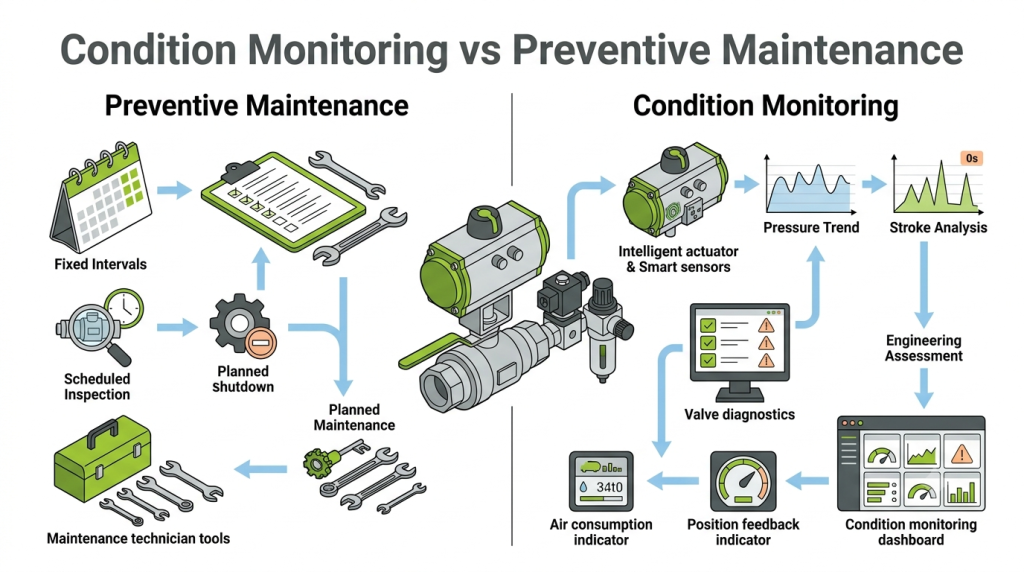
Preventive maintenance and condition monitoring are often presented as competing maintenance strategies. In practice, they address different engineering challenges and work best when applied together. Preventive maintenance reduces the likelihood of predictable failures through scheduled activities, while condition monitoring provides continuous insight into the actual health of industrial assets. Understanding the strengths and limitations of both approaches is essential for improving reliability, reducing unplanned downtime, and making informed maintenance decisions.
Industrial facilities rely on thousands of assets operating together to maintain safe, efficient, and uninterrupted production. Every valve, actuator, pump, compressor, motor, and instrument gradually changes throughout its operational life. The challenge for maintenance teams is not simply repairing equipment after failure, but recognising when intervention is actually required.
For many years, preventive maintenance formed the foundation of industrial maintenance programmes. Equipment was inspected, lubricated, calibrated, or overhauled according to fixed schedules based on calendar time or operating hours. This approach significantly improved equipment reliability compared with purely reactive maintenance and remains an essential part of modern asset management.
However, industrial plants have become increasingly automated, and equipment now operates under widely varying process conditions. Two identical assets may experience completely different operating environments, resulting in different rates of degradation. This has increased the importance of condition monitoring, which evaluates equipment based on its actual operating condition rather than assuming degradation follows a fixed timeline.
Rather than replacing preventive maintenance, condition monitoring complements it by providing engineers with better information about asset health. Together, these approaches support more effective maintenance planning, improved operational reliability, and better lifecycle decisions.
Why Maintenance Strategy Matters
Maintenance is no longer viewed simply as a repair function. In modern industrial facilities it is a strategic engineering discipline that directly influences safety, production availability, operating costs, energy efficiency, and asset lifecycle performance.
Every maintenance activity requires time, labour, spare parts, and often temporary process interruptions. Performing maintenance too frequently increases operating costs and introduces unnecessary intervention risks. Waiting too long, however, increases the likelihood of unexpected failures that may result in production losses or safety incidents.
Selecting an appropriate maintenance strategy therefore involves balancing several engineering considerations:
- Asset criticality
- Safety requirements
- Process availability
- Failure mechanisms
- Maintenance costs
- Operational risk
- Diagnostic capability
The objective is not simply to perform maintenance, but to intervene at the appropriate time using information that reflects the actual condition of the equipment.
Understanding Preventive Maintenance
Preventive maintenance is a planned maintenance strategy in which equipment is inspected, serviced, adjusted, or replaced at predetermined intervals. These intervals are typically established using manufacturer recommendations, historical operating experience, regulatory requirements, or engineering judgement.
The underlying principle is straightforward. Components known to degrade over time are maintained before their expected service life expires, reducing the probability of failure during normal operation.
Common Preventive Maintenance Activities
- Routine inspections
- Lubrication
- Seal replacement
- Filter replacement
- Calibration of field instruments
- Valve functional testing
- Actuator overhaul
- Electrical connection inspection
Engineering Advantages
Preventive maintenance provides a structured and predictable maintenance programme. Resources can be planned in advance, spare parts can be prepared, and maintenance activities can often be coordinated with scheduled plant shutdowns.
This approach is particularly effective for components whose degradation mechanisms are well understood and whose service life is relatively predictable. It also supports regulatory compliance in industries where periodic inspection or testing is mandatory.
Engineering Limitations
Despite its widespread use, preventive maintenance cannot determine the actual condition of every asset. It assumes that equipment degrades according to an average lifecycle, whereas real operating conditions often differ significantly from those assumptions.
Some components continue operating well beyond their scheduled maintenance interval, while others deteriorate much earlier because of contamination, harsh environmental conditions, abnormal process operation, or unforeseen mechanical stress.
As a result, preventive maintenance may sometimes lead to unnecessary replacement of healthy components while still failing to identify hidden degradation developing between scheduled inspections.
Calendar Time
      │
      ▼
Scheduled Inspection
      │
      ▼
Scheduled Maintenance
      │
      ▼
Return to Service
For many industrial assets, preventive maintenance remains an essential reliability practice. However, modern facilities increasingly supplement scheduled maintenance with continuous or periodic condition assessment, allowing engineering decisions to be based not only on elapsed time but also on measured equipment performance.
Understanding Condition Monitoring
Unlike preventive maintenance, which follows predetermined schedules, condition monitoring evaluates the actual health of an asset while it remains in service. The objective is to identify changes in equipment behaviour that indicate degradation before those changes develop into functional failures.
Rather than asking “How long has this equipment been operating?”, condition monitoring asks a more valuable engineering question:
“What is the equipment telling us about its current condition?”
Every industrial asset generates information. Pressure fluctuations, vibration, actuator stroke time, valve travel, air consumption, electrical current, temperature, and diagnostic alarms all provide insight into how equipment is performing. Individually these parameters may appear insignificant, but together they reveal trends that help engineers understand whether reliability is improving, remaining stable, or gradually declining.
Condition monitoring may be performed continuously through online diagnostics or periodically during routine inspections. Regardless of the monitoring method, the purpose remains the same: detect degradation early enough to allow maintenance to be planned rather than forced by an unexpected failure.
Typical Parameters Used for Condition Monitoring
| Parameter | Engineering Significance |
|---|---|
| Pressure | Supply stability, regulator performance and pneumatic integrity. |
| Temperature | Abnormal operating conditions, overheating or environmental influence. |
| Vibration | Mechanical wear, imbalance or developing equipment faults. |
| Stroke Time | Changes in friction, actuator performance or pneumatic restrictions. |
| Valve Position | Travel accuracy, hysteresis and positioning performance. |
| Air Consumption | Internal leakage or deterioration of pneumatic components. |
| Diagnostic Status | Early indication of abnormal operating behaviour. |
Engineering Comparison: Preventive Maintenance vs Condition Monitoring
These two maintenance strategies are often compared as alternatives. In reality, they complement each other. Preventive maintenance reduces the likelihood of predictable failures through scheduled intervention, while condition monitoring improves maintenance timing by providing information about the asset’s actual condition.
| Preventive Maintenance | Condition Monitoring |
|---|---|
| Based on predefined maintenance intervals. | Based on actual equipment condition. |
| Time-driven maintenance planning. | Data-driven maintenance planning. |
| Assumes average equipment degradation. | Measures actual degradation. |
| Suitable for predictable wear mechanisms. | Suitable for variable operating conditions. |
| Requires periodic shutdown or inspection. | Can often be performed while equipment remains in service. |
| May replace components that are still healthy. | Supports maintenance only when deterioration is identified. |
| Provides planned maintenance scheduling. | Provides engineering insight for maintenance decisions. |
Selecting one strategy over the other is rarely the objective. The most effective reliability programmes combine both approaches, using preventive maintenance to address known wear mechanisms while relying on condition monitoring to detect degradation that cannot be predicted by time alone.
Practical Examples in Valve Automation Systems
Automated valve assemblies demonstrate why maintenance strategies should be selected according to equipment behaviour rather than applied uniformly across every component. A shutdown valve package combines mechanical, pneumatic, electrical, and instrumentation elements, each with different degradation mechanisms and maintenance requirements.
Pneumatic Actuators
Preventive maintenance typically includes seal replacement, lubrication, inspection of moving components, and verification of actuator performance at scheduled intervals.
Condition monitoring focuses on indicators such as stroke time, air consumption, operating pressure, and actuator response. Increasing air consumption or slower movement often indicates deterioration before functional failure occurs.
Solenoid Valves
Scheduled maintenance may involve cleaning pilot passages, replacing seals, verifying electrical connections, and functional testing.
Condition monitoring evaluates switching response, diagnostic information, abnormal current consumption, and valve operating behaviour. These parameters can reveal contamination or internal wear while the valve remains operational.
Positioners
Preventive maintenance generally includes calibration checks and inspection of pneumatic connections.
Condition monitoring identifies gradual calibration drift, increasing positioning error, excessive actuator movement, or unstable control performance, allowing corrective action before process performance is affected.
Filter Regulators and Air Preparation Units
Scheduled replacement of filter elements remains good engineering practice. However, monitoring supply pressure stability and downstream pressure behaviour provides valuable information about regulator performance and air quality between maintenance intervals.
Emergency Shutdown Valve Assemblies
Shutdown valves represent one of the clearest examples of why maintenance strategies should work together. Preventive maintenance ensures periodic inspection and proof testing, while condition monitoring improves confidence that the complete automation package remains capable of performing its safety function throughout normal operation.
Reliability is rarely determined by a single component. The health of an automated valve assembly depends on the combined performance of the actuator, pneumatic controls, instrumentation, air supply, and mechanical valve. Maintenance strategies should therefore evaluate the complete system rather than individual devices in isolation.
Selecting the Appropriate Maintenance Strategy
There is no universal maintenance strategy that suits every industrial asset. Equipment differs in criticality, operating environment, failure mechanisms, and maintenance accessibility. Selecting the most appropriate approach requires engineering judgement supported by operational data, risk assessment, and an understanding of how the asset contributes to the overall process.
Preventive maintenance remains an effective solution for components with predictable wear characteristics or where periodic inspection is required by regulatory standards, manufacturer recommendations, or plant operating procedures. It provides a structured maintenance programme and helps ensure that essential servicing activities are not overlooked.
Condition monitoring becomes increasingly valuable where equipment degradation is influenced by changing operating conditions, variable process demands, or hidden failure mechanisms. Rather than assuming how an asset should behave after a given period of time, engineers evaluate its actual condition and determine whether maintenance is genuinely required.
In practice, most industrial facilities achieve the highest level of reliability by combining both approaches. Preventive maintenance establishes the baseline maintenance programme, while condition monitoring continuously improves maintenance decisions through better visibility of asset health.
Engineering Factors That Influence Maintenance Strategy
| Engineering Consideration | Recommended Approach |
|---|---|
| Predictable wear mechanisms | Preventive Maintenance |
| Variable operating conditions | Condition Monitoring |
| Critical shutdown equipment | Combination of both strategies |
| Hidden degradation mechanisms | Condition Monitoring |
| Regulatory inspection requirements | Preventive Maintenance |
| High production downtime costs | Integrated maintenance strategy |
| Assets with diagnostic capability | Condition Monitoring supported by diagnostics |
Key Takeaways
Preventive maintenance and condition monitoring should not be viewed as competing maintenance philosophies. Each addresses different aspects of equipment reliability and together they form the foundation of an effective asset management strategy.
- Preventive maintenance reduces predictable wear-related failures through planned intervention.
- Condition monitoring provides continuous insight into actual equipment health.
- Operational decisions become more effective when supported by engineering data rather than fixed maintenance intervals alone.
- Critical assets such as automated valve assemblies benefit from combining scheduled maintenance with continuous condition assessment.
- Improved operational visibility enables maintenance teams to intervene before degradation develops into functional failure.
- Reliability engineering focuses on understanding equipment behaviour throughout the asset lifecycle—not simply repairing failures after they occur.
As industrial facilities continue to adopt smarter automation and digital diagnostic technologies, maintenance strategies are becoming increasingly data-driven. Engineers are no longer limited to asking when equipment should be serviced—they can now understand why maintenance is required and prioritise interventions based on actual operating condition.
Frequently Asked Questions
Is condition monitoring replacing preventive maintenance?
No. Condition monitoring complements preventive maintenance by providing information about the actual condition of equipment. Most industrial facilities benefit from combining both approaches.
Which maintenance strategy is better for critical shutdown valves?
Critical shutdown systems typically require both scheduled maintenance and condition monitoring. Preventive maintenance supports inspection and proof testing, while condition monitoring helps identify degradation between maintenance intervals.
Can condition monitoring reduce maintenance costs?
It can reduce unnecessary maintenance activities by identifying when equipment continues to operate within acceptable limits while enabling earlier intervention when deterioration begins to develop.
What parameters are commonly monitored in valve automation systems?
Typical parameters include actuator stroke time, supply pressure, air consumption, valve travel, temperature, vibration, electrical status, and diagnostic information generated by intelligent field devices.
Continue Your Reliability Journey
Explore practical engineering insights and industrial automation solutions that help improve reliability, operational visibility, and lifecycle performance across critical process assets.
Explore Reliability Solutions