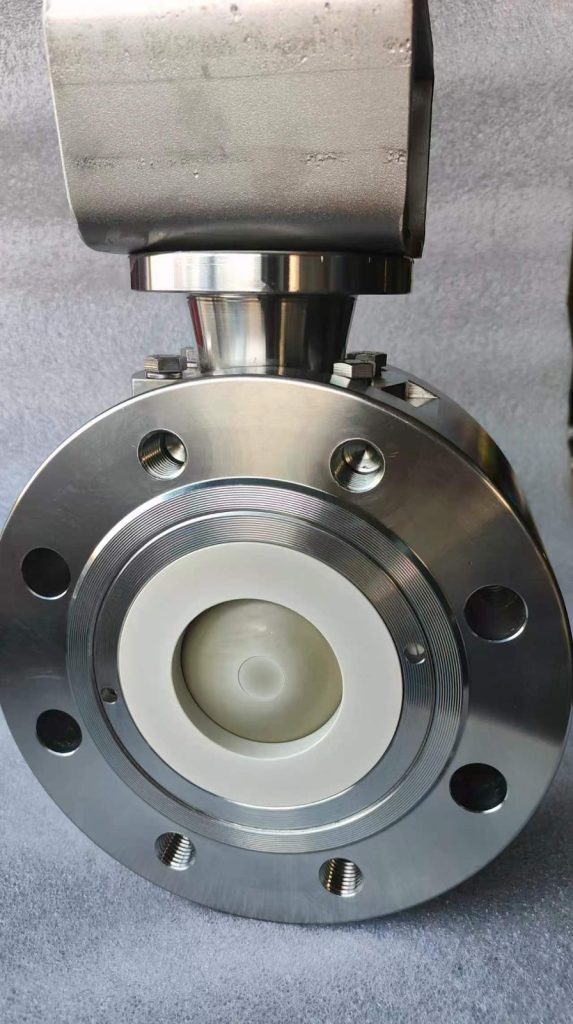

Tribological Failure Modes & Process Drivers in Pulp & Paper
Diagnosing why standard metallic valve trims fail under severe erosion, corrosion, and slurry wear.
1. Introduction
Final control elements operating in pulp and paper processing plants endure severe mechanical and chemical degradation. Process lines handling high-consistency wood pulp, abrasive inorganic fillers, recycled fiber slurries, and chemically aggressive liquor recovery fluids frequently cause rapid trim degradation in standard control valves. The consequence is lost control accuracy, severe internal leakage, increased deadband, and premature total valve failure.
When control valves experience rapid trim erosion, process loops destabilize. Uncontrolled flow variations directly affect basis weight, stock consistency, bleaching efficiency, and liquor density. Resolving these operational challenges requires moving beyond conventional metallic alloys toward high-hardness ceramic surfaces integrated into optimized rotary valve geometries.
Evaluating these severe service applications requires an analysis of tribological failure modes, fluid dynamics, and process parameters across the pulp mill.
2. Why Conventional Valve Trims Fail
Conventional metallic valve trims—including austenitic stainless steels (e.g., AISI 316L) and duplex stainless steels (e.g., UNS S31803 / 2205)—exhibit limited service life when exposed to abrasive slurry environments. The primary mechanical and chemical mechanisms driving accelerated trim destruction include:
Mechanical Micro-Abrasion and Impingement
Two-body and three-body abrasive wear occur when hard suspended solid particles enter the narrow clearance gap between the sealing elements. When particle hardness (Hp) exceeds trim material hardness (Hm) such that Hp / Hm > 1.2, severe micro-cutting and micro-ploughing occur. Solid particulate matter (TiO2, CaCO3, kaolin clay, sand) gouges the metallic substrate, destroying ground sealing surfaces and causing rapid loss of shutoff capability per ISO 5208 or ANSI/FCI 70-2 standards.
Three-Body Abrasive Wear in Metallic Trim
=========================================
      [ Motion Direction ] --->
-----------------------------------------  <-- Sealing Surface (Low Hardness: Hm)
  o         O          o       O     o    <-- Particles (High Hardness: Hp)
               (Micro-Ploughing / Micro-Cutting: Hp/Hm > 1.2)
-----------------------------------------  <-- Counter-Surface
Fiber Dewatering and Packing Dynamics
Pulp suspensions exhibit viscoelastic, non-Newtonian behavior characterized by a yield stress (τ0). In conventional globe or standard ball valve designs, stagnant zones behind seat rings accumulate fibers. Under differential pressure (ΔP), liquid drains from the fiber network (dewatering), leaving a dense, compressed fiber mat. This mat creates mechanical binding, drastically increasing the required break-away torque, inducing actuator stall, and causing seat deformation during valve closure.
Sliding Wear and Galling
Unlubricated contact between metal seating surfaces under high seat loading leads to localized adhesive wear (galling). Micro-welds form across contact asperities, which break during segment rotation, tearing material from the sealing face and creating leak paths.
Cavitation-Accelerated Erosion
In throttling service with high pressure recovery ratios, local pressure drops below the fluid vapor pressure (Pv), forming vapor cavities. As fluid pressure recovers downstream of the vena contracta, these cavities collapse near metal surfaces, generating localized micro-jets with impact pressures exceeding 1000 MPa. This mechanical fatigue strips protective passive films (Cr2O3), exposing fresh metal to immediate chemical attack.
Synergy of Corrosion and Erosion (Erosion-Corrosion)
In chemical recovery circuits (green, white, and black liquor) and bleaching stages (ClO2, active chlorine), chemical attack and mechanical erosion act synergistically. Mechanical abrasion continuously removes the passive oxide layer. The bare metal matrix corrodes rapidly before re-passivation can occur, causing degradation rates significantly faster than the sum of corrosion and erosion acting independently:
3. Process Conditions That Drive Valve Wear
Process units throughout pulp and paper mills present distinct fluid property profiles that accelerate valve trim wear.
+-----------------------------------------------------------------------------------+
|                            PULP & PAPER PROCESS UNITS                             |
+------------------------------------+----------------------------------------------+
|          STOCK PREPARATION         |               CHEMICAL RECOVERY              |
+------------------------------------+----------------------------------------------+
| • High Consistency Pulp (3%-12%+)  | • Green Liquor (Dregs, Smelt Contaminants)   |
| • Filler Slurries (CaCO3, TiO2)    | • White Liquor (Caustic, High Velocity)      |
| • Recycled Fiber (Sand, Staples)   | • Black Liquor (High Viscosity, Scaling)     |
+------------------------------------+----------------------------------------------+
Stock Preparation and Recycled Fiber (OCC) Processing
- Consistency Variations: Medium to high consistency pulp (3% to 12%+ oven-dry fiber) exhibits significant shear yield stress. Fiber entanglements form network structures that resist shear flow at low velocities, generating non-uniform force vectors on internal valve components.
- Inorganic Fillers: Kaolin clay (Mohs hardness ~2.0–2.5), calcium carbonate (CaCO3, Mohs ~3.0), titanium dioxide (TiO2, Mohs ~5.5–6.0), and silica sand contaminants (SiO2, Mohs ~7.0) act as aggressive abrasives. Finely ground particles enter dynamic seal gaps, causing continuous low-angle micro-erosion and three-body abrasion.
Chemical Recovery Circuit
- Green Liquor Service: Green liquor contains undissolved inorganic solids (dregs) consisting of unburned carbon, iron sulfides, and heavy metal silicates. Furthermore, green liquor exhibits a strong tendency to precipitate hard sodium carbonate (Na2CO3) and calcium carbonate scales on internal surfaces, causing mechanical binding of rotating parts.
- White and Black Liquor Service: White liquor (NaOH + Na2S) combines high caustic alkalinity (pH > 13) with high line velocities, accelerating erosion-corrosion. Concentrated black liquor (65% to 80%+ solids) presents high viscosity coupled with suspended inorganic salts at elevated temperatures (110°C to 150°C), generating combination scaling and high-torque mechanical wear.
Digester and Bleach Plant Operations
- Batch and Continuous Digesters: High-temperature liquor circulation lines experience rapid thermal cycling, high differential pressures, and aggressive chemical attack, challenging seat energization mechanics and packing integrity.
- Bleach Plant Applications: Exposure to chlorine dioxide (ClO2), ozone (O3), and acids (H2SO4) rapidly corrodes low-alloy steels, requiring corrosion-resistant substrates combined with chemically inert surface barriers.