
Renewable Solutions
Globe Control Valves for Steam & Process Applications
Precise flow control and stable modulation for steam and process systems
Incorrect valve sizing can lead to instability, cavitation, or inefficient operation. Therefore, accurate valve selection is critical for reliable performance.
Nordenflow engineers globe control valve solutions based on real process conditions, ensuring predictable response and stable operation across the full operating range.
Engineers typically select globe valves when precise modulation and control stability are required under varying pressure and flow conditions.
When You Need Globe Control Valves
Engineers select globe control valves when process stability and control accuracy cannot be compromised.
In particular, these valves are preferred in applications where flow behavior must remain predictable under changing pressure conditions.
Precise Flow Control is Required
Accurate modulation of flow, pressure, or temperature across a wide operating range requires stable and predictable valve response.
Process Stability is Critical
In such systems, control loop stability directly depends on consistent valve behavior and repeatable performance.
High Pressure Drop Must Be Managed
These valves are suitable where pressure reduction must be controlled without causing instability, cavitation, or flow disturbances.
Continuous Throttling Operation
Frequent or continuous adjustment requires valve designs that maintain control accuracy over extended operating cycles.
Cavitation or Noise Control is a Concern
In demanding conditions, multi-stage trims help manage cavitation, flashing, and noise to protect system performance.
High Control Accuracy is Required
In these cases, precise valve positioning and repeatability directly influence product quality and process efficiency.
As a result, selecting the wrong valve type in these conditions can lead to unstable control, excessive wear, or inefficient operation.
What We Supply
We deliver engineered globe control valve solutions configured based on real process conditions, not standard catalog selection.
As a result, each solution is optimized based on Cv sizing, pressure drop distribution, and control performance requirements to ensure stable operation and long-term reliability.
Valve and Actuation Package
Complete valve and actuator assemblies are configured based on control requirements to ensure reliable and responsive operation.
Trim Selection and Configuration
Trim designs are selected to manage cavitation, noise, and flow behavior, ensuring stable control under demanding process conditions.
Cv Sizing and Pressure Drop Analysis
Accurate sizing ensures controllability and prevents instability, cavitation, or inefficient operation across the full operating range.
Material Selection
Materials are selected based on fluid properties, temperature, and corrosion requirements to ensure long-term durability.
Control System Integration
Integration with plant control systems ensures accurate feedback, positioning, and compatibility with existing automation environments.
Inspection and Testing
Testing and inspection are performed according to applicable standards to verify performance, leakage, and operational reliability.
Engineering Scope
Valve performance depends on how it behaves under dynamic process conditions, not just static sizing values.
Therefore, engineers evaluate key parameters together to ensure stable control, predictable response, and long-term performance.
Cv Sizing
Engineers define the flow coefficient (Cv) based on required flow rate to ensure controllability and avoid oversizing.
Pressure Drop (ΔP)
Engineers manage pressure drop across the valve to maintain stable operation and prevent cavitation or noise.
Control Behavior
Flow characteristics and rangeability determine how accurately the valve responds under changing process conditions.
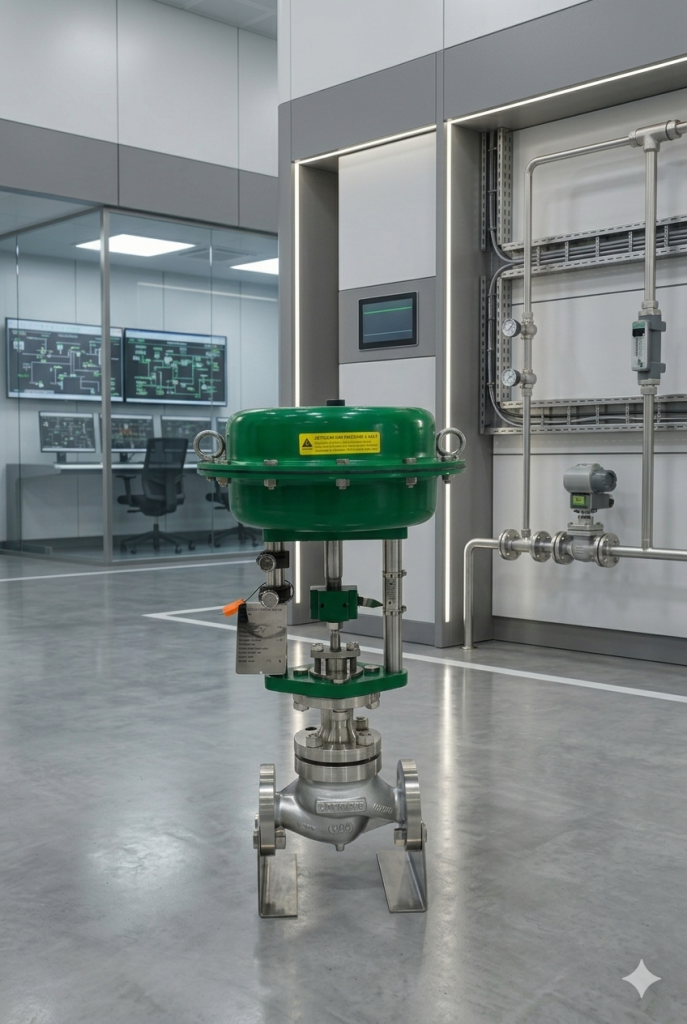
Features & Standards
These valves are configured based on application requirements, operating conditions, and performance expectations. The following features and standards define the valve capability and reliability in industrial applications.
Sizes: DN15 – DN600 (1/2″ – 24″)
Pressure Classes: PN16 – PN160 / ASME Class 150 – 900
Covers a wide range of process conditions from standard to high-pressure applications.
Trim Types: Parabolic, Contoured, Multi-Stage
Design: Anti-cavitation, noise reduction
Trim selection is critical to ensure stable control and prevent cavitation or excessive noise.
Materials: WCB, CF8M, stainless steel, duplex, special alloys
Material selection is based on fluid properties, temperature, and corrosion requirements.
Leakage Class: Class IV, V, VI
(ANSI/FCI 70-2 & IEC 60534-4)
Defines shutoff performance and sealing reliability in critical applications.
Design Standards: ASME B16.34, ISA 75.08
Testing: API 598
Compliance with international standards ensures performance and operational reliability.
Actuation: Pneumatic, Electric, Electro-hydraulic
Actuation options are selected based on control requirements and system integration.
Applications
For these applications, where precise flow regulation and stable control response are critical under varying process conditions.
In these systems, incorrect valve selection can lead to instability, inefficient operation, or reduced process performance.
Pulp & Paper — Consistency and Steam Control
Control of pulp consistency, chemical dosing, and steam flow in digesters and drying sections. Poor valve performance can directly impact product quality and process stability.
Steam Systems — Pressure and Temperature Control
Regulation of steam flow and pressure in boilers, turbines, and heat exchangers. Inaccurate control can reduce efficiency and affect system stability.
Chemical Processes — Dosing and Reaction Control
Accurate flow control in dosing and reaction processes. Poor valve selection can affect reaction stability and product consistency.
Oil & Gas — Flow and Pressure Regulation
Control of gas and liquid flow in processing units. Unstable valve behavior can lead to pressure fluctuations and inefficient operation.
Power Generation — Energy Control Systems
Flow and pressure control in power plants. Inaccurate regulation can impact efficiency and operational safety.
Water & Utilities — Flow Distribution
Regulation of flow and pressure in water systems. Poor control can lead to system imbalance and inefficient distribution.
Globe vs Ball vs Butterfly — How to Choose
Each valve type is designed for different control priorities. Selection depends on whether accuracy, capacity, or operating conditions are the dominant factor.
Globe Control Valve
Designed for precise flow regulation and stable control response under varying process conditions.
→ Best for high accuracy, throttling, and control loop stability
Segment Ball Valve
Suitable for higher flow capacity and applications with lower pressure drop or more challenging media.
→ Best for higher capacity and less restrictive flow paths
Triple Offset Butterfly Valve
Designed for severe service conditions requiring tight shutoff and reliable performance under high temperature or pressure.
→ Best for severe service and tight shutoff requirements
When control accuracy and stability are the primary concern, globe control valves are typically preferred due to their predictable flow characteristics and higher rangeability.
Accurate Cv calculation is critical to ensure controllability and prevent choked flow or instability.
Cv = Q √ (SG / ΔP)
Where Q is flow rate (GPM), SG is specific gravity, and ΔP is pressure drop (P₁ – P₂).
By analyzing these variables, Nordenflow minimizes the risk of choked flow and ensures stable valve performance through Valve Signature Reports and ANSI FCI 70-2 leakage class verification.
Get the Right Globe Control Valve for Your Process
Selecting the wrong valve can lead to instability, cavitation, or inefficient operation.
Submit your process data and receive a valve recommendation based on flow conditions, pressure requirements, and control performance.
Supporting industrial projects across Finland and the EU.
• Flow rate and operating range
• Inlet and outlet pressure (ΔP)
• Fluid type, temperature, and properties
• Control requirement (on/off or modulating)
• Cavitation, noise, or shutoff requirements