
Releable Solutions
Segment Ball Valves for High-Flow and Challenging Media Applications.
High-capacity flow control with low pressure drop for slurry, fibrous, and contaminated process media.
Conventional control valves often clog, wear rapidly, or lose performance under these conditions.
In such applications, segment ball valves maintain stable operation where flow capacity and durability are critical.
At Nordenflow, we engineer segment ball valve solutions based on flow behavior, media characteristics, and wear conditions. As a result, systems operate reliably with reduced maintenance requirements.
Engineers typically select segment ball valves when handling difficult media or when maintaining high flow capacity outweighs the need for high-precision control.
When You Need Segment Ball Valves
They are typically selected when are selected flow capacity and resistance to clogging are critical.
In such applications, maintaining stable operation with difficult media becomes more important than achieving high-precision control.
High Flow Capacity is Required
Large flow volumes must be handled with minimal restriction while maintaining system efficiency.
Low Pressure Drop is Critical
Minimizing pressure loss is essential to maintain efficiency and avoid unnecessary energy consumption.
Difficult or Contaminated Media
These valves handle fibers, particles, and slurry where conventional control valves tend to clog or wear rapidly.
Pulp & Paper and Slurry Applications
Common in pulp stock control, wastewater systems, and abrasive processes where reliability is essential.
Robust and Low-Maintenance Operation
Durability and resistance to wear are prioritized over high-precision control performance.
Moderate Control Requirements
Suitable where stable control is needed, but not at the precision level required for globe control valves.
As a result, selecting the wrong valve type in these conditions can lead to clogging, excessive wear, and increased maintenance requirements.
What We Supply
We deliver segment ball valve solutions configured for real process conditions, not standard catalog selection.
In addition, each solution is optimized to handle abrasive media, prevent clogging, and maintain performance under continuous operation.
Valve and Actuation Package
Complete valve and actuator assemblies ensure reliable operation and stable control in demanding applications.
Robust Valve Design
The segment ball design reduces clogging and maintains performance with fibers, particles, and slurry.
Cv Optimization and Flow Performance
Proper sizing maximizes flow capacity while maintaining system efficiency with low pressure drop.
Materials for Abrasive Service
Materials are selected to withstand wear, corrosion, and aggressive process conditions.
Control System Integration
Integration with positioners and control systems ensures stable operation under varying process conditions.
Reduced Maintenance Requirements
Designed to reduce wear and fouling, helping minimize downtime and maintenance frequency.
Engineering Scope
Segment ball valve performance depends on maintaining flow capacity and resisting wear under demanding process conditions.
In these applications, clogging, abrasion, and unstable operation can significantly impact system reliability. Therefore, valve design and configuration must be aligned with real process conditions.
Cv Capacity
High Cv values allow large flow volumes with minimal restriction. Without sufficient capacity, the system can experience pressure loss and reduced efficiency.
Wear & Erosion Resistance
Materials and valve design must withstand abrasive media and continuous operation. Otherwise, wear can lead to frequent maintenance and reduced service life.
Control Stability
Flow characteristics and actuator response are configured to maintain stable operation. In unstable conditions, control performance can degrade significantly.
As a result, segment ball valves are preferred where maintaining flow capacity and reliable operation under harsh conditions is more critical than achieving high-precision control.
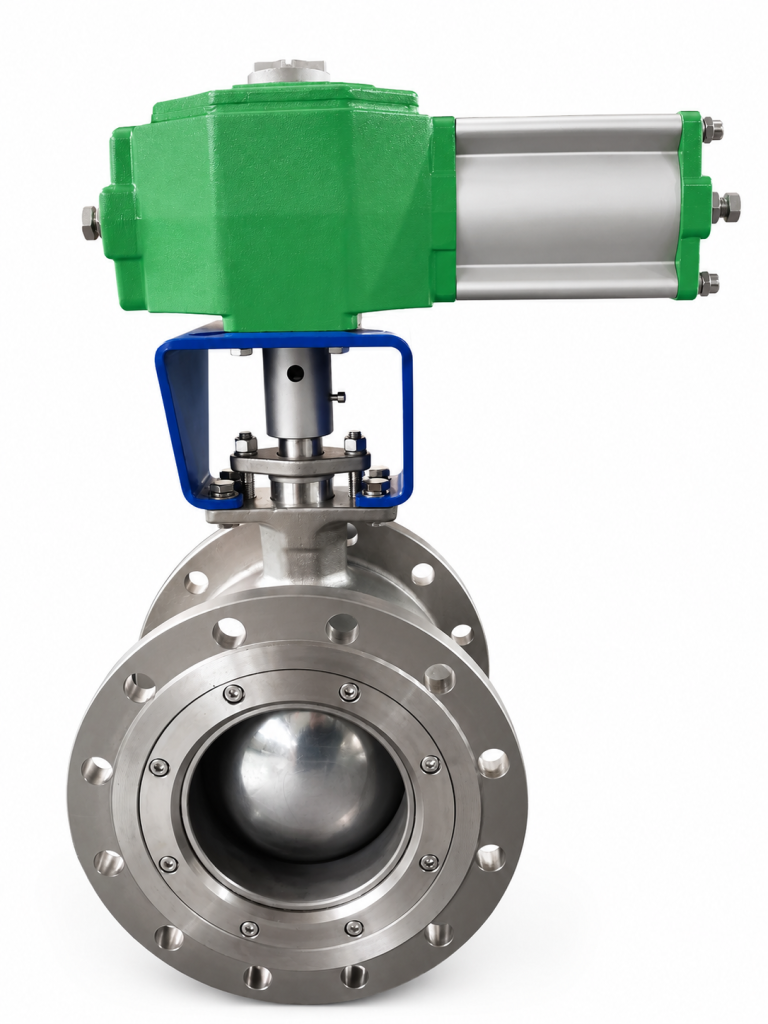
Features & Standards
These features define the valve’s ability to handle high flow rates, abrasive media, and continuous operation. In demanding applications, proper configuration directly impacts performance and reliability.
Sizes: DN25 – DN600 (1″ – 24″)
Pressure Classes: PN10 – PN150 / ASME Class 150 – 900
Covers a wide range of process conditions from standard to demanding industrial applications.
Flow Characteristics: Equal percentage
Design: High Cv, low pressure drop
Ensures high flow capacity while maintaining system efficiency and minimizing pressure losses.
Materials: Carbon steel, stainless steel, duplex, special alloys
Trim: Hardened surfaces for abrasive service
Selected to withstand wear, corrosion, and aggressive media in demanding environments.
Shutoff: Class IV / V (typical)
Sealing: Metal or soft seat depending on service conditions
Defines sealing performance and reliability based on process requirements.
Design Standards: ASME B16.34, IEC 60534
Testing: API 598
Compliance with international standards ensures consistent performance and operational reliability.
Actuation: Pneumatic, Electric, Electro-Hydraulic
Options: Positioners and control accessories
Configured to match control requirements and ensure stable operation within the system.
Applications
In these applications, these valves are used in applications where clogging, abrasion, and high flow rates challenge conventional control valves.
In these conditions, selecting the wrong valve can lead to blockage, excessive wear, or frequent maintenance.
Pulp & Paper — Fiber and Slurry Control
Used in pulp stock, screening, and wastewater systems. Poor valve selection can lead to clogging and unstable process control.
Wastewater and Slurry Systems
Suitable for abrasive and contaminated fluids. Inadequate valve performance can increase wear and maintenance frequency.
Mining and Abrasive Services
Applied in high solid-content processes. Without proper valve design, erosion and reduced service life become critical issues.
Chemical Processes — High Flow Handling
Used where large flow volumes are required. Poor control can lead to unstable operation under varying process conditions.
Power and Utility Systems
Flow control in utility systems where efficiency and durability are essential. Excessive pressure loss can reduce system performance.
General Process Industries
Suitable where reliability and flow capacity are more important than high-precision control performance.
As a result, selecting the right valve configuration is critical to ensure stable operation and minimize downtime in demanding process environments.
Segment Ball vs Globe vs Butterfly — How to Choose
Each valve type is selected based on different performance priorities, including flow capacity, control accuracy, and operating conditions.
In practice, selecting the wrong valve can lead to clogging, unstable control, or reduced system efficiency.
Segment Ball Valve
Designed for high flow capacity and reliable operation in applications with challenging or contaminated media.
→ Best for slurry, fibers, abrasive media, and low pressure drop
Globe Control Valve
Provides precise flow regulation and stable control performance under varying process conditions.
→ Best for high accuracy, throttling, and control loop stability
Triple Offset Butterfly Valve
Designed for severe service conditions requiring tight shutoff and reliable performance under high temperature or pressure.
→ Best for high temperature, high pressure, and tight shutoff
As a rule, when handling slurry, fibers, or contaminated media, segment ball valves provide more reliable operation than globe valves. In contrast, globe valves are preferred when control accuracy is critical, while butterfly valves are selected for severe service and tight shutoff requirements.
Get the Right Valve for Challenging Flow Conditions
Share your process conditions to evaluate whether a segment ball valve fits your application. In addition, we review flow capacity, media type, and operating requirements to ensure reliable performance.
• Required flow rate and operating range
• Type of media, including slurry, fibers, or particles
• Inlet and outlet pressure conditions (ΔP)
• Operating temperature and environment
• Wear, clogging, or maintenance concerns