
RELEABEL Solutions
Filter and Pressure Regulators for Stable Valve Control Systems
Stable Air Supply and Pressure Control for Reliable Automation Performance
Air quality and pressure stability directly affect actuator response, valve movement consistency, and overall control reliability. Contaminated or unstable air supply can create delayed response, unstable loop behavior, premature component wear, and unreliable shutdown performance.
At Nordenflow, we support filter and pressure regulator solutions for pneumatic control systems, valve automation, and safety applications where stable pressure control and clean instrument air are essential for long-term operational reliability.
Applied in pneumatic actuator systems, solenoid valve assemblies, smart positioners, ESD architectures, and industrial process automation
Conditions That Require Filter and Pressure Regulation Systems
Reliable pneumatic automation depends on consistent instrument air quality, stable downstream pressure, and sufficient airflow under changing operating conditions. Filter and pressure regulation systems become increasingly important when pneumatic performance begins to deteriorate because the supplied air can no longer maintain the conditions required for accurate and repeatable actuator operation.
Pressure Instability During Operation
Fluctuating supply pressure or insufficient downstream regulation can produce inconsistent actuator movement, unstable valve positioning, and reduced control loop stability, particularly where multiple pneumatic devices operate from a common air supply.
Reduced Dynamic Response
Slow actuator stroking, delayed shutdown response, or inconsistent switching behaviour often indicates that the pneumatic supply cannot maintain adequate pressure and flow during transient demand rather than a fault within the actuator itself.
Instrument Air Contamination
Moisture, oil aerosols, particulate contamination, and accumulated condensate accelerate internal wear, damage seals, increase component friction, and reduce the long-term reliability of pneumatic control equipment.
Inconsistent Pneumatic Device Performance
Solenoid valves, smart positioners, volume boosters, and pneumatic accessories require stable operating pressure and clean instrument air to maintain repeatable switching performance and positioning accuracy.
Recurring Maintenance Activity
Frequent seal replacement, sticking pneumatic components, regulator adjustment, or repeated actuator servicing often indicate unresolved air quality, pressure regulation, or condensate management issues elsewhere in the pneumatic system.
Demanding Industrial Environments
Oil & gas, LNG, marine, power generation, chemical processing, and other continuous-process industries rely on properly conditioned instrument air to maintain consistent automation performance throughout normal operation and safety shutdown sequences.
In many pneumatic automation systems, unstable valve behaviour originates from variations in air quality, pressure stability, or available flow capacity rather than from actuator or valve failures. Evaluating the pneumatic supply before replacing automation components frequently leads to faster troubleshooting and more effective long-term reliability improvements.
Filter and Pressure Regulation Solutions for Pneumatic Automation Systems
Reliable pneumatic automation depends on selecting the appropriate air preparation and pressure control technology for the application. Rather than relying on a single product type, engineers should consider air quality requirements, operating pressure, flow demand, environmental conditions, and system architecture when designing pneumatic supply systems.
NordenFlow supplies a broad range of filtration and pressure regulation technologies from IMI Norgren and IMI Maxseal to support industrial process automation, valve actuation, shutdown systems, and instrument air applications across demanding operating environments.
Instrument Air Filtration
Filtration solutions remove particulate contamination, moisture, and oil aerosols to protect pneumatic components, improve equipment reliability, and maintain consistent instrument air quality.
Pressure Regulation
Pressure regulators maintain stable downstream pressure despite variations in supply conditions, helping ensure repeatable actuator performance and reliable pneumatic control.
Filter-Regulator Assemblies
Integrated filtration and pressure regulation simplify pneumatic installation while providing clean, regulated air for valve automation, control systems, and general instrument air services.
Precision & High-Pressure Regulation
Specialized regulator technologies support applications requiring highly stable outlet pressure, elevated inlet pressures, process gas control, or demanding pneumatic operating conditions.
Corrosion-Resistant & Industrial Configurations
Material selections including aluminium, brass, and stainless steel provide suitable solutions for offshore, marine, LNG, chemical processing, and other harsh industrial environments.
Integration with Valve Automation Systems
Air preparation and pressure regulation components integrate with pneumatic actuators, solenoid valves, smart positioners, partial stroke testing systems, and complete emergency shutdown valve assemblies.
Effective pneumatic performance is achieved by selecting the appropriate combination of filtration, pressure regulation, materials, and installation configuration rather than treating air preparation as a standalone utility component. Matching these technologies to operating conditions improves reliability throughout the complete valve automation system.
Engineering Configuration and Selection Considerations
Selecting a pneumatic air preparation solution involves more than matching pressure ratings or connection sizes. Configuration should reflect the required air quality, operating pressure, flow demand, installation environment, maintenance strategy, and the performance requirements of the complete automation system.
Configuration Architecture
Standalone filters, pressure regulators, integrated FR assemblies, and modular FRL systems allow engineers to configure pneumatic air preparation according to application complexity, maintenance requirements, and available installation space.
Filtration Strategy
Filter element selection depends on contamination level, required air cleanliness, and equipment sensitivity. Standard particulate filtration, fine filtration, and coalescing elements each address different instrument air quality requirements.
Pressure Range Selection
Applications range from conventional instrument air regulation to high-pressure gas reduction. Selecting an appropriate pressure class ensures stable downstream performance without unnecessarily increasing system complexity.
Flow Capacity Matching
Air preparation equipment should be selected to satisfy peak pneumatic demand while maintaining stable downstream pressure during actuator movement, emergency shutdown, and other transient operating conditions.
Material and Environmental Compatibility
Material selection should consider corrosion exposure, ambient conditions, hazardous-area requirements, and long-term durability. Aluminium, brass, and stainless-steel constructions provide suitable solutions for different industrial environments.
Safety and Bowl Construction
Polycarbonate and metal bowls provide different advantages depending on operating pressure, environmental exposure, and plant safety requirements. Selection should reflect both maintenance accessibility and installation conditions.
Installation and System Integration
Panel-mounted, bracket-mounted, manifold-mounted, and modular assemblies simplify integration with valve automation packages while supporting maintenance access and future system expansion.
Condensate Management
Manual and automatic drain arrangements remove accumulated moisture before it affects pneumatic performance, helping maintain reliable operation and reduce maintenance associated with water contamination.
Selecting the appropriate air preparation configuration requires balancing filtration performance, pressure regulation, flow capacity, environmental suitability, and maintenance strategy. Considering these factors together helps establish a stable pneumatic supply that supports reliable valve automation and long-term system performance.
Engineering Capability Overview
Filter and pressure regulation solutions are available in a wide range of configurations to accommodate different pneumatic architectures, operating pressures, environmental conditions, and automation requirements. Available capabilities vary by product series and application.
Pressure Control
Solutions are available for conventional instrument air regulation, precision pressure control, and high-pressure gas reduction across a broad range of industrial operating conditions.
Filtration Performance
Multiple filtration grades support particulate removal, fine filtration, and coalescing applications for pneumatic systems with different air quality requirements.
Materials and Construction
Available in aluminium, brass, and stainless-steel constructions with configuration options suitable for corrosive, offshore, marine, chemical processing, and other demanding industrial environments.
Installation Flexibility
Product families support panel, bracket, manifold, and modular installation arrangements, allowing integration with new valve automation packages as well as retrofit projects.
Industrial Compliance
Selected product families are available with internationally recognized industrial approvals and certifications, including hazardous-area compliance and air quality standards where required by the application.
Because capability varies between product families, final configuration should be selected according to operating pressure, required air quality, environmental conditions, and the performance objectives of the complete pneumatic automation system rather than by specification values alone.
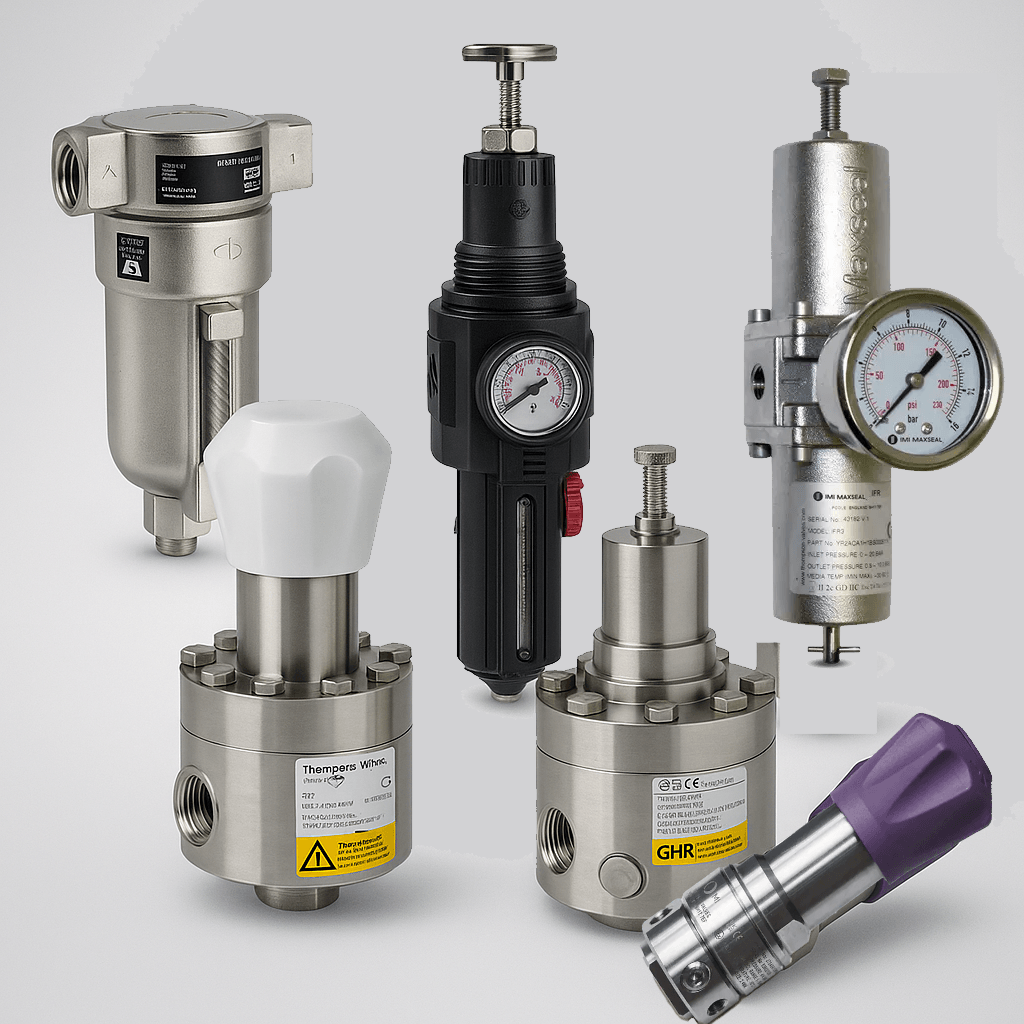
Representative IMI Models & Technical Selection Guide
The following representative IMI models provide an engineering overview of commonly specified filter regulators, pressure regulators, back pressure regulators and high-pressure filters used in industrial automation and instrumentation systems. The tables below support preliminary product selection. Additional pressure ranges, connection types, materials and optional configurations are available upon request.
IMI Maxseal® Instrumentation Products
| Model | Product Type | Maximum Working Pressure | Port Size | Body Material | Media | Typical Applications |
|---|---|---|---|---|---|---|
| IFR3 | Filter Regulator | 17 barg | 1/4" NPT | SS316 | Gas | Instrument air, ESD panels |
| IFR4 | Filter Regulator | 17 barg | 1/2" NPT | SS316 | Gas | High-flow instrument air |
| J70 | Spring Loaded Regulator | 700 barg | 1/4" NPT | SS316L | Gas / Liquid | High-pressure gas reduction |
| J72 | Spring Loaded Regulator | 414 barg | 3/4" NPT / BSPP | SS316L | Gas / Liquid | Process pressure control |
| L72 | Back Pressure Regulator | 414 barg | 3/4" NPT / BSPP | SS316L | Gas / Liquid | Upstream pressure control |
| W11 / W12 / W13 | Stainless Steel Filters | Up to 550 barg | 3/8"–1½" | SS316 | Gas | High-pressure filtration |
IMI Norgren® Air Preparation Products
| Model | Product Type | Maximum Working Pressure | Port Size | Body Material | Media | Typical Applications |
|---|---|---|---|---|---|---|
| B52G / B54G | Stainless Steel Filter Regulator | 31 bar (Manual) / 17 bar (Auto) | 1/4"–1" NPT / ISO G | Stainless Steel | Compressed Air | Corrosive environments, offshore, chemical processing, hazardous area instrument air systems |
| B72G / B74G | Filter Regulator | 17 barg | 1/4"–3/4" | Aluminium / Zinc | Gas | Pneumatic automation |
| B17 | Filter Regulator | 17 barg | 3/4"–1½" | Powder-coated aluminium | Gas | High-flow instrument air |
The models shown above represent commonly specified IMI solutions for industrial pneumatic and instrumentation systems. Product selection should consider operating pressure, media compatibility, flow requirements, environmental conditions and material suitability. Contact NordenFlow for engineering support with product selection, application review and complete IMI portfolio recommendations.
Engineering Factors That Influence Pneumatic Stability and Valve Automation Performance
Reliable pneumatic performance depends on the interaction of air quality, pressure control, flow capacity, installation conditions, and system architecture. Evaluating these engineering factors together helps establish a stable air supply that supports consistent actuator operation, accurate valve positioning, and dependable shutdown performance throughout the automation system.
Pressure Stability Under Dynamic Demand
Pressure regulators should maintain consistent downstream pressure during changing pneumatic demand, including simultaneous actuator movement and rapid shutdown events, to support predictable valve performance.
Air Quality and Equipment Sensitivity
The required level of filtration depends on the sensitivity of downstream components. Moisture, oil aerosols, and particulate contamination can progressively reduce the performance and service life of pneumatic control equipment.
Flow Capacity and Peak Air Consumption
Air preparation equipment should accommodate peak pneumatic demand without excessive pressure reduction during actuator stroking, emergency shutdown, or multiple-device operation from a common air supply.
Condensate Control and Moisture Management
Effective condensate removal helps minimise corrosion, seal degradation, contamination, and cold-weather operating issues that can affect long-term pneumatic performance.
Environmental and Installation Conditions
Ambient temperature, hazardous-area classification, vibration, corrosion exposure, and installation accessibility influence both equipment selection and long-term maintenance requirements.
Integration Within the Automation System
Air preparation equipment should be considered as part of the complete valve automation package, supporting pneumatic actuators, solenoid valves, smart positioners, partial stroke testing devices, and emergency shutdown systems through a stable and appropriately conditioned air supply.
Reliable valve automation depends on more than individual component performance. A properly engineered pneumatic supply system balances air quality, pressure stability, flow capacity, environmental suitability, and equipment integration to support consistent operation throughout the asset lifecycle.
Engineering Review Before Selecting Air Preparation Equipment
Pneumatic instability is not always caused by the regulator or filter itself. Reviewing the operating conditions, pneumatic architecture, and existing performance issues before selecting replacement equipment helps identify the most appropriate engineering solution and avoids unnecessary component changes.
✓ Valve type, actuator configuration, and automation architecture
✓ Available instrument air pressure, pressure stability, and expected flow demand
✓ Existing operating issues including slow response, instability, sticking, or excessive maintenance
✓ Current filtration, pressure regulation, and condensate management arrangement
✓ Installation environment, hazardous-area requirements, and material considerations
✓ Required performance objective, such as improved reliability, shutdown readiness, retrofit, or system upgrade
Many pneumatic performance issues originate upstream from inadequate air preparation, pressure instability, or unsuitable system configuration. Reviewing these engineering factors before replacing actuators, valves, or accessories frequently leads to more effective and lower-cost solutions.