

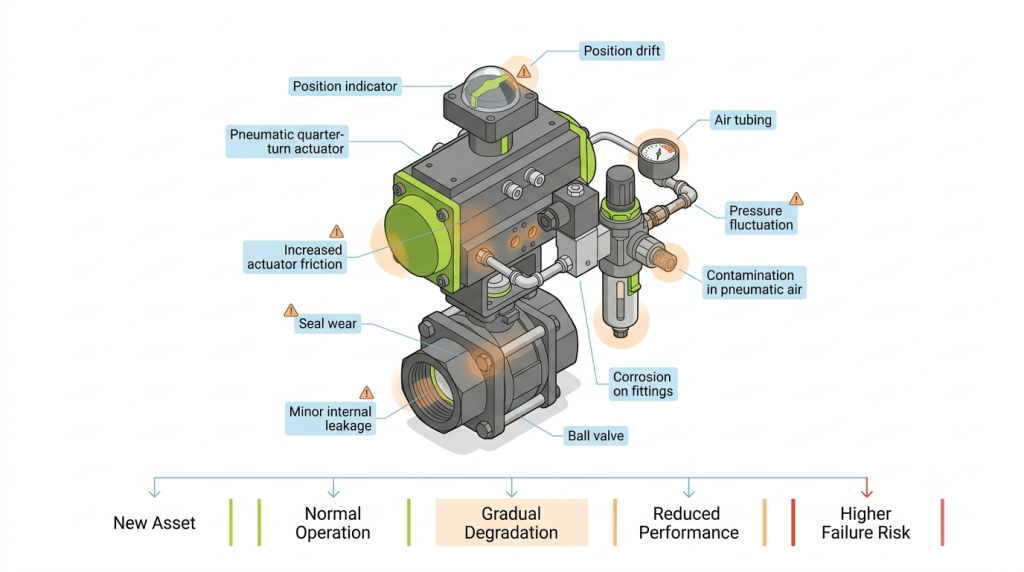
Why Do Industrial Assets Gradually Lose Reliability?
Industrial assets rarely fail without warning. In most cases, reliability declines gradually through wear, contamination, environmental exposure, operational stress, and ageing of mechanical, pneumatic, hydraulic, and electrical components. Understanding how this degradation develops is the foundation of reliability engineering and enables maintenance teams to detect problems before they become failures.
Every industrial facility expects its equipment to operate reliably throughout its design life. Pumps, valves, actuators, compressors, instrumentation, and rotating machinery are all selected, installed, and commissioned to perform specific operational functions under defined process conditions.
Yet every experienced maintenance engineer knows that equipment does not maintain the same condition throughout its lifecycle. Components age. Mechanical tolerances change. Pneumatic systems develop small leaks. Sensors drift. Corrosion slowly progresses. Environmental conditions continuously influence equipment performance.
Reliability therefore should never be considered a fixed characteristic. It is a dynamic engineering property that changes continuously throughout an asset’s operational life. The objective of reliability engineering is not simply to repair equipment after failure, but to recognise and manage this gradual deterioration before it affects production, safety, or maintenance costs.
Reliability Is Dynamic, Not Constant
Many people associate equipment reliability with the quality of the original design or manufacturer. While these factors certainly influence expected service life, they do not prevent degradation from occurring. From the moment equipment is commissioned, physical changes begin to affect its condition.
These changes are usually small and develop over long periods. A slight increase in friction, a gradual reduction in sealing performance, minor contamination within pneumatic circuits, or calibration drift inside instrumentation may have little immediate impact on production. However, as these individual changes accumulate, overall system reliability gradually decreases.
This process explains why industrial failures are rarely isolated events. What appears to be a sudden breakdown is often the final stage of degradation that has been developing unnoticed for months or even years.
 New Equipment
       │
       ▼
 Stable Operation
       │
       ▼
 Progressive Degradation
       │
       ▼
 Reduced Reliability
       │
       ▼
 Functional Failure
What Causes Industrial Assets to Lose Reliability?
Reliability degradation is rarely caused by a single mechanism. Instead, multiple physical processes interact throughout the asset lifecycle, gradually influencing equipment performance and increasing the probability of failure.
Although the dominant mechanisms vary between industries and equipment types, several degradation processes are commonly encountered across industrial automation systems.
Mechanical Wear
Bearings, gears, valve seats, stems, seals, springs, and moving assemblies experience continuous mechanical loading during operation. Friction gradually changes component dimensions and increases internal clearances, eventually affecting operating accuracy, response time, and efficiency.
Corrosion and Environmental Exposure
Moisture, chemicals, salt, ultraviolet radiation, temperature fluctuations, and aggressive process media continuously attack exposed equipment surfaces. Corrosion may weaken structural components, reduce sealing capability, or interfere with moving mechanisms long before complete failure becomes visible.
Contamination
Dust, moisture, oil residue, process particles, and degraded lubricants frequently accumulate inside pneumatic, hydraulic, and mechanical systems. Even small levels of contamination can influence valve performance, increase friction, restrict flow paths, and accelerate component wear.
Thermal Cycling
Repeated heating and cooling causes expansion and contraction of materials. Over time, thermal cycling contributes to fatigue, loosening of fasteners, seal degradation, and dimensional changes that influence equipment reliability.
Vibration
Industrial equipment is continuously exposed to mechanical vibration generated by rotating machinery, piping systems, and process operations. Excessive vibration may loosen fittings, damage electrical connections, accelerate fatigue, or increase leakage within pneumatic assemblies.
Instrument Drift
Pressure transmitters, position sensors, switches, and other field instrumentation gradually lose calibration accuracy through ageing, environmental exposure, and repeated operating cycles. Small deviations may remain unnoticed while influencing process performance and maintenance decisions.
Pneumatic and Hydraulic Leakage
Elastomer ageing, damaged seals, loose fittings, and worn valve components gradually increase leakage rates within actuator control systems. Although minor leakage may not immediately affect operation, it often represents one of the earliest indicators of declining reliability.
Human Intervention
Equipment modifications, maintenance practices, incorrect adjustments, improper installation, and undocumented field changes can all influence long-term reliability. Even well-intentioned maintenance activities may introduce new failure mechanisms if configuration control is not maintained.
None of these mechanisms typically causes immediate equipment failure. Instead, they progressively reduce operational margins until normal process variations become sufficient to trigger malfunction, increased maintenance activity, or complete functional failure.
Hidden Failures vs Functional Failures
One of the most important concepts in reliability engineering is understanding the difference between a hidden failure and a functional failure. Although these terms are frequently used in maintenance and functional safety disciplines, they describe two very different stages in the degradation process.
A functional failure is visible. Equipment can no longer perform its intended function within the required operating limits. Production may be interrupted, alarms are generated, maintenance is requested, or the process enters a safe shutdown condition.
A hidden failure is different. The equipment may continue operating normally while one or more internal components gradually lose performance. These changes often remain undetected because they do not immediately affect production or process measurements. However, the equipment’s ability to respond correctly when required has already been compromised.
In many industrial systems, hidden failures represent a greater long-term risk than obvious failures because they create a false sense of confidence. Equipment appears healthy until a demand occurs, at which point the degradation becomes visible through an unexpected malfunction.
Normal Operation
       │
       ▼
Small Degradation
       │
       ▼
Hidden Failure
       │
       ▼
Performance Reduction
       │
       ▼
Functional Failure
       │
       ▼
Maintenance Action
Why Scheduled Maintenance Isn’t Always Enough
Preventive maintenance has been the foundation of industrial maintenance programmes for decades. Components are inspected, lubricated, adjusted, or replaced after a defined number of operating hours or according to a fixed calendar schedule.
This approach has proven effective for many types of equipment, particularly where wear rates are predictable and failure mechanisms are well understood. However, modern industrial facilities increasingly operate under varying process conditions that make degradation far less predictable than a fixed maintenance interval assumes.
Two identical actuators installed on different process lines may experience completely different operating environments. One may cycle only a few times each month under clean conditions, while another operates continuously in high temperatures, vibration, moisture, or corrosive atmospheres. Applying identical maintenance intervals to both assets does not necessarily produce the same reliability outcome.
Scheduled maintenance also has practical limitations. It typically provides only a snapshot of equipment condition at the time of inspection. Degradation that develops between inspections may remain unnoticed for weeks or months, particularly when changes occur gradually or intermittently.
For this reason, many organisations increasingly combine preventive maintenance with condition monitoring, diagnostics, and operational data analysis to gain a more complete understanding of asset health throughout the operating lifecycle.
Reliability Degradation in Valve Automation Systems
Automated valve assemblies illustrate reliability degradation particularly well because they combine mechanical, pneumatic, electrical, and instrumentation components within a single final control element. The overall reliability of the assembly depends on every component performing correctly throughout its service life.
In many shutdown systems, the valve itself is rarely the first component to experience degradation. Instead, small changes within supporting pneumatic or instrumentation devices gradually influence the behaviour of the complete automation package.
Pneumatic Actuators
Actuator reliability may gradually decline as seals harden, internal friction increases, lubrication deteriorates, or mechanical wear affects moving components. These changes often appear first as slower stroke times, reduced positioning accuracy, or increased air consumption rather than complete failure.
Solenoid Valves
Solenoid valves are exposed to contamination, moisture, coil ageing, pressure fluctuations, and repeated switching cycles. Pilot passages may gradually become restricted, moving parts may stick, or internal leakage may increase. Because these changes often develop slowly, valve performance may remain acceptable during normal operation while reliability during a shutdown demand steadily decreases.
Positioners
Positioners continuously translate control signals into precise actuator movement. Over time, calibration drift, mechanical wear, contaminated air supply, and pneumatic leakage can reduce positioning accuracy or increase response time. Small deviations may initially appear insignificant but often indicate the beginning of broader system degradation.
Air Preparation Units
Filter regulators and air preparation assemblies play a critical role in maintaining stable pneumatic performance. Contaminated filters, unstable regulators, moisture accumulation, or deteriorating seals can influence the performance of every downstream pneumatic device, making proper air preparation essential for long-term reliability.
Tubing and Fittings
Pneumatic tubing is frequently considered a passive component, yet vibration, thermal cycling, mechanical stress, and improper installation can gradually introduce leakage or pressure losses throughout the control circuit. Even minor leaks may affect actuator response and increase compressor loading over time.
Pneumatic Manifolds
Modern manifold assemblies reduce the number of external tube connections while integrating pneumatic devices into a compact control package. Although this approach improves installation consistency and maintainability, the manifold itself should be periodically inspected to verify internal sealing integrity, pressure distribution, and the performance of integrated pneumatic components.
Shutdown Valve Assemblies
An emergency shutdown valve package functions as an integrated system rather than a collection of individual products. Reliable operation depends on the combined performance of the valve, actuator, control accessories, pneumatic circuit, and instrumentation. Degradation affecting any one of these elements can reduce the reliability of the complete final element.
Reliability should always be evaluated at the system level. Replacing a single component may solve an immediate problem, but understanding how degradation develops across the complete valve automation package provides a more effective basis for long-term lifecycle management.