

From Process Control to Process Isolation: How to Select the Right Flow Control Valve Technology
Selecting a flow control valve technology should not begin with the question, “Which valve is better?”
The more useful engineering question is:
What is the process asking the valve to do?
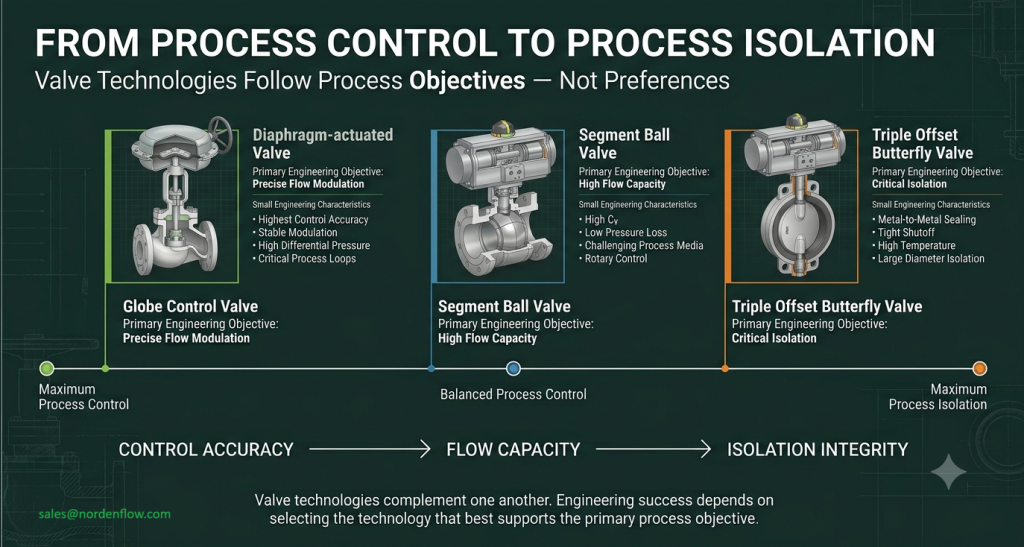
Globe Control Valves, Segment Ball Valves and Triple Offset Butterfly Valves exist because industrial processes impose different requirements on flow control and isolation. A valve may need to provide precise modulation, handle high flow capacity, operate with challenging process media, withstand significant differential pressure, or provide tight isolation under demanding conditions.
These requirements lead to different engineering priorities.
For this reason, flow control valve technology selection should begin with the process condition and engineering objective—not with a preferred valve type or manufacturer.
Process Conditions → Engineering Objective → Valve Technology → Valve Sizing & Configuration → Automation → Lifecycle Considerations
What Factors Influence Flow Control Valve Selection?
Flow control valve selection is influenced by considerably more than nominal pipe size and pressure rating.
The engineering evaluation may include:
- Process medium and its physical properties
- Operating pressure and temperature
- Differential pressure (ΔP)
- Required flow rate and turndown
- Required Cv or Kv
- Flow characteristic
- Control accuracy
- Cavitation and flashing risk
- Pressure loss
- Shutoff requirements
- Valve size
- Operating frequency
- Required actuator type
- Fail position
- Environmental conditions
- Applicable standards
- Maintenance and lifecycle requirements
The relative importance of these parameters changes from one application to another.
For example, a high-differential-pressure steam control application presents a different valve selection problem from a large-diameter pipeline requiring critical isolation.
Similarly, controlling clean process fluid is fundamentally different from controlling slurry, fibrous media or other challenging process media.
Therefore, an industry name such as Oil & Gas, LNG, Power or Pulp & Paper does not, by itself, determine the appropriate valve technology.
The actual process duty does.
Three Primary Engineering Objectives
A practical way to understand the major flow control valve technologies is to identify the primary engineering objective.
Precise Process Control
When accurate and stable modulation of flow, pressure or temperature is the dominant requirement, control performance becomes the primary selection criterion.
Globe Control Valves are commonly considered for these duties.
High Flow Capacity
When high flow capacity, low pressure loss and challenging process media become dominant considerations, rotary control technology can offer a different engineering approach.
Segment Ball Valves are often considered for these applications.
Critical Process Isolation
When the primary requirement shifts from continuous modulation to dependable isolation, sealing performance, temperature capability and valve geometry become increasingly important.
Triple Offset Butterfly Valves are commonly applied to these duties.
The three technologies should therefore not be viewed simply as competing alternatives. They address different engineering priorities.
When Should a Globe Control Valve Be Selected?
A Globe Control Valve uses linear valve motion and a defined internal flow path to regulate process flow.
Its primary engineering advantage is the ability to provide controlled and predictable modulation across the required operating range.
A Globe Control Valve may be considered when the application requires:
- Precise flow regulation
- Pressure control
- Temperature control
- Stable process modulation
- High differential pressure handling
- Defined flow characteristics
- High control accuracy
For demanding applications, valve selection may require evaluation of the relationship between Cv/Kv, pressure drop, flow velocity, cavitation, flashing, noise and trim design.
The question is therefore not simply:
Can the valve pass the required flow?
The more important question is:
Can the valve control that flow predictably across the required operating range?
Typical Globe Control Valve Applications
- Steam control
- Boiler feedwater control
- Pressure control
- Temperature control
- Process flow regulation
- High differential pressure control
For these duties, control performance can be more important than achieving the lowest possible pressure loss.
When Is a Segment Ball Valve Preferred?
A Segment Ball Valve uses rotary motion and a segmented ball geometry to provide flow control.
One of its important engineering characteristics is the combination of high flow capacity and relatively low pressure loss.
This can become particularly relevant when the process involves:
- High flow requirements
- High Cv/Kv requirements
- Low pressure-loss objectives
- Slurry
- Fibrous media
- Dirty process media
- Abrasive or challenging services
- Significant flow variation
The segmented flow passage can provide high capacity while maintaining the controllability expected from a rotary control valve.
This makes Segment Ball Valve technology particularly relevant in applications where the characteristics of the process medium are a major part of the valve selection problem.
The engineering question becomes:
How effectively can the valve control the required flow while handling the actual process medium and pressure-loss constraints?
Typical Segment Ball Valve Applications
- Slurry service
- Fibrous process media
- Dirty process fluids
- High-capacity flow control
- Pulp and paper applications
- Water and wastewater processes
- Applications where low pressure loss is important
When Should a Triple Offset Butterfly Valve Be Used?
A Triple Offset Butterfly Valve addresses a different engineering requirement.
Its defining characteristic is the geometry created by three offsets between the shaft, disc and sealing arrangement.
This geometry changes how the disc approaches the seat and is intended to minimize rubbing between the sealing surfaces during operation.
In a typical metal-seated triple-offset design, the sealing action occurs through the interaction of metallic sealing surfaces rather than through continuous sliding contact.
This makes the technology relevant to demanding isolation applications.
Typical engineering considerations include:
- Tight shutoff
- Critical process isolation
- High-temperature service
- Large valve diameters
- Steam isolation
- LNG process isolation
- Tank farm isolation
- Emergency shutdown duties
- Pipeline isolation
The primary engineering question is therefore different from that of a modulating control valve:
Can the valve provide the required isolation performance under the specified process and environmental conditions?
For critical isolation, engineers should evaluate the complete design, including sealing geometry, materials, pressure and temperature rating, leakage requirements, actuator configuration and applicable standards.
Globe vs Segment Ball vs Triple Offset: What Is the Engineering Difference?
A direct comparison is useful, provided it is understood as a technology-level guide rather than a universal performance ranking.
| Engineering Requirement | Globe Control Valve | Segment Ball Valve | Triple Offset Butterfly Valve |
|---|---|---|---|
| Precise modulation | ●●●●● | ●●● | ● |
| High flow capacity | ●●● | ●●●●● | ●●●● |
| Low pressure loss | ●●● | ●●●●● | ●●●● |
| High ΔP control | ●●●●● | ●●● | ●● |
| Challenging process media | ●● | ●●●●● | ●●● |
| Critical isolation | ●● | ●●● | ●●●●● |
| High-temperature isolation | ●●● | ●●● | ●●●●● |
| Large-diameter isolation | ●● | ●●● | ●●●●● |
Note: The ratings above are directional engineering comparisons, not guaranteed performance levels. Actual suitability depends on valve design, sizing, materials, process conditions and manufacturer-specific construction.
How Do Process Conditions Change Valve Selection?
Consider steam service.
Steam may require:
- Precise pressure control
- Temperature control
- High differential pressure handling
- High-temperature capability
- Isolation
Therefore, simply stating “steam service” does not automatically determine the valve technology.
The engineering objective still needs to be defined.
The same principle applies to LNG.
An LNG facility may contain applications requiring:
- Flow regulation
- Cryogenic service
- Emergency isolation
- Tight shutoff
Again, the process duty—not simply the industry or medium name—drives the technology decision.
A useful engineering sequence is:
1. Identify the Process Conditions
Determine pressure, temperature, medium, flow, differential pressure and operating range.
2. Define the Engineering Objective
Determine whether the dominant requirement is control accuracy, flow capacity, isolation, or a combination of these.
3. Select the Valve Technology
Select the technology whose fundamental characteristics best match the identified objective.
4. Complete the Valve Engineering
Evaluate sizing, Cv/Kv, materials, trim or sealing arrangement, pressure rating, leakage requirements and actuator configuration.
Typical Process Conditions and Valve Technology
| Process Requirement | Primary Technology |
|---|---|
| Precise flow modulation | Globe Control Valve |
| High differential pressure control | Globe Control Valve |
| Pressure or temperature control | Globe Control Valve |
| High flow capacity | Segment Ball Valve |
| Low pressure loss | Segment Ball Valve |
| Slurry service | Segment Ball Valve |
| Fibrous media | Segment Ball Valve |
| Challenging process media | Segment Ball Valve |
| Critical isolation | Triple Offset Butterfly Valve |
| Tight shutoff | Triple Offset Butterfly Valve |
| High-temperature isolation | Triple Offset Butterfly Valve |
| Large-diameter isolation | Triple Offset Butterfly Valve |
This is a starting point for engineering evaluation—not a substitute for detailed valve sizing and application review.
Is There a Single Best Flow Control Valve Technology?
No. There is no universally best valve technology for every industrial application.
The appropriate selection depends on the relationship between:
Process Conditions → Engineering Objective → Valve Technology
For example:
- Precise modulation + high ΔP → Globe Control Valve
- High capacity + challenging media → Segment Ball Valve
- Critical isolation + high temperature + large diameter → Triple Offset Butterfly Valve
The technologies therefore complement one another.
The objective is not to identify the universally superior valve. The objective is to select the technology that best satisfies the actual engineering duty.
Valve Technology Selection Is Only the Beginning
Once the appropriate technology has been identified, the engineering evaluation continues.
- Valve sizing
- Cv/Kv calculation
- Pressure drop
- Flow characteristic
- Cavitation and flashing assessment
- Materials selection
- Seat or trim configuration
- Leakage requirements
- Pressure and temperature rating
- Actuator sizing
- Fail-safe position
- Solenoid valve configuration
- Position feedback
- Partial Stroke Testing
- Applicable standards
- Testing and documentation
This is where valve technology selection becomes application engineering.
The objective is not simply to select a valve that physically fits the pipeline. The objective is to develop a valve and automation configuration that is appropriate for the process duty and lifecycle requirements.
A Practical Valve Selection Framework
1. Process Condition
What are the pressure, temperature, medium, flow and differential-pressure conditions?
2. Engineering Objective
Is the primary requirement precise control, high flow capacity or critical isolation?
3. Valve Technology
Which technology best matches the primary duty?
4. Valve Sizing & Configuration
What Cv/Kv, size, trim, sealing arrangement and pressure class are required?
5. Automation & Actuation
What actuator, fail position, position feedback and control architecture are required?
6. Lifecycle Considerations
What are the maintenance, modernization, testing and future operational requirements?
This approach turns valve selection from a product comparison into a structured engineering decision.
Engineering Takeaway
Flow control valve technology selection should start with the process, not the product.
Globe Control Valves are typically considered when precise modulation and control performance dominate.
Segment Ball Valves become attractive when high flow capacity, low pressure loss and challenging process media are important.
Triple Offset Butterfly Valves become relevant when critical isolation, tight shutoff, elevated temperature and large-diameter applications dominate.
The correct question is therefore not:
Which valve is the best?
It is:
Which valve technology best satisfies the engineering objective of this process?
Understand the Process → Define the Objective → Select the Technology
How NordenFlow Supports Flow Control Technology Selection
NordenFlow approaches flow control from an application-engineering perspective.
The objective is not simply to identify a valve that matches a line size or specification. It is to understand the process duty, evaluate the available technologies and develop an appropriate valve, actuation and instrumentation configuration.
NordenFlow can support engineering teams with:
- Flow control technology selection
- Valve application evaluation
- Valve automation and actuation integration
- Instrumentation selection
- Technical clarification
- Project engineering support
- Modernization and retrofit evaluation
- Lifecycle-oriented engineering support
The appropriate technology is not necessarily the most sophisticated option.
It is the technology that best matches the engineering objective.
Frequently Asked Questions
What factors should be considered when selecting a flow control valve?
Key factors include process medium, pressure, temperature, differential pressure, required flow rate, Cv/Kv, control range, flow characteristic, cavitation and flashing risk, shutoff requirements, valve size, actuator requirements, applicable standards and lifecycle considerations.
When should a Globe Control Valve be selected?
A Globe Control Valve is typically considered when precise and stable flow modulation, pressure control, temperature control or high differential pressure handling are important engineering requirements.
When is a Segment Ball Valve preferred?
A Segment Ball Valve can be advantageous when high flow capacity, low pressure loss and the ability to handle challenging process media such as slurry or fibrous fluids are important.
When should a Triple Offset Butterfly Valve be used?
Triple Offset Butterfly Valves are commonly considered for critical isolation duties where tight shutoff, high-temperature capability, metal-to-metal sealing and large-diameter practicality are important.
Is a Globe Valve better than a Segment Ball Valve?
Neither technology is universally better. Globe and Segment Ball Valves address different engineering priorities. The appropriate choice depends on process conditions, control requirements, flow capacity, pressure loss and the characteristics of the process medium.
What is the difference between control and isolation valve selection?
Control valve selection focuses primarily on predictable modulation of process variables such as flow, pressure or temperature. Isolation valve selection focuses primarily on achieving the required shutoff and isolation performance under specified process conditions.
Have a Flow Control Application That Requires Technology Evaluation?
NordenFlow can help evaluate the process conditions, engineering objectives and available valve technologies before moving to detailed valve sizing and configuration.
Understanding the Process. Selecting the Technology. Improving Performance.