

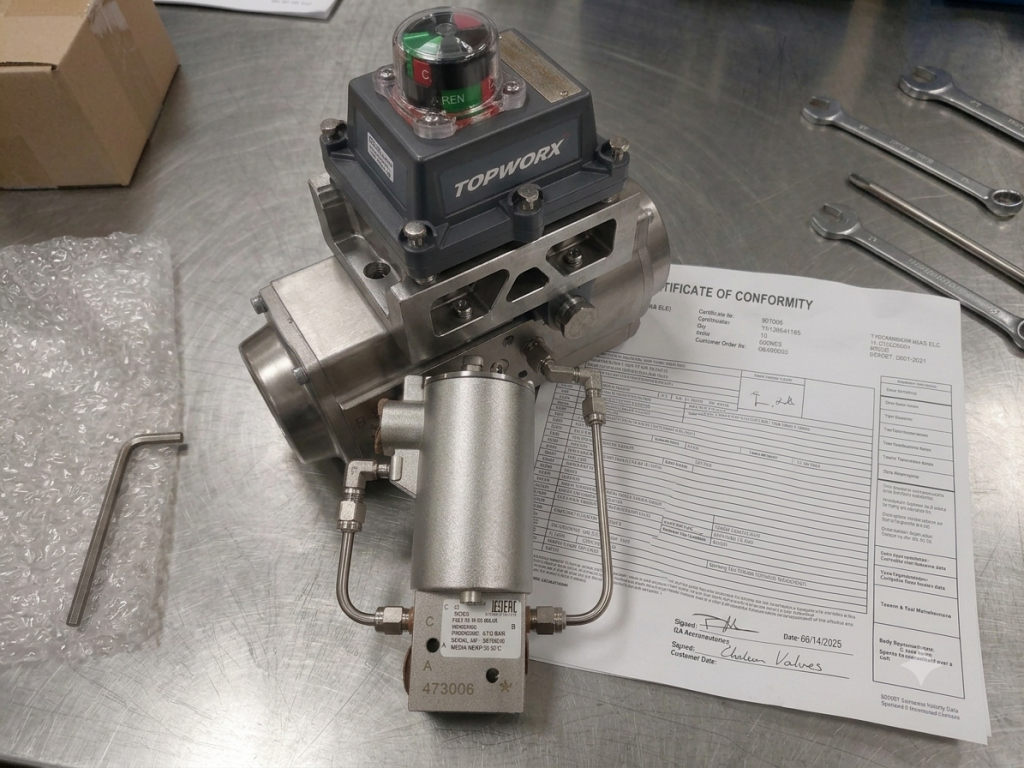
Valve Automation Retrofit vs Replacement: How to Make the Right Lifecycle Decision
Valve automation systems rarely become obsolete overnight. More often, industrial facilities reach a point where aging instrumentation, discontinued spare parts, maintenance difficulties, changing process requirements, or new functional safety expectations begin to affect the long-term performance of an installed automation package.
However, an aging automation system does not automatically require complete replacement. In many installations, the valve assembly and actuator remain mechanically suitable for continued operation while associated components such as solenoid valves, position feedback devices, pneumatic accessories, control interfaces, or local instrumentation have become obsolete or difficult to maintain.
This creates an important engineering decision: should the existing valve automation system be retrofitted, modernized, or completely replaced?
These three strategies are related, but they are not necessarily the same. A retrofit may replace selected components while retaining valuable existing assets. Modernization can involve a broader improvement of automation capability, diagnostics, reliability, or integration. Replacement establishes a new equipment and engineering baseline when the existing system no longer provides sufficient technical or lifecycle value.
The correct decision should therefore be based on the condition, compatibility, functionality, safety requirements, lifecycle cost, and future requirements of the complete automation system—not simply on equipment age.
What Is Valve Automation Retrofit?
Valve automation retrofit is the engineering upgrade of selected components of an existing valve automation system while retaining those parts of the installed asset that remain technically and economically suitable for continued service.
A retrofit does not necessarily mean replacing the valve itself. Depending on the application, the intervention may focus on the actuator, solenoid valve, positioner, feedback system, pneumatic accessories, electrical interfaces, or other automation components.
The objective is to remove a specific limitation—such as obsolescence, unreliable instrumentation, poor diagnostics, or unavailable spare parts—without unnecessarily discarding mechanically sound assets.
Retrofit vs Modernization vs Replacement
In industrial projects, the terms retrofit, modernization, and replacement can overlap. The distinction used in this article is based on the scope of engineering intervention and the extent to which the existing system is retained.
| Strategy | Basic Approach | Typical Objective |
|---|---|---|
| Retrofit | Upgrade selected components while retaining suitable existing assets. | Resolve specific technical, maintenance, or obsolescence problems. |
| Modernization | Improve the broader capability of an existing automation system. | Increase reliability, diagnostics, maintainability, integration, or lifecycle performance. |
| Replacement | Remove the existing automation package and establish a new engineering baseline. | Address fundamental technical, mechanical, safety, compatibility, or lifecycle limitations. |
A retrofit can therefore be part of a broader modernization project. Conversely, modernization does not automatically require complete replacement.
The engineering objective is to determine the smallest practical intervention that can reliably achieve the required operational and lifecycle outcome.
Why Existing Valve Automation Systems Need Lifecycle Review
Industrial valve automation systems are exposed to different operating conditions and component lifecycles. The actuator, valve, instrumentation, pneumatic accessories, electrical interfaces, and control devices do not necessarily age at the same rate.
A system installed many years ago may therefore contain a combination of reliable mechanical equipment and obsolete control components.
Aging Instrumentation
Position feedback devices, switches, positioners, and associated instrumentation may become difficult to maintain or may no longer provide the diagnostics and integration capabilities expected by the current control architecture.
Obsolete Solenoid Valves and Accessories
A solenoid valve or pneumatic accessory can become a maintenance constraint even when the actuator and valve assembly remain mechanically suitable.
Discontinued Spare Parts
Loss of manufacturer support or discontinued components can increase maintenance risk and extend repair times.
Changing Functional Requirements
Changes to process operation, control philosophy, diagnostics, communication, or functional safety requirements may create requirements that were not part of the original automation design.
Increasing Maintenance Burden
Repeated failures and corrective maintenance can indicate that the existing automation architecture is approaching the end of its practical lifecycle even if individual components remain operational.
Documentation Gaps
Missing drawings, incorrect valve data, undocumented modifications, and incomplete maintenance records can make continued operation increasingly difficult to manage.
What Components Can Be Retrofitted?
One of the principal advantages of a structured retrofit strategy is that the engineering scope can be limited to components that actually require intervention. The exact scope depends on the existing valve, actuator, interfaces, control philosophy, and application requirements.
Actuators
An actuator may be replaced or upgraded when its mechanical condition, torque capacity, control performance, availability of spare parts, or compatibility with the required automation function becomes inadequate.
If the existing valve remains suitable and the mechanical interface can be retained, actuator retrofit may avoid unnecessary replacement of the complete valve assembly.
Solenoid Valves
Obsolete, unreliable, or unsuitable solenoid valves can often be replaced as part of a valve automation retrofit, provided that pressure rating, flow capacity, electrical configuration, hazardous-area requirements, fail position, and pneumatic function are correctly matched.
Positioners and Feedback Devices
Positioners, limit switches, position transmitters, and feedback devices can be upgraded to improve control accuracy, diagnostics, condition monitoring, or integration with modern control systems.
Pneumatic Accessories
Filters, regulators, boosters, quick exhaust valves, tubing, fittings, and other pneumatic accessories may become sources of reliability problems. These components can often be reviewed independently rather than replacing the entire automation package.
Electrical and Control Interfaces
Depending on the existing architecture, electrical interfaces, local control components, junction arrangements, or communication interfaces may be upgraded without replacing the complete mechanical valve assembly.
Instrumentation and Diagnostics
Modern feedback and diagnostic technologies may provide additional information about valve position, actuator behavior, or equipment condition. The feasibility of such upgrades depends on the existing control architecture and required functionality.
When Does Valve Automation Retrofit Make Sense?
Retrofit is generally attractive when the existing equipment still retains significant engineering value and the main limitations can be addressed through targeted component upgrades.
Typical indicators include:
- The existing valve remains mechanically suitable for the process.
- The actuator remains structurally and mechanically sound, or can be economically upgraded.
- The problem is localized to one or more automation components.
- Replacement components can be correctly integrated with the existing equipment.
- The existing mounting and mechanical interfaces can be retained or adapted reliably.
- Required control and feedback functionality can be achieved without rebuilding the complete system.
- Functional safety requirements can be satisfied by the proposed engineering solution.
- The retrofit provides adequate long-term supportability.
- The resulting system can be documented and maintained effectively.
The important point is that retrofit should be selected because the existing asset still provides engineering value—not simply because the initial project cost appears lower.
When Is Broader Modernization More Appropriate?
Modernization becomes more appropriate when the limitations extend beyond a single component and the existing automation system needs a broader improvement in capability.
Examples may include:
- Multiple automation components have reached obsolescence.
- Diagnostic capability is insufficient for current maintenance requirements.
- Feedback and instrumentation need to be upgraded across the system.
- Control interfaces require improvement.
- Remote monitoring or digital asset integration is required.
- Maintenance practices require improved standardization.
- Functional or operational requirements have evolved without fundamentally invalidating the existing asset.
- The existing mechanical equipment remains valuable but the automation architecture requires substantial improvement.
In these cases, modernization can provide a more coherent lifecycle strategy than a series of unrelated component replacements.
When Is Complete Replacement the Better Decision?
Complete replacement becomes more appropriate when preserving the existing baseline no longer provides sufficient technical, operational, safety, or lifecycle value.
Potential indicators include:
- Significant mechanical deterioration of the valve or actuator.
- The existing valve or actuator is no longer suitable for the current process conditions.
- The required functionality cannot be achieved through practical retrofit.
- The existing architecture is fundamentally incompatible with new control requirements.
- Extensive undocumented modifications have created unacceptable engineering uncertainty.
- Critical safety requirements cannot reasonably be achieved through selective upgrades.
- Supportability is poor across the complete installed system.
- Major process changes have fundamentally altered the required valve automation duty.
- The cost and complexity of preserving the existing system approach or exceed the value it provides.
Replacement should therefore be regarded as a lifecycle reset rather than simply a response to equipment age.
Retrofit vs Modernization vs Replacement: Engineering Decision Matrix
The following matrix provides a preliminary engineering framework. It is not a substitute for application-specific assessment.
| Engineering Condition | Retrofit | Modernization | Replacement |
|---|---|---|---|
| Single obsolete component | ✓ | — | — |
| Actuator remains mechanically sound | ✓ | ✓ | — |
| Multiple control components obsolete | △ | ✓ | △ |
| Need improved diagnostics | △ | ✓ | ✓ |
| Major control architecture change | — | ✓ | ✓ |
| Mechanical deterioration | — | — | ✓ |
| Major process change | △ | ✓ | ✓ |
| Critical documentation gaps | △ | ✓ | ✓ |
| Existing valve no longer suitable | — | — | ✓ |
| Long-term spare parts concern | ✓ | ✓ | ✓ |
Legend: ✓ = potentially appropriate; △ = depends on engineering assessment; — = generally not the preferred strategy.
Lifecycle Cost: Retrofit vs Replacement
Comparing retrofit and replacement based only on initial equipment price can produce a misleading lifecycle decision.
The appropriate comparison should consider the total impact of each strategy across engineering, installation, commissioning, maintenance, shutdown, documentation, and future support requirements.
Typical Retrofit Cost Factors
- Replacement components
- Engineering and compatibility assessment
- Mechanical or electrical adaptation
- Installation and commissioning
- Testing and documentation
- Shutdown or intervention requirements
- Future maintenance implications
Typical Replacement Cost Factors
- New automation equipment
- Removal of existing equipment
- Mechanical modifications
- New mounting and interfaces
- Electrical and pneumatic modifications
- Engineering and commissioning
- Testing and documentation
- Shutdown impact
- Future maintenance and spare-part strategy
Technical Assessment Before Choosing Retrofit or Replacement
A reliable lifecycle decision begins with an engineering assessment of the complete installed system. Equipment age can be a useful indicator, but it should not be the primary decision criterion.
Mechanical Condition
Assess the valve, actuator, mounting arrangement, mechanical interfaces, corrosion, wear, leakage history, and overall physical condition.
Actuator Condition and Performance
Review actuator torque or thrust requirements, operating history, mechanical condition, available spare parts, control performance, and compatibility with the required valve duty.
Valve Compatibility
Confirm that the existing valve remains suitable for current and future process conditions, including pressure, temperature, flow, materials, duty cycle, and required fail position.
Instrumentation and Feedback
Determine whether existing feedback devices, positioners, switches, and transmitters continue to provide the required accuracy, diagnostics, reliability, and integration.
Control Architecture
Evaluate compatibility with the current DCS, PLC, remote I/O, communication systems, local controls, and maintenance philosophy.
Functional Safety
Where the valve automation system performs a safety-related function, the proposed retrofit or replacement must be evaluated against the applicable safety requirements, design basis, proof-test strategy, hardware configuration, diagnostics, and lifecycle documentation.
A component-level retrofit should not be assumed to preserve the safety integrity of the original design without appropriate engineering verification.
Documentation
Review valve data sheets, actuator information, wiring diagrams, pneumatic diagrams, instrument indexes, cause-and-effect documentation, logic diagrams, and modification records.
Spare Parts and Obsolescence
Assess current manufacturer support, spare-part availability, replacement options, lead times, and the expected lifecycle of the proposed components.
Future Process Requirements
The selected strategy should account for foreseeable changes in process conditions, control requirements, diagnostics, maintenance practices, and system integration.
Industrial Applications of Valve Automation Retrofit and Modernization
Lifecycle decisions become particularly important in industries with large installed bases of automated valves, high shutdown costs, long asset lifecycles, or demanding maintenance and safety requirements.
Oil and Gas
Existing valve automation systems in upstream, midstream, downstream, and gas infrastructure facilities may remain in service for many years. Retrofit and modernization can be considered when individual automation components become obsolete while the underlying valve and actuator assets remain suitable.
Applications involving safety-related or critical shutdown functions require application-specific engineering and verification.
Power Generation and Energy
Power facilities often contain long-lived valve and actuator installations where instrumentation, control interfaces, and auxiliary components may have significantly different lifecycles.
Chemical and Process Industries
Process plants can benefit from selective automation upgrades when existing valve assemblies remain mechanically appropriate but instrumentation, diagnostics, or control components require modernization.
Pulp and Paper
Long operating cycles and extensive installed valve populations can make lifecycle assessment important for determining whether individual automation packages should be retrofitted, modernized, or replaced.
Water and Wastewater
Water infrastructure frequently includes long-lived actuated valves and distributed control equipment. Component-level retrofit can be considered where mechanical assets remain suitable but control or instrumentation components require replacement.
Marine and Offshore
In marine and offshore environments, equipment accessibility, shutdown constraints, environmental conditions, spare-part availability, and documentation can strongly influence the preferred lifecycle strategy.
Engineering Decision Workflow
A structured decision process helps prevent both unnecessary replacement and short-term retrofit solutions that leave fundamental problems unresolved.
              EXISTING VALVE AUTOMATION SYSTEM
                            |
                            v
                 ENGINEERING ASSESSMENT
                            |
                            v
                  IDENTIFY LIMITATIONS
                            |
              +-------------+-------------+
              |                           |
              v                           v
     COMPONENT-LEVEL ISSUE       FUNDAMENTAL SYSTEM ISSUE
              |                           |
              v                           v
     CAN EXISTING ASSETS          CAN EXISTING ASSETS
     RETAIN ENGINEERING VALUE?    MEET FUTURE REQUIREMENTS?
              |                           |
        +-----+-----+                 +---+---+
        |           |                 |       |
       YES          NO               YES      NO
        |           |                 |       |
        v           v                 v       v
     RETROFIT   REPLACEMENT     MODERNIZE  REPLACE
        |                           |
        +-------------+-------------+
                      |
                      v
          UPDATED LIFECYCLE PLAN
                      |
                      v
       DOCUMENTATION / COMMISSIONING
                      |
                      v
              ASSET HANDOVER
The final decision should be documented together with the technical assessment, selected scope, compatibility checks, safety evaluation, commissioning requirements, and future maintenance strategy.
Common Mistakes When Choosing Retrofit or Replacement
Replacing Equipment Based Only on Age
Age alone does not determine remaining engineering value. A well-maintained actuator may remain suitable while an associated solenoid valve or feedback device has already become obsolete.
Focusing Only on Initial CAPEX
The lowest purchase price may not represent the lowest lifecycle cost once shutdown, engineering, maintenance, spare parts, and future support are considered.
Ignoring Compatibility
A new component should not be selected simply because it performs the same nominal function. Mechanical interfaces, pneumatic requirements, electrical characteristics, control logic, environmental conditions, and safety requirements must also be verified.
Retrofitting Without a Future Lifecycle Plan
Replacing one obsolete component with another component that has limited support can simply postpone the same lifecycle problem.
Ignoring Documentation
A technically successful modification can still create long-term maintenance risk if drawings, datasheets, wiring information, pneumatic diagrams, and configuration records are not updated.
Treating the Valve and Automation Package as One Lifecycle
The valve body, actuator, instrumentation, pneumatic accessories, and control interfaces may have completely different lifecycle profiles. They should therefore be assessed individually before making a complete replacement decision.
When Should Retrofit Be Avoided?
Retrofit should not be selected simply because it appears less expensive than replacement.
A retrofit may be inappropriate when the underlying valve or actuator no longer provides sufficient mechanical or operational value, when the required functionality cannot be achieved reliably, or when the existing architecture creates unacceptable safety, compatibility, or lifecycle constraints.
Particular caution is required when:
- The existing valve is no longer suitable for the current process.
- Mechanical integrity is uncertain.
- The actuator cannot meet required torque, thrust, speed, or fail-position requirements.
- Required control functionality cannot be achieved through available retrofit options.
- Critical safety requirements cannot be demonstrated after modification.
- Documentation is insufficient to establish the existing system configuration.
- The proposed retrofit introduces excessive interface complexity.
- Long-term spare-part support remains uncertain.
- A major process change makes the existing equipment fundamentally unsuitable.
In these situations, complete replacement may provide a more controlled and supportable engineering baseline.
Frequently Asked Questions
What is valve automation retrofit?
Valve automation retrofit is the upgrade or replacement of selected components in an existing automated valve system while retaining components that remain technically and economically suitable for continued service.
What is the difference between retrofit and replacement?
Retrofit preserves suitable existing assets and upgrades selected components. Replacement removes the existing automation baseline and establishes a new system. The appropriate strategy depends on the technical condition, compatibility, functionality, safety requirements, and lifecycle value of the installed equipment.
Is retrofit better than replacing a valve automation system?
Not necessarily. Retrofit can be advantageous when existing assets retain significant engineering value and the main limitations can be addressed through targeted upgrades. Replacement may be more appropriate when the existing baseline is mechanically, technically, or economically unsuitable for future requirements.
Can an actuator be retrofitted without replacing the valve?
Yes, in suitable applications. The valve’s mechanical condition, required torque or thrust, mounting interface, operating conditions, fail position, and compatibility with the proposed actuator must first be verified.
Which valve automation components can be retrofitted?
Depending on the system, components such as actuators, solenoid valves, positioners, feedback devices, pneumatic accessories, electrical interfaces, and diagnostic equipment may be candidates for retrofit.
When should an existing valve automation system be replaced?
Replacement should be considered when the existing valve or actuator is no longer mechanically suitable, when required functionality cannot be achieved reliably through retrofit or modernization, when safety or compatibility constraints cannot be resolved, or when the existing system no longer provides sufficient lifecycle value.
How should retrofit and replacement lifecycle costs be compared?
Compare more than equipment purchase price. Consider engineering, adaptation, installation, commissioning, shutdown impact, documentation, maintenance, spare parts, future supportability, and the expected remaining life of the existing assets.
Does modernization always require complete replacement?
No. Modernization can be achieved through a coordinated upgrade of existing assets when the underlying mechanical equipment remains suitable and the required improvements can be implemented reliably.
What is the first step in a valve automation retrofit decision?
The first step is an engineering assessment of the existing valve automation system. The assessment should establish mechanical condition, actuator capability, instrumentation, control architecture, safety requirements, obsolescence, documentation, and future process requirements before defining the retrofit scope.
Key Takeaways
- Equipment age alone should not determine replacement.
- Retrofit is appropriate when existing assets retain sufficient engineering value and the primary limitations can be addressed through targeted upgrades.
- Modernization is broader than component-level retrofit and may improve diagnostics, reliability, control, maintainability, and lifecycle capability.
- Replacement becomes appropriate when the existing baseline can no longer support technical, operational, safety, or lifecycle requirements.
- Valve automation components should be assessed according to their individual lifecycle condition rather than treating the complete package as a single asset.
- Lifecycle cost should include engineering, shutdown, installation, maintenance, documentation, and future support—not only equipment CAPEX.
- A successful retrofit requires compatibility, safety, documentation, and future lifecycle planning.
NordenFlow Engineering Support
Valve automation lifecycle decisions require more than selecting a replacement component from a catalogue. The engineering assessment should establish which parts of the installed system still provide value and which components have become constraints on reliability, maintainability, safety, or future operation.
NordenFlow supports industrial valve automation assessment, retrofit engineering, actuator and instrumentation upgrades, modernization strategies, and replacement evaluation based on the actual operating and lifecycle requirements of the asset.
The objective is not to recommend retrofit or replacement by default, but to identify the technically appropriate intervention and establish a practical lifecycle strategy for the existing valve automation system.