

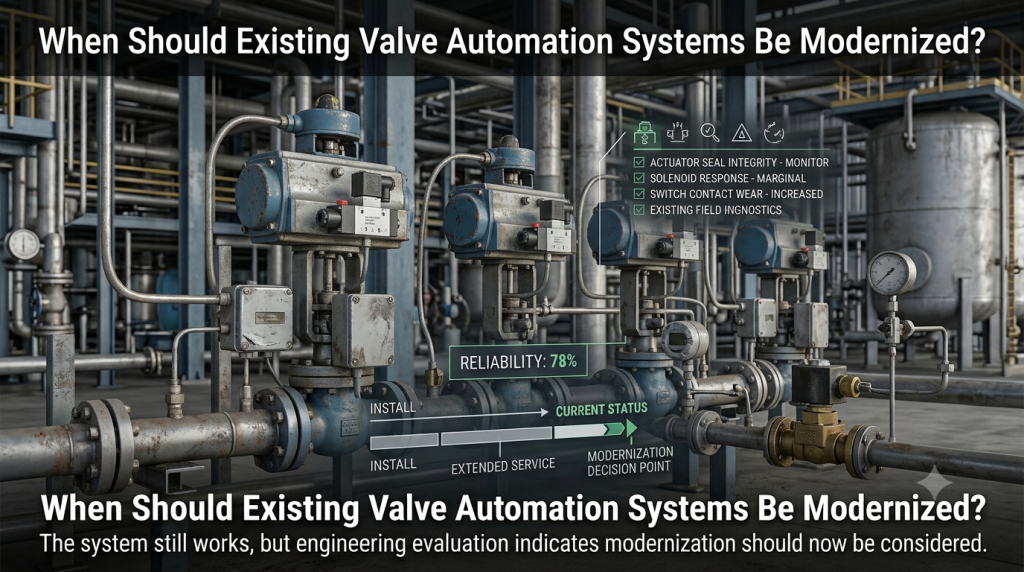
When Should Existing Valve Automation Systems Be Modernized?
Modernization decisions are often driven by visible failures—an actuator stops responding, a solenoid valve begins to leak, or spare parts become difficult to source. While these events justify investigation, they rarely provide enough information to determine whether the automation system has reached the point where modernization offers greater long-term value than continued maintenance.
Many valve automation packages remain mechanically serviceable for decades, yet their overall performance is constrained by aging control components, obsolete instrumentation, undocumented modifications, or increasing maintenance demands. In these situations, replacing individual devices may restore operation temporarily without addressing the engineering limitations that continue to affect reliability, diagnostics, and lifecycle cost.
This article examines how engineering teams can evaluate existing valve automation systems and determine when modernization becomes the more appropriate engineering strategy.
The Engineering Challenge
Valve automation systems rarely reach end-of-life as a complete assembly. Instead, different components age at different rates.
The actuator may remain structurally sound, while the solenoid valve becomes obsolete. Position feedback devices may no longer communicate with modern control systems, pneumatic tubing may have deteriorated, or documentation may no longer reflect the installed configuration. As maintenance activities accumulate over years of operation, temporary modifications often become permanent without a comprehensive engineering review.
The result is an automation package that still operates but demands increasing maintenance effort, offers limited diagnostic capability, and introduces uncertainty during shutdowns or critical process operations.
The engineering challenge is therefore not to determine whether equipment is old, but whether it continues to satisfy current operational, maintenance, and reliability expectations. Age alone is rarely a sufficient criterion for modernization; performance within the current operating context is far more meaningful.
Why Valve Automation Systems Become Engineering Constraints
Mechanical degradation is only one aspect of system aging. Operational and technological changes frequently alter the expectations placed on valve automation long after the original installation.
Production rates may increase, requiring faster or more repeatable valve operation. Safety instrumented functions may be reassessed, introducing new proof testing requirements or diagnostic expectations. Digital asset management platforms may require condition monitoring capabilities that older automation packages cannot provide. At the same time, original manufacturers may discontinue components, extending repair times and increasing dependence on refurbished or non-standard spare parts.
These changes create an engineering mismatch between the original design assumptions and current operational requirements. The automation system may still function, but it no longer supports the level of reliability, maintainability, or system integration expected by the facility.
Modernization therefore becomes an engineering decision based on lifecycle performance rather than equipment age.
Engineering Decision Workflow
Existing Valve Automation System
            │
            ▼
Evaluate Operational Performance
            │
            ▼
Recurring Maintenance or Operational Issues?
        ┌──────────────┴──────────────┐
        │                             │
       No                            Yes
        │                             │
        ▼                             ▼
Continue Periodic          Engineering Assessment
Maintenance                         │
                                    ▼
                    Identify Primary Limitation
          ┌────────────┬────────────┬────────────┐
          │            │            │
 Mechanical      Control &      Functional
Condition       Diagnostics       Safety
          │            │            │
          └────────────┴────────────┴────────────┐
                                                 ▼
                           Can Critical Components
                              Be Reliably Upgraded?
                           ┌────────────┴────────────┐
                           │                         │
                          Yes                       No
                           │                         │
                           ▼                         ▼
                  Targeted Modernization     Complete System
                                              Modernization
Decision Matrix – Continue, Upgrade or Modernize?
| Engineering Consideration | Continue Operating | Targeted Modernization | Complete Modernization |
|---|---|---|---|
| ———————————————————– | —————— | ———————- | ———————- |
| Mechanical integrity remains satisfactory | ✓ | ✓ | — |
| Recurring instrumentation failures | — | ✓ | ✓ |
| Spare parts becoming obsolete | — | ✓ | ✓ |
| Digital diagnostics required | — | ✓ | ✓ |
| Functional safety requirements have changed | — | ✓ | ✓ |
| Extensive undocumented modifications | — | — | ✓ |
| Lifecycle maintenance cost increasing significantly | — | ✓ | ✓ |
| Multiple automation technologies from different generations | — | — | ✓ |
The objective of this evaluation is not to justify replacement, but to determine whether continued maintenance remains the most effective engineering strategy over the remaining asset life.
Engineering Reference
| Standard | Engineering Interpretation |
|---|---|
| ——— | ——————————————————————————————————————————————————— |
| IEC 61511 | Modernization should consider whether existing automation continues to support the required Safety Instrumented Functions throughout the asset lifecycle. |
| IEC 61508 | Diagnostic capability and systematic integrity become increasingly important when upgrading automation associated with safety functions. |
| ISO 55000 | Lifecycle decisions should balance performance, maintenance effort, operational risk, and long-term asset value rather than equipment age alone. |
These standards do not prescribe when modernization must occur; they provide engineering frameworks for evaluating risk, lifecycle performance, and operational objectives.
In Practice
Many modernization projects begin with a request to replace an actuator because it is considered “old.” Engineering assessment often reveals a different picture. The actuator housing and torque mechanism may remain in excellent condition, while the recurring operational issues originate from obsolete solenoid valves, contaminated air preparation units, degraded tubing, or unreliable limit switches.
In these cases, replacing the entire automation package increases project cost without proportionally improving system performance. Conversely, there are installations where repeated repairs have resulted in mixed generations of components, inconsistent documentation, and increasing maintenance complexity. Here, comprehensive modernization simplifies future maintenance and restores a consistent engineering baseline.
The distinction lies in understanding which components limit system performance and which continue to provide reliable service.
NordenFlow Engineering Insight
Effective modernization begins by identifying the components that no longer support reliable operation. Replacing equipment because it is old often adds cost without improving engineering performance.
Key Takeaways
- Modernization decisions should be based on engineering performance rather than equipment age.
- Reliability, maintainability, diagnostics, and lifecycle support are stronger indicators than years in service.
- Individual automation components often reach end-of-life at different times, making selective modernization a practical alternative.
- Obsolete instrumentation can become a greater operational risk than aging mechanical equipment.
- Lifecycle assessment should precede technology selection to ensure modernization addresses the actual engineering constraint.
- A structured engineering review frequently identifies opportunities to improve system performance without replacing mechanically sound assets.
Related Reading
**Solution Pages**
- Valve Automation Engineering
- Valve Automation Retrofit & Modernization
- Reliability Improvement Services
- Functional Safety Engineering
**Product Pages**
- Pneumatic Valve Actuators
- Electric Valve Actuators
- Solenoid Valves
- Valve Positioners
- Air Preparation Units
- Partial Stroke Testing Systems
**Knowledge Articles**
- When Should Valve Actuators Be Repaired Instead of Replaced?
- How Do You Know a Redundant Shutdown System Has Lost Its Redundancy?
- Why Is Proof Testing Required in Safety Instrumented Systems?
- Understanding Diagnostic Coverage in Safety Instrumented Systems
- Planning Valve Automation Retrofits During Plant Shutdowns