

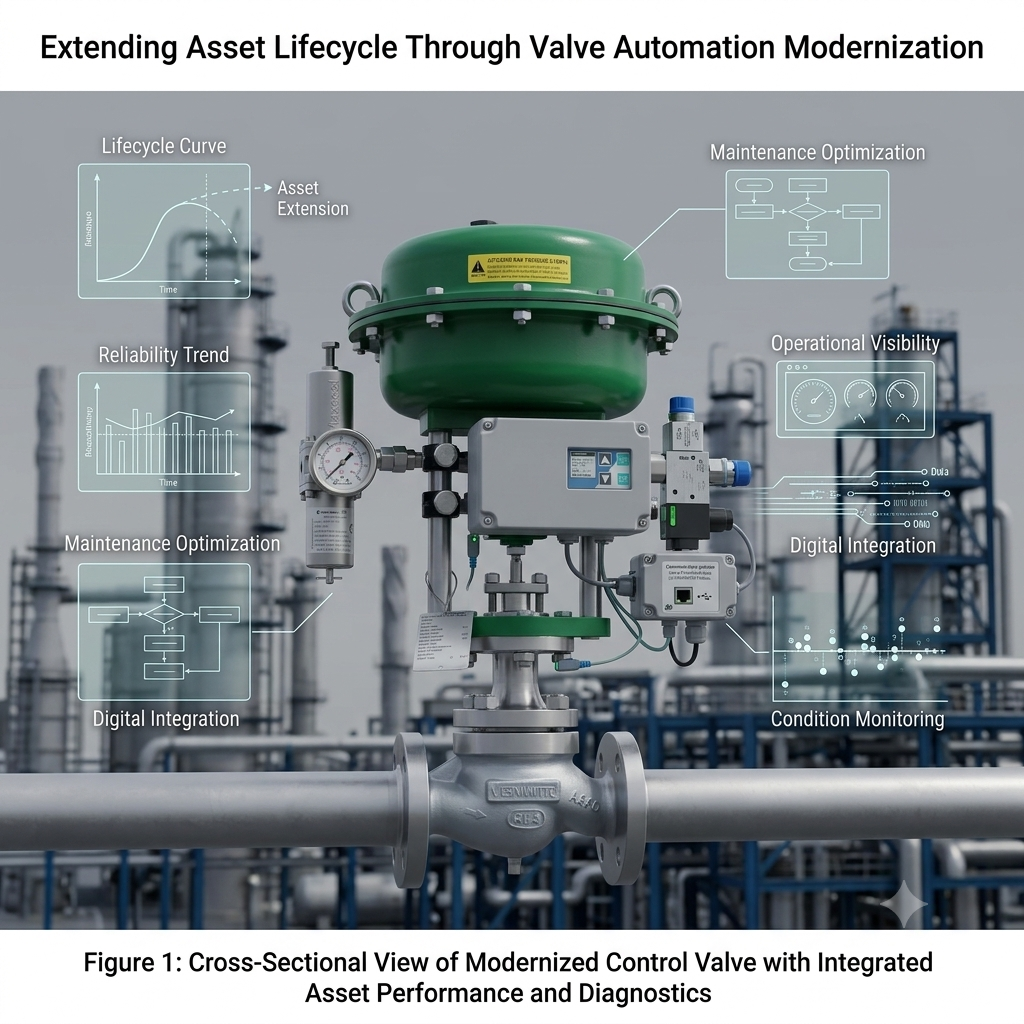
Extending Asset Lifecycle Through Valve Automation Modernization
Industrial assets are expected to remain in operation for decades, yet the automation systems supporting them rarely share the same lifecycle. Valves, actuators, and associated mechanical assemblies often continue to perform reliably long after the instrumentation, control accessories, and communication interfaces have become technologically outdated. This mismatch creates an engineering challenge: should valuable mechanical assets be replaced because the automation surrounding them no longer satisfies current operational requirements?
In many facilities, the answer is no. Modernization allows engineering teams to preserve mechanically healthy assets while upgrading the automation technologies that influence reliability, diagnostics, maintainability, and operational visibility. Rather than restarting the lifecycle through complete replacement, modernization extends the useful service life of existing equipment by addressing the engineering limitations that develop as operational expectations evolve.
This approach is increasingly adopted in brownfield facilities where capital investment must be balanced against production continuity. Instead of replacing complete valve assemblies, engineers evaluate which elements continue to deliver value and which should be upgraded to support future operational objectives.
The Engineering Challenge
Mechanical equipment and automation components rarely age at the same rate. Valve bodies, pneumatic actuators, and mounting assemblies may continue operating for many years with predictable maintenance requirements, while associated solenoid valves, limit switches, position transmitters, air preparation units, and local control devices gradually become obsolete or difficult to maintain.
As these supporting components deteriorate, maintenance effort increases. Spare parts become difficult to obtain, troubleshooting consumes more engineering time, documentation no longer reflects field modifications, and integration with modern control systems becomes increasingly limited. Although production may continue, the automation system gradually shifts from supporting operational reliability to becoming one of its primary constraints.
Replacing mechanically reliable equipment simply because surrounding technologies have aged often results in unnecessary capital expenditure. Conversely, delaying modernization until repeated failures occur increases maintenance costs, operational uncertainty, and shutdown risk. The engineering challenge is therefore to identify the point where automation improvements provide greater lifecycle value than continued maintenance without discarding assets that remain fit for service.
Engineering Perspective
Asset lifecycle extension is fundamentally an engineering strategy rather than a maintenance activity. Its objective is not merely to keep equipment operating, but to ensure that existing assets continue supporting production, safety, maintainability, and operational flexibility throughout changing business and process requirements.
Modern valve automation technologies provide opportunities to improve system performance without replacing the primary mechanical equipment. Enhanced diagnostics, improved pneumatic control, digital communication interfaces, partial stroke testing, intelligent position feedback, and modern air preparation systems all contribute to higher operational confidence while preserving existing mechanical assets.
This philosophy recognises that lifecycle value is created through engineering optimisation rather than equipment replacement. Every retained component represents preserved capital investment, reduced installation effort, shorter shutdown duration, and lower environmental impact. The engineering objective is to maximise these benefits without compromising operational reliability or future maintainability.
Lifecycle extension also supports long-term asset management strategies. By modernising automation incrementally, facilities can align investment with planned shutdowns, production expansions, or digital transformation initiatives instead of committing to large-scale replacement projects that may provide limited additional engineering value.
Engineering Decision Workflow
                  Existing Valve Automation System
                                 │
                                 ▼
                  Evaluate Mechanical Condition
                                 │
                                 ▼
                 Are Primary Mechanical Assets
                     Suitable for Continued Service?
                     ┌─────────────┴─────────────┐
                     │                           │
                    YES                         NO
                     │                           │
                     ▼                           ▼
       Assess Automation Performance     Plan Asset Replacement
                     │
                     ▼
      Are Reliability or Diagnostic Limitations
          Affecting Operational Performance?
                     ┌─────────────┴─────────────┐
                     │                           │
                    YES                         NO
                     │                           │
                     ▼                           ▼
          Identify Modernization Scope   Continue Planned
                     │                   Maintenance Strategy
                     ▼
     Upgrade Control Components, Diagnostics,
      Instrumentation and Communication Systems
                     │
                     ▼
          Extended Asset Lifecycle with
      Improved Reliability and Maintainability
Engineering Decision Matrix
Modernization should not be viewed as an intermediate step before replacement. It is an engineering strategy that extends asset value by addressing the components that limit operational performance while preserving equipment that continues to deliver reliable service. A structured evaluation helps distinguish between situations where modernization provides the greatest return and those where complete replacement offers a more sustainable lifecycle solution.
| Engineering Evaluation Criteria | Modern Automation Upgrade | Complete Asset Replacement |
|---|---|---|
| Valve and actuator remain mechanically reliable | Highly Recommended | Generally unnecessary |
| Instrumentation has become obsolete | Recommended | Only if multiple systems require replacement |
| Increasing maintenance frequency | Recommended after root cause analysis | Consider only if mechanical deterioration exists |
| Need for remote diagnostics and asset monitoring | Highly Recommended | May be incorporated with replacement projects |
| Spare part availability becoming limited | Replace obsolete automation components | Required only when critical mechanical parts are unavailable |
| Functional safety improvements required | Engineering assessment required | Recommended for major system redesigns |
| Brownfield modernization project | Typically the preferred approach | Usually limited to severely degraded assets |
| Long-term lifecycle extension objective | High engineering value | Suitable when existing assets cannot support future operation |
The objective of this matrix is to support engineering judgement rather than prescribe a single solution. Asset criticality, production requirements, shutdown opportunities, and maintenance philosophy should always influence the final lifecycle strategy.
Engineering Reference
Engineering standards provide a framework for evaluating lifecycle performance, reliability, and long-term asset management. They support engineering decisions but should not replace engineering judgement developed through inspection, operational experience, and lifecycle assessment.
| Standard | Engineering Interpretation |
|---|---|
| ISO 55000 | Lifecycle extension should maximise asset value by balancing reliability, operational performance, maintenance effort, and investment over the remaining service life. |
| IEC 61511 | Automation modernization should maintain or improve the integrity and availability of Safety Instrumented Functions throughout the operational lifecycle. |
| IEC 62443 | Digital modernization introduces cybersecurity considerations that should be evaluated alongside reliability and operational performance. |
Engineering Reality
Engineering assessments frequently reveal that the highest-value assets within a valve automation package are also the longest-lasting. Valve bodies, actuators, and mounting systems often remain mechanically suitable for continued service after twenty years or more of operation. In contrast, auxiliary automation devices usually become the primary source of maintenance effort, operational uncertainty, and spare part challenges.
Facilities that modernize these supporting technologies often achieve measurable improvements in reliability without interrupting established mechanical systems. Upgraded diagnostics simplify troubleshooting, modern communication interfaces improve operational visibility, and new pneumatic accessories reduce maintenance variability. The result is not simply newer equipment, but a more predictable and maintainable automation system capable of supporting future operational requirements.
Successful lifecycle extension depends on recognising that engineering value is preserved by retaining healthy assets while modernizing only those components that have become operational constraints. This targeted approach frequently delivers greater long-term value than replacing complete automation packages with equivalent new installations.
NordenFlow Engineering Insight
The most sustainable engineering investment is often the one that preserves proven mechanical assets while modernizing the technologies that determine reliability, maintainability, and operational performance. Effective lifecycle extension begins with engineering evaluation—not equipment replacement.
Key Takeaways
Extending asset lifecycle is not about keeping equipment in service for as long as possible. It is about ensuring that existing assets continue to deliver reliable, maintainable, and safe operation while supporting future production requirements. Modern valve automation technologies provide opportunities to improve performance without unnecessarily replacing mechanically healthy equipment.
- Mechanical assets and automation components follow different lifecycle curves and should be evaluated independently.
- Modernization creates the greatest value when it removes operational limitations while preserving reliable mechanical equipment.
- Improved diagnostics, communication, and control technologies can significantly extend the useful life of existing valve automation systems.
- Lifecycle decisions should consider reliability, maintainability, operational flexibility, spare part availability, and future integration requirements rather than equipment age alone.
- Targeted automation upgrades often reduce shutdown duration, engineering effort, and capital expenditure compared with complete system replacement.
- Engineering assessment should always define the modernization scope before selecting technologies or replacement equipment.
Planning a Valve Automation Modernization Project?
Every facility has unique operational objectives, maintenance strategies, and lifecycle constraints. A successful modernization project begins with understanding the engineering value of existing assets before deciding what should be upgraded, retained, or replaced.
NordenFlow supports engineering teams in evaluating valve automation systems, identifying modernization opportunities, improving reliability, and developing practical lifecycle strategies that align with operational goals, shutdown planning, and long-term asset performance.
Whether your project involves a single shutdown valve, a brownfield modernization program, or a plant-wide reliability initiative, engineering assessment provides the foundation for making confident lifecycle decisions.