

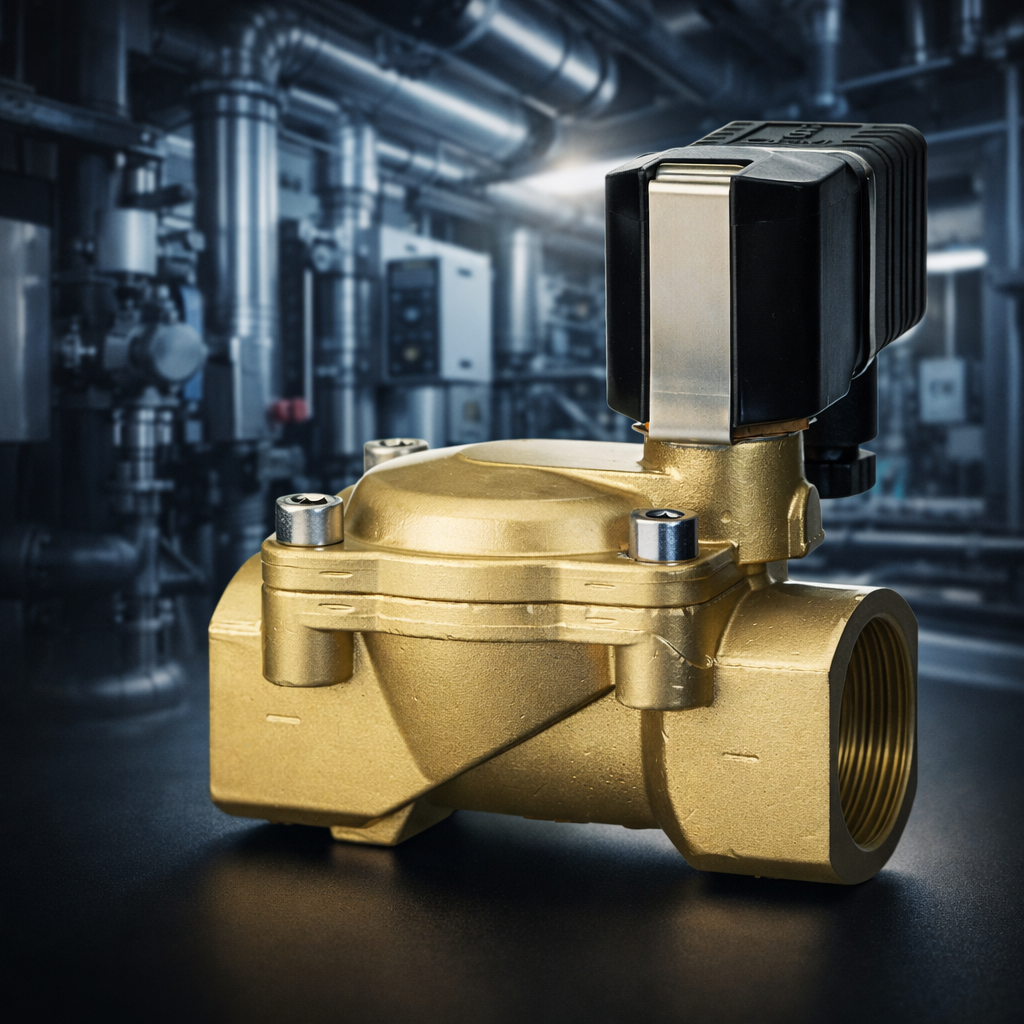
Indirect Solenoid Actuated Diaphragm Valves: How They Work and How to Select Them
An indirect solenoid actuated diaphragm valve, also known as a pilot-operated diaphragm solenoid valve, uses a solenoid pilot to control the pressure acting on a flexible diaphragm. Instead of using the electromagnetic coil to directly move the main valve element, the solenoid controls a smaller pilot passage and uses the process pressure differential to operate the main flow path.
This architecture allows relatively compact solenoid operators to control larger flow paths than may be practical with a direct-acting solenoid valve. However, indirect operation introduces an important engineering requirement: the valve must have the required differential pressure across the main valve to operate correctly.
This article explains how indirect solenoid actuated diaphragm valves work, how they differ from direct-acting solenoid valves, what their main advantages and limitations are, and which technical parameters should be checked before selecting a valve for an industrial application.
What Is an Indirect Solenoid Actuated Diaphragm Valve?
An indirect solenoid actuated diaphragm valve is a two-way on/off fluid control valve in which a solenoid pilot controls the pressure above a flexible diaphragm.
The solenoid does not normally provide the full mechanical force required to open the main flow passage. Instead, it operates a small pilot orifice. The resulting pressure difference across the diaphragm creates the force required to move the main sealing element.
This operating principle is commonly described as pilot-operated or indirect-acting.
The architecture is particularly useful where the application requires relatively high flow capacity while keeping the electromagnetic pilot compact.
How Does an Indirect Diaphragm Solenoid Valve Work?
The operating principle can be understood as a sequence of pressure changes inside the valve.
Valve in the Normally Closed Condition
When a normally closed valve is de-energized, the main diaphragm remains seated and blocks the flow path. Process fluid enters the valve chamber through a small internal bleed orifice.
Because the pressure acting on the upper surface of the diaphragm is sufficient to maintain the sealing force, the main valve remains closed.
Solenoid Energized
When the electrical control signal energizes the solenoid coil, the pilot plunger moves and opens the pilot passage.
The pressure in the chamber above the diaphragm is released through the pilot path.
Pressure Differential Develops
As the upper chamber pressure decreases, the pressure acting on the lower side of the diaphragm becomes dominant.
The resulting pressure differential creates the force required to lift the diaphragm from the main valve seat.
Main Flow Path Opens
The diaphragm moves away from the seat and the main flow path opens.
When the solenoid is de-energized, the pilot path closes, the upper chamber pressure is restored through the internal passage, and the diaphragm returns to the closed position.
CONTROL SIGNAL
      |
      v
SOLENOID PILOT
      |
      v
PILOT ORIFICE
      |
      v
PRESSURE CHANGE
ABOVE DIAPHRAGM
      |
      v
PRESSURE DIFFERENTIAL
      |
      v
DIAPHRAGM MOVEMENT
      |
      v
MAIN FLOW PATH
Why Is Differential Pressure Important?
The most important engineering limitation of a conventional pilot-operated diaphragm valve is the requirement for a sufficient pressure differential.
Unlike many direct-acting designs, an indirect diaphragm valve cannot simply rely on the electromagnetic coil to generate the complete force required to open the main orifice.
The selected valve therefore needs to be checked against the manufacturer’s specified minimum differential pressure.
For example, the IMI Buschjost 82400/82410 range specifies a minimum differential pressure of 0.1 bar for the documented standard configuration. The exact operating pressure range and flow performance still depend on the selected model, orifice, port size and configuration.
Therefore, minimum differential pressure should never be replaced by a generic rule such as “0.3 bar is always required.” The correct value must come from the technical data for the selected valve configuration.
Direct-Acting vs. Indirect Solenoid Valves
Choosing between direct-acting and indirect solenoid technology is fundamentally a question of operating principle, pressure conditions, flow requirement and application constraints.
| Parameter | Direct-Acting Solenoid Valve | Indirect / Pilot-Operated Diaphragm Valve |
|---|---|---|
| Main actuation principle | The solenoid directly moves the main sealing element. | The solenoid controls a pilot circuit and process pressure moves the diaphragm. |
| Differential pressure | Some designs can operate at zero differential pressure. | A specified minimum differential pressure is normally required. |
| Flow capacity | Often limited by the force available from the solenoid. | Can provide relatively high flow capacity with a compact pilot operator. |
| Solenoid function | Directly generates the force for main valve movement. | Controls the pilot passage. |
| Energy requirement | Depends on valve size and design. | Can provide efficient operation for larger flow paths because the coil controls the pilot. |
| Contamination sensitivity | Depends on the valve design. | Pilot passages and bleed orifices require attention to fluid cleanliness. |
| Typical selection priority | Low flow, low pressure differential or applications requiring direct actuation. | Higher flow capacity where sufficient differential pressure is available. |
Neither technology is universally better. The correct selection depends on the actual process conditions.
Key Engineering Advantages of Indirect Diaphragm Valves
High Flow Capacity
Pilot-operated diaphragm designs can provide relatively large flow passages while using a compact solenoid pilot. This makes the architecture attractive for industrial fluid control applications where flow capacity is important.
Compact Solenoid Operator
The electromagnetic operator only controls the pilot mechanism rather than providing the entire force required to move the main diaphragm.
Suitable for Automated On/Off Control
Indirect solenoid diaphragm valves are well suited to electrically commanded on/off fluid control where the process conditions match the valve’s operating envelope.
Damped Diaphragm Operation
The diaphragm-based operating principle can provide controlled movement characteristics that are useful in fluid control applications where abrupt valve movement should be avoided.
Wide Range of Industrial Configurations
Depending on the product family, indirect diaphragm valves can be supplied with different port sizes, electrical coil configurations, normally closed or normally open functions, sealing materials and pressure ranges.
When Should You Use an Indirect Solenoid Actuated Diaphragm Valve?
An indirect diaphragm solenoid valve should be considered when the application requires automated on/off control with relatively high flow capacity and the process provides the differential pressure required by the selected valve.
Typical selection conditions include:
- Industrial fluid control
- Water and utility systems
- Neutral gases
- Heating and cooling circuits
- Industrial automation systems
- Process utility lines
- Large distributed valve networks
- Applications where compact solenoid operators are preferred
The suitability of the valve must still be confirmed against the actual medium, pressure, temperature, flow rate, contamination level and required valve function.
| Industry / Application | Typical Service | Key Selection Considerations |
|---|---|---|
| Water Treatment | Water and utility fluids | Pressure, flow, temperature, seal compatibility |
| Industrial Process | Process utilities and neutral fluids | Kv/Cv, pressure differential, medium compatibility |
| Energy & Power | Cooling and auxiliary utilities | Reliability, pressure, temperature, system function |
| Industrial Gas | Compatible neutral gases | Pressure, leakage, seals, temperature |
| Mining & Dust Collection | Utility and pneumatic services | Contamination, filtration, pilot passages |
| Fire Protection | Selected auxiliary control functions | Approvals, certification, system requirements |
| Food & Beverage | Water, gases and compatible fluids | Hygiene, materials, certifications |
| HVAC & Building Utilities | Heating and cooling fluids | Pressure, temperature, flow, valve function |
| Industrial Machinery | Water, air and gases | Cycle frequency, response, space, maintenance |
Industrial Applications of Indirect Solenoid Actuated Diaphragm Valves
Indirect solenoid actuated diaphragm valves are widely used for automated on/off control of gases and liquids where the application provides the required differential pressure and the selected valve materials are compatible with the process medium.
Their combination of relatively high flow capacity, compact solenoid operation and 2/2-way on/off control makes them suitable for a broad range of industrial and commercial fluid-control systems.
Water Treatment and Water Systems
Indirect diaphragm solenoid valves can be used for automated control of water and utility-water circuits, including water treatment equipment, distribution systems, cooling circuits and other utility services.
For water applications, engineers should verify pressure, temperature, flow coefficient, seal material and the manufacturer’s requirements for filtration or straining.
Industrial Process and Utility Systems
In industrial plants, these valves can be used for on/off control of process utilities and neutral fluids. Typical services may include water, compressed gases and other compatible utility media.
The valve should be selected according to the actual process conditions rather than the nominal pipe size alone.
Energy and Power Generation
Solenoid-operated process valves are used in power and energy facilities for automated control of utility fluids, cooling systems and auxiliary process services.
Where a valve forms part of a safety-related or critical control function, the complete application requirements must be evaluated separately from the basic solenoid valve specification.
Industrial Gas Systems
Indirect solenoid diaphragm valves can be applied to compatible neutral gases for automated isolation and flow control.
Gas applications require particular attention to pressure differential, leakage requirements, seal compatibility, temperature and the applicable installation requirements.
Mining and Dust Collection Systems
Process valve technologies are also used in mining and dust collection systems for automated control of fluids and pneumatic or utility services.
Where the medium contains significant contamination or particulates, filtration and pilot-passage protection become important considerations for pilot-operated valve architectures.
Fire Protection and Auxiliary Systems
Solenoid-operated valves may be used in selected auxiliary and control functions within fire protection systems.
However, a standard industrial solenoid valve should not automatically be considered suitable for a fire-protection safety function. The required approvals, system standards, reliability requirements and application-specific certification must be verified for the intended duty.
Food and Beverage Equipment
Solenoid valves are also used in food and beverage equipment for automated control of water, gases and other compatible fluids.
For hygienic or food-contact applications, the valve must be selected from a configuration specifically suitable for the required hygiene, material and certification requirements. A standard industrial NBR diaphragm configuration should not be assumed to be suitable for food-contact service.
Heating, Cooling and HVAC Utility Systems
Indirect diaphragm solenoid valves can be used in selected heating, cooling and HVAC utility applications where the medium, pressure, temperature and flow requirements are within the valve’s specified operating range.
Typical duties can include automated control of water and other compatible utility fluids.
Industrial Machinery and Equipment
Machine builders can use compact solenoid-operated diaphragm valves to control water, air, gases and other compatible fluids within automated equipment.
In these applications, valve selection should consider not only the process medium but also cycle frequency, response requirements, electrical supply, available space and maintenance accessibility.
When Should You NOT Use a Standard Indirect Diaphragm Valve?
A pilot-operated diaphragm valve is not automatically the correct solution simply because the required line size is relatively large.
Alternative valve architectures should be considered when:
- The available differential pressure can fall below the manufacturer’s minimum requirement.
- The process requires operation at or near zero differential pressure.
- The fluid is highly viscous and may not operate reliably through the pilot circuit.
- The medium contains contaminants that may obstruct small pilot passages.
- The fluid temperature exceeds the specified valve or elastomer limits.
- The required pressure exceeds the selected valve’s operating range.
- The required flow coefficient cannot be achieved with the available configuration.
- The required fail position or response characteristic is not compatible with the valve design.
In these situations, a direct-acting solenoid valve, force-assisted design, piston-operated valve or another process valve architecture may be more appropriate.
How to Select an Indirect Solenoid Actuated Diaphragm Valve
Valve selection should start with the process conditions rather than the connection size or coil voltage.
1. Identify the Process Medium
Determine whether the valve will control a gas, liquid, water-based fluid, steam or another medium.
Check chemical compatibility between the medium and all wetted materials, including the diaphragm and seat seal.
2. Determine the Required Flow
The required flow rate should be converted into an appropriate flow coefficient such as Kv or Cv, according to the selected engineering method.
Do not select a valve based solely on nominal pipe size. A valve with the same nominal connection size can have significantly different flow performance depending on the orifice and internal design.
3. Check Minimum Differential Pressure
Determine the lowest pressure differential expected during normal and abnormal operating conditions.
Compare this value with the manufacturer’s minimum differential pressure requirement.
4. Check Maximum Operating Pressure
The maximum upstream pressure and the pressure differential must remain within the specified operating envelope of the selected model.
5. Check Fluid Temperature
Verify both the fluid temperature and ambient temperature against the valve’s specified limits.
6. Select the Diaphragm and Seal Material
The elastomer must be compatible with the process medium and temperature.
Common materials may include NBR, EPDM or other elastomers depending on the product configuration. Material selection must be based on the actual medium and operating conditions.
7. Select Normally Closed or Normally Open Function
Determine whether the valve should be:
- Normally Closed (NC)
- Normally Open (NO)
The required normal position should be determined from the process control philosophy and the consequences of loss of electrical power.
8. Verify the Electrical Configuration
Confirm the required coil voltage, AC/DC configuration, power consumption, electrical connection and environmental protection.
9. Consider Fluid Cleanliness
Pilot-operated valves contain small internal passages. Contaminated fluids can therefore affect reliable operation.
Where contamination is expected, the manufacturer’s recommendations regarding filtration or strainers should be followed.
IMI Buschjost 82400 / 82410 Indirect Diaphragm Valve Range
The IMI Buschjost 82400/82410 range is a representative industrial family of indirect solenoid actuated diaphragm valves.
The manufacturer’s documentation identifies the range as 2/2-way diaphragm valves with port sizes from approximately DN 8 to DN 50 and connection options including G and NPT sizes. The standard range is specified for neutral gases and liquids, with brass body construction and NBR seat sealing in the documented configuration.
The range is designed for indirect solenoid operation and is available in different configurations depending on the selected model.
| Parameter | Typical 82400/82410 Range Information |
|---|---|
| Valve type | 2/2-way diaphragm valve |
| Actuation | Indirect solenoid actuated |
| Medium | Neutral gases and liquids |
| Port sizes | G1/4 to G2; selected NPT configurations |
| Fluid temperature | -10 to +90 °C in the documented standard range |
| Ambient temperature | -10 to +50 °C in the documented standard range |
| Body material | Brass (CW617N) in the standard documented configuration |
| Seat seal | NBR in the standard documented configuration |
| Minimum differential pressure | 0.1 bar in the documented standard range |
| Mounting | Optional; manufacturer preferably recommends solenoid vertical on top |
| Contaminated fluids | Strainer recommended where contamination is present |
The exact pressure rating, Kv value, electrical configuration, function and materials must always be verified against the selected part number rather than assumed from the series designation.
Example: Selecting a Buschjost 82400 Configuration
Consider an industrial water application requiring automated two-way isolation. The selection process should not begin with the statement “the pipeline is DN25, therefore select a DN25 valve.”
The engineering sequence should instead be:
- Confirm the fluid and temperature.
- Determine the required flow rate.
- Calculate or establish the required Kv.
- Determine the minimum and maximum operating pressure.
- Verify the available differential pressure.
- Select the required port connection.
- Select NC or NO function.
- Select the appropriate diaphragm and seal material.
- Confirm the electrical coil configuration.
- Check environmental and installation requirements.
This process prevents a common specification error: selecting a valve from nominal pipe size alone while ignoring differential pressure and flow requirements.
Common Failure Modes of Indirect Diaphragm Solenoid Valves
Insufficient Differential Pressure
If the available pressure differential is below the specified minimum, the valve may fail to open correctly or may not operate reliably.
Blocked Pilot Passage
Contamination, particulates or deposits can interfere with the small pilot passages required for indirect operation.
Diaphragm Degradation
Incorrect elastomer selection, excessive temperature or chemical incompatibility can degrade the diaphragm and affect sealing performance.
Incorrect Flow Sizing
An incorrectly sized valve can produce excessive pressure loss or insufficient flow capacity.
Incorrect Electrical Configuration
The coil voltage, frequency, power consumption and connection must match the control system and selected solenoid configuration.
Incorrect Normal Position
Selecting NC instead of NO, or vice versa, can create an undesirable process condition during loss of electrical power.
Engineering Checklist Before Ordering
| Parameter | Question to Confirm |
|---|---|
| Medium | What fluid or gas will the valve control? |
| Flow rate | What is the required minimum, normal and maximum flow? |
| Kv / Cv | What flow coefficient is required? |
| Pressure | What are the minimum and maximum upstream pressures? |
| Differential pressure | Will the valve always have sufficient differential pressure? |
| Temperature | What are the minimum and maximum fluid and ambient temperatures? |
| Connection | What port size and connection standard are required? |
| Function | Is normally closed or normally open operation required? |
| Materials | Are the body, diaphragm and seal materials compatible with the medium? |
| Electrical supply | What coil voltage, AC/DC configuration and power are available? |
| Contamination | Is filtration or a strainer required? |
| Environment | Are ambient temperature and ingress protection requirements satisfied? |
| Installation | Is the proposed mounting orientation acceptable? |
Indirect Diaphragm Valve vs. Other Solenoid Valve Architectures
The term “solenoid valve” describes the actuation method, not a single valve architecture. Different internal designs can be appropriate for different process conditions.
| Valve Architecture | Primary Advantage | Important Limitation |
|---|---|---|
| Direct-acting solenoid valve | Can operate independently of process differential pressure in suitable designs. | Main solenoid force can limit flow capacity as valve size increases. |
| Indirect diaphragm solenoid valve | High flow capacity with compact pilot operation. | Requires specified differential pressure. |
| Piston-operated valve | Suitable for applications requiring different pressure and flow characteristics. | Selection depends strongly on medium and pressure conditions. |
| Special-purpose process valve | Can be engineered for demanding media or operating conditions. | Usually requires more detailed application-specific selection. |
Where These Valves Fit in an Industrial Automation System
An indirect solenoid actuated diaphragm valve is normally only one component of a larger control system.
A typical industrial architecture may include:
DCS / PLC / Control System
          |
          v
Electrical Command
          |
          v
Solenoid Coil
          |
          v
Pilot Mechanism
          |
          v
Diaphragm Valve
          |
          v
Process Flow
For higher-consequence applications, the solenoid valve may also form part of a larger instrumentation or shutdown architecture involving redundant control paths, monitored feedback, safety logic or specialized valve manifolds.
The solenoid valve should therefore be selected according to the function it performs within the complete system rather than as an isolated component.
When Technical Selection Matters More Than Brand Selection
A recognizable manufacturer does not eliminate the need for engineering selection. Even within a single product family, different part numbers can have different port sizes, coil configurations, valve functions, flow coefficients and operating limits.
The correct engineering question is therefore not:
“Which solenoid valve brand should we buy?”
It is:
“Which valve architecture and configuration reliably satisfies the process conditions and required control function?”
Once the technical requirements are established, manufacturer and model selection becomes much more straightforward.
Frequently Asked Questions
What is an indirect solenoid actuated diaphragm valve?
It is a solenoid-operated diaphragm valve in which the electrical solenoid controls a pilot passage while the process pressure differential provides the force required to move the main diaphragm.
How does a pilot-operated diaphragm valve work?
The solenoid opens or closes a small pilot passage. This changes the pressure in the chamber above the diaphragm. The resulting pressure differential moves the diaphragm and changes the main flow path.
What is the difference between direct and indirect solenoid valves?
A direct-acting valve uses the electromagnetic solenoid force to move the main sealing element. An indirect valve uses the solenoid to control a pilot circuit and uses process pressure to move the main diaphragm.
Does an indirect solenoid valve require differential pressure?
Yes, conventional pilot-operated diaphragm valves normally require a specified minimum differential pressure. The exact requirement depends on the selected valve design.
What happens if the differential pressure is too low?
The diaphragm may fail to move correctly because the pressure force required for operation is insufficient. The valve may remain closed or fail to operate reliably.
Can an indirect diaphragm valve handle contaminated fluids?
Some designs can be used with contaminated fluids, but contamination can interfere with small pilot passages. Manufacturer recommendations regarding filtration or strainers should therefore be followed.
How do I select an indirect solenoid valve?
Start with the process medium, flow rate, pressure range, minimum differential pressure, temperature, required Kv/Cv, valve function, materials, electrical supply and environmental conditions. Do not select the valve from line size alone.
When should I choose a direct-acting solenoid valve?
A direct-acting design should be considered when the application requires operation without sufficient differential pressure, when the flow requirement is relatively small, or when the operating principle of a pilot-operated diaphragm valve is not compatible with the process conditions.
Key Takeaways
- Indirect solenoid actuated diaphragm valves use pilot operation rather than direct electromagnetic movement of the main diaphragm.
- Differential pressure is a fundamental selection parameter.
- Do not use a generic minimum pressure value. Always verify the manufacturer’s data for the selected model.
- Flow capacity should be evaluated using Kv/Cv and actual operating conditions, not nominal pipe size alone.
- Medium compatibility, temperature and contamination must be checked before selecting the diaphragm and seal materials.
- Direct-acting and indirect-acting valves are not interchangeable technologies. Their suitability depends on process conditions.
- IMI Buschjost 82400/82410 is an example of an industrial indirect solenoid actuated diaphragm valve range.
- The selected valve should be evaluated as part of the complete instrumentation and control architecture, not as an isolated component.
NordenFlow Engineering Support
Selecting a solenoid valve for an industrial application is not simply a matter of matching the pipe connection and electrical voltage.
NordenFlow approaches valve selection from the process and automation requirements first: medium, pressure, differential pressure, flow, temperature, materials, control function, environmental conditions and required operating behavior.
For industrial applications involving indirect solenoid actuated diaphragm valves, IMI Buschjost technologies and related process fluid control solutions, NordenFlow can support the technical selection, configuration review and application assessment.