

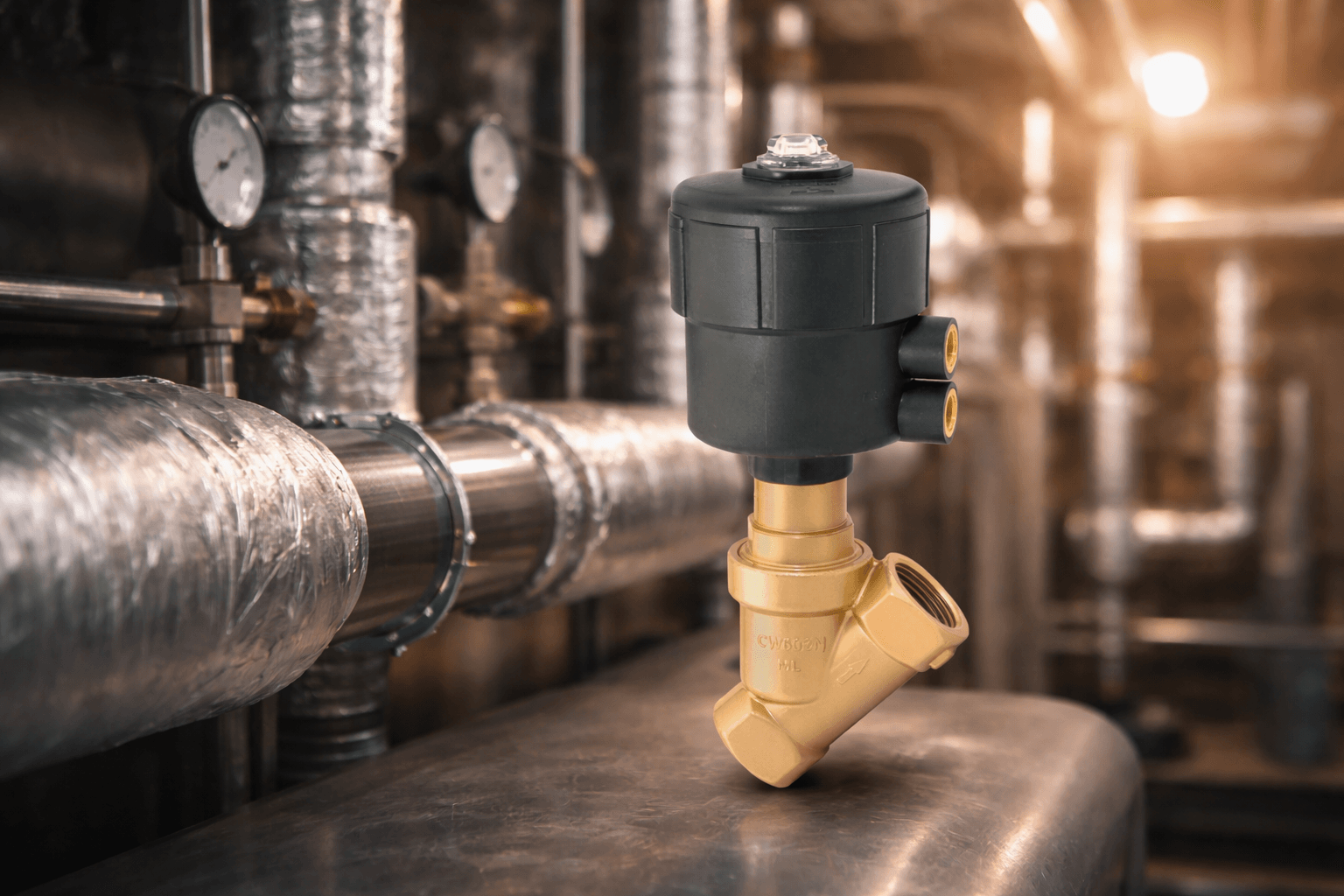
Angle Seat Valves in Industrial Applications: High-Flow Fluid Control
In industrial fluid systems, valve selection directly impacts flow efficiency, pressure stability, and lifecycle cost. Among various valve types, angle seat valves are widely used where high flow rates, high temperatures, and frequent switching are required.
The Realities of High-Flow Fluid Networks
Fluid control solutions from IMI Norgren are specifically engineered to handle demanding applications involving steam, compressed air, industrial gases, and aggressive fluids.
A misapplied valve compromises your entire system reliability. This makes careful selection essential for long-term plant uptime.
What Is an Angle Seat Valve?
An angle seat valve is a pneumatically actuated valve designed with an angled flow path that minimizes restriction and turbulence. Instead of forcing the flow through an S-shaped path like standard globe designs, it positions the seat at an angle.
Key functional characteristics:
- Dedicated on/off operation (not for continuous modulation).
- High flow coefficient ($K_v$) relative to its compact size.
- Low pressure drop ($\Delta P$) across the internal valve chamber.
- Fast actuation with exceptionally high cycle capability.
This design makes angle seat valves particularly suitable for process environments where flow performance and durability are critical.
Why Angle Seat Valves Dominate Industrial Applications
Compared to conventional solenoid or globe valves, angle seat valves offer significantly higher flow rates and reduced energy losses due to lower pressure drop. This becomes critical in high-demand process loops, steam distribution systems, and bulk fluid transfer lines.
Furthermore, their robust construction—typically high-grade stainless steel—ensures maximum resistance to severe thermal stress and an extended operational life under continuous duty cycles.
In automated systems where valves switch thousands of times per day, angle seat technology provides high-frequency durability. The linear plunger configuration reduces wear on sealing components, ensuring reliable long-term performance in CIP/SIP cleaning skids and automated production processes.
Angle Seat Valve vs. Other Valve Types
The comparative reference below details the specific engineering selection criteria between common valve configurations.
| Valve Type | Flow Capacity | Primary Function | Best Use Case Focus |
|---|---|---|---|
| Solenoid Valve | Low to Medium | On/Off | Compact layouts, fast pilot switching. |
| Ball Valve | Medium to High | On/Off | General line isolation. |
| Angle Seat Valve | Exceptionally High ($K_v$) | On/Off | High flow loops combined with high cycling. |
| Control Valve | Medium to High | Modulating | Precise, continuous flow and pressure control. |
Typical Industrial Applications and Cross-Industry Deployment
These valves support a wide range of media, including compressed air, inert gases, liquids, mild chemicals, steam, and hot condensate. This versatility makes them a standard solution across multiple heavy sectors:
- Energy & Steam Systems: Steam distribution networks, boiler rooms, and condensate recycling systems.
- Pulp & Paper Industry: Direct process steam control lines and aggressive chemical handling loops.
- Marine Applications: Heavy engine room auxiliary systems, fuel handling modules, and thermal systems.
- Food & Beverage: High-frequency Cleaning-in-Place (CIP) loops and hygienic automated processes.
Industrial applications require more than basic functionality. Products from IMI Norgren are designed to meet these heavy demands by incorporating high-performance pneumatic actuators, durable stainless steel bodies, and self-adjusting seals that prevent fluid leakage under harsh conditions.
A Structured Engineering Framework for Selection
Instead of selecting a valve based on basic catalog data alone, design teams must focus on actual operating conditions. To secure long-term performance, evaluate your parameters using this systematic engineering checklist:
- Pressure Differential: Map out the lowest and highest operating pressure limits ($\Delta P$) across the system.
- Media Composition: Verify compatibility with steam, raw water, viscous fluids, or aggressive chemicals.
- Thermal Boundaries: Evaluate extreme media temperature spikes, which is highly critical in saturated steam loops.
- Flow Requirements: Calculate the exact flow coefficient ($K_v$) needed to prevent line sizing restrictions.
- Loop Duty Cycle: Match your operational frequency with intermittent or continuous performance profiles.
- Fail-Safe Requirements: Specify precise Normally Closed (NC) or Normally Open (NO) mechanical internals.
Frequently Asked Questions
What is an angle seat valve, and when should I use it?
An angle seat valve is a pneumatically actuated linear valve designed with an angled seat configuration. You should specify it in high-flow, high-cycle applications where standard solenoid valves would stall or burn out due to extreme pressures and continuous switching.
Can angle seat valves be used for precise modulation control?
No. Angle seat valves are explicitly optimized for fast on/off isolation. When your system requirements prioritize flow efficiency and high-frequency durability over precise throttling, angle seat technology is the preferred choice over modulating control valves.
Why does the IMI Norgren angle seat valve handle steam systems more effectively?
IMI Norgren designs utilize premium stainless steel cast bodies paired with robust PTFE seats and spring-loaded chevron packings. This combination handles continuous thermal expansion, scale build-up, and chemical cleaning loops without losing zero-leakage sealing performance.
Application-Focused Fluid Control Partnership
NordenFlow Oy provides application-focused fluid control solutions throughout Finland, supporting industries such as energy, marine, and process manufacturing. With full technical access to premium product lines from IMI Norgren, NordenFlow delivers engineering-driven valve selection and process loop optimization. Moving past basic catalog guesswork and evaluating real-world system dynamics is the fastest way to eliminate unexpected plant downtime and ensure long-term mechanical reliability.