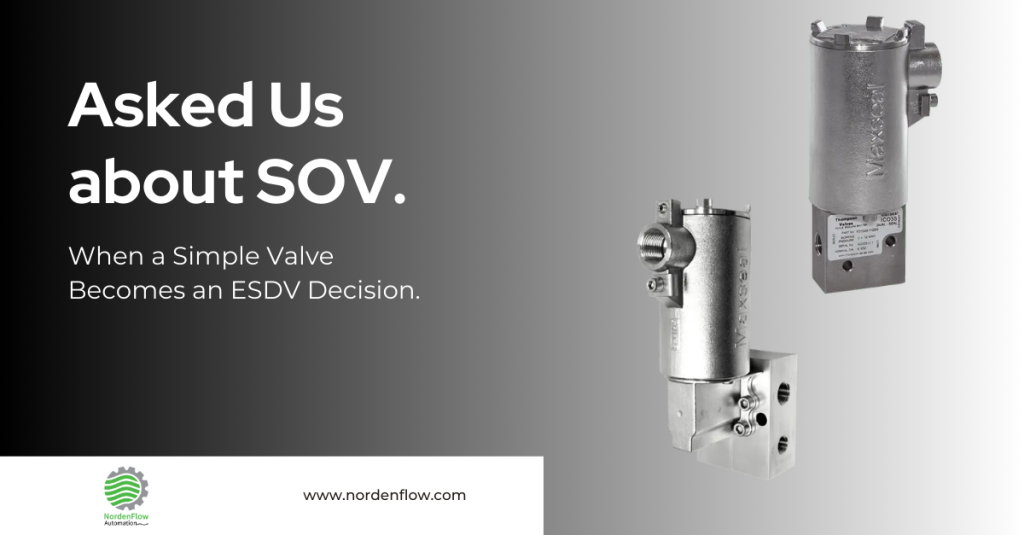

Why Solenoid Valves Fail in ESD Systems: The Hidden Trigger Points
When an Emergency Shutdown (ESD) system fails a safety audit, field technicians usually suspect the large pneumatic actuators or the primary isolation valves. However, field data reveals a much simpler, frequently overlooked root cause: the physically smallest component in the automation stack—the pilot solenoid valve—fails to perform when called upon.
The Stagnation Hazard in Safety Elements
This vulnerability represents a unique engineering challenge because safety valves are inherently dormant. Unlike process control valves that modulate constantly, ESD assemblies remain completely static for months or even years at a time.
Consequently, the pilot solenoids must vent large actuator chambers instantly after enduring extensive periods of total inactivity under harsh environmental conditions.
The Single Point of Failure Nobody Expects
Solenoid valves act as the direct electro-pneumatic gateway between the safety logic solver and the mechanical actuator cylinder. When an emergency shutdown command strips power from the inductive coil, the internal valve mechanism must shift immediately to dump the compressed instrument air holding the actuator open.
If the internal spool or armature fails to shift, the pneumatic pressure stays trapped inside the actuator cylinder. As a result, the main shutdown valve remains frozen in its last running position, completely compromising the plant’s functional safety layer. This dependency makes solenoid mechanical reliability just as critical as the performance of the massive valve body itself.
When Do These Hidden Failures Reveal Themselves?
Because pilot solenoids spend their lifetimes energized in the safe running position, internal defects rarely show up during normal, day-to-day operations. Instead, these latent failures stay masked until specific operational triggers occur:
- During a live, high-stress emergency plant shutdown demand.
- During scheduled online diagnostic testing, such as a Partial Stroke Test (PST).
- Immediately following prolonged turnarounds or extensive idle periods without cycling.
- Within pneumatic loops exposed to chronic moisture carryover, compressor oil mist, or ambient particulates.
Because these flaws remain completely hidden during normal production, implementing structured diagnostic visibility across the pilot instrumentation layer is critical.
Core Engineering Failure Mechanisms Explored
Understanding why these devices fail allows engineering teams to design more resilient Safety Instrumented Functions (SIFs). The table below details the real root causes behind safety loop degradation.
| Mechanical Failure Mode | Physical Plant Root Cause | Direct Safety Impact |
|---|---|---|
| Internal Spool Sticking | Long idle states degrade elastomer seals under high coil temperatures, causing the rubber compounds to bond to the valve casing. | The spool completely seizes up, freezing the valve in its open position. |
| Pneumatic Contamination | Trace moisture, synthetic compressor oil carryover, or pipe scale migrates into internal pilot ports. | Creates a sticky residue that plugs narrow ports and jacks up internal friction. |
| Exhaust Vent Blockages | Ambient environmental salt crystals, dirt, ice, or insects accumulate inside the open exhaust pathways. | Mechanically blocks the air exit path, heavily slowing or preventing shutdown. |
| Electrical Coil Burnout | Continuous electrical energization generates high heat, breaking down lower wire insulation classes over time. | Total loss of magnetic inductive force, preventing electrical actuation. |
| Pilot Pressure Starvation | Upstream instrument air distribution networks experience localized drops below required pilot thresholds. | The pilot loop cannot generate enough pneumatic force to slide its own spool. |
Why This Matters for Functional Safety Data
From a functional safety perspective, any hidden mechanical issue in the pilot system directly elevates the assembly’s dangerous undetected failure rate ($\lambda_{\text{DU}}$). This surge directly inflates the Average Probability of Failure on Demand ($\text{PFD}_{\text{avg}}$) calculation for the entire loop. Consequently, a single sticky solenoid spool can instantly invalidate a plant’s hard-won SIL 2 or SIL 3 safety compliance profile.
Practical Engineering Strategies to Prevent Solenoid Failures
Eliminating these critical failure modes requires robust specification practices and preventative testing loops:
- Upgrade Your Air Infrastructure: Deploy dedicated dual-stage filtration and high-capacity desiccant dryers at the valve skid to isolate the solenoid from oil and water carryover.
- Enforce Periodic Cycling: Integrate automated weekly or monthly Partial Stroke Testing (PST). This small movement shears away early internal deposits and breaks up seal binding before it locks the spool completely.
- Shield the Exhaust Pathways: Fit heavy-duty, stainless steel breather vents or bug screens onto all open solenoid exhaust ports to prevent external environmental blockages.
- Utilize Low-Power Coils: Specify premium, low-wattage certified solenoids to significantly reduce continuous thermal dissipation, preventing coil burnouts.
Frequently Asked Questions
What is the primary difference between a direct-acting and a pilot-operated solenoid valve?
Direct-acting solenoids use purely electromagnetic coil force to physically shift the sealing seat, making them highly reliable in low-pressure lines. Conversely, pilot-operated solenoids utilize the pressure of the fluid medium itself to move the internal spool, requiring a minimum line pressure to stroke successfully.
Why does a Partial Stroke Test catch solenoid faults early?
When a smart system runs a PST, it briefly interrupts the electrical current to the solenoid coil. If the valve exhibits delayed pressure venting due to internal stiction, the system’s digital pressure sensors detect the lag immediately, flagging a maintenance warning.
Can a 2oo3 solenoid manifold eliminate spurious plant trips?
Yes. A two-out-of-three voting manifold architecture requires at least two independent solenoids to vent before the main actuator can exhaust. This configuration ensures that if one single solenoid suffers a random coil failure, the plant keeps running without an expensive nuisance shutdown.
Key Takeaway for Plant Reliability Teams
In high-integrity automated safety loops, a pilot solenoid valve is not a secondary accessory; it is the vital component that determines whether an emergency shutdown can occur. Replacing expensive actuators and valves to solve sluggish response times is a common, costly troubleshooting error. By focusing on premium solenoid design selection, clean instrument air management, and automated online proof testing, facilities can easily eliminate hidden loop failures and ensure instant emergency responsiveness.