

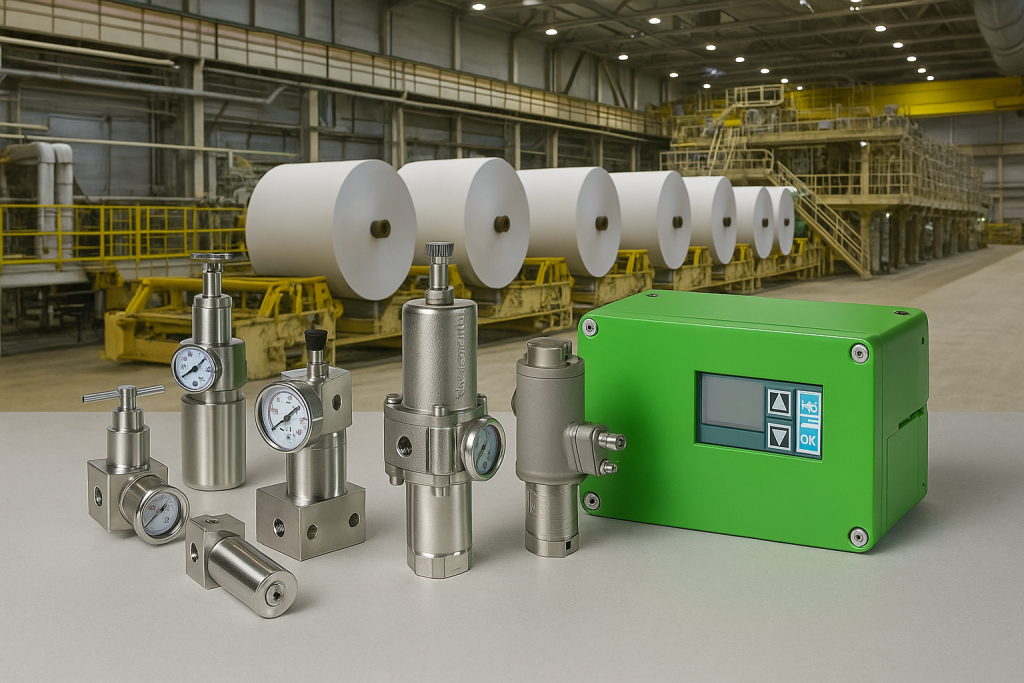
Valve Automation in Pulp & Paper Industry — Challenges and Reliable Control Solutions
The pulp and paper industry operates under some of the most demanding industrial conditions.
Continuous production, high temperatures, aggressive chemicals, and strict process requirements create an environment where even minor control failures can lead to significant operational issues.
In these systems, reliability is not optional — it is critical for maintaining efficiency, safety, and product quality.
Why control systems struggle in pulp and paper applications
Unlike standard industrial processes, pulp and paper operations involve multiple interconnected systems where process stability depends on accurate and responsive control.
Typical challenges include:
- High humidity and corrosive chemicals affecting equipment performance
- Temperature variations in steam and drying sections
- Continuous operation with limited tolerance for downtime
- Complex flow control in chemical and water treatment systems
These conditions place significant stress on valves, actuators, and control accessories.
The role of instrumentation in maintaining process stability
In pulp and paper mills, control accuracy directly impacts energy consumption, product quality, and system safety.
Instrumentation and control accessories are not secondary components — they are essential for ensuring that valves and actuators perform consistently under changing conditions.
Positioners — precision in steam and flow control
Valve positioners are critical in applications where precise modulation is required, such as steam control, chemical dosing, and water management.
In systems like recovery boilers, accurate steam control is necessary to maintain efficiency and reduce emissions.
Positioners enable:
- Stable valve positioning under fluctuating conditions
- Improved process control accuracy
- Reduced energy consumption
Solenoid valves — reliable switching in harsh environments
Pulp and paper processes expose equipment to moisture, chemicals, and temperature extremes.
Solenoid valves provide reliable on/off control in critical applications such as:
- Steam and condensate systems
- Chemical dosing processes
- Auxiliary water control systems
Using industrial-grade solenoid valves reduces the risk of failure and ensures consistent operation during startup and shutdown.
Filter regulators — protecting pneumatic reliability
Pneumatic systems are widely used for valve actuation in pulp and paper plants.
However, contaminated air — including moisture, oil, and particles — can lead to actuator failure or unstable performance.
Filter regulators provide:
- Clean and stable air supply
- Protection of sensitive pneumatic components
- Improved actuator response consistency
This is particularly important in:
- Paper machine automation systems
- Emergency shutdown valves (ESDVs)
- Chemical processing lines
High-pressure regulators — controlling steam and gas systems
Steam systems are central to pulp and paper operations, especially in drying processes and energy generation.
High-pressure regulators ensure safe and stable control of these systems.
Key applications include:
- Steam distribution in drying sections
- Boiler and feedwater control
- Gas control in recovery boilers and kilns
Proper pressure regulation reduces the risk of system instability and improves operational safety.
What happens when instrumentation fails
Failures in control accessories can quickly escalate into larger operational problems:
- Unplanned downtime in continuous production systems
- Safety risks from uncontrolled steam or chemical release
- Inconsistent product quality
These risks highlight the importance of reliable instrumentation in maintaining stable operations.
What this means for pulp and paper operators
Improving system reliability is not only about selecting high-quality valves and actuators.
It requires ensuring that supporting components — positioners, solenoid valves, and regulators — are properly selected and suited for the operating environment.
In many cases, upgrading instrumentation can significantly improve performance without major system changes.
Key takeaway
The pulp and paper industry demands robust, reliable, and precise control systems.
Instrumentation and control accessories play a critical role in achieving this, ensuring that valve automation systems operate consistently under harsh conditions.
Reliable control is not achieved by major components alone — it depends on the entire system working together.
Next step
If your process involves unstable control, actuator issues, or frequent maintenance, reviewing your instrumentation setup can reveal hidden weaknesses in the system.