
RELEBLE Solutions
Instrumentation for Control and Safety Systems
Instrumentation & Control Systems for Process Stability, Valve Automation and Functional Safety
Process availability depends on more than the performance of the final control element. Stable control loops, deterministic actuator response, and predictable safe-state transitions require an instrumentation architecture that manages signal transmission, pneumatic energy, diagnostic feedback, and valve actuation as one integrated system. Under the IEC 61511 safety lifecycle, instrumentation becomes an engineering discipline that directly influences loop stability, shutdown performance, and long-term asset reliability.
Nordenflow designs instrumentation packages for industrial valve automation by combining severe-service switching devices, process control components, pneumatic infrastructure, intelligent diagnostics, and high-integrity valve manifolds into coordinated system architectures. Rather than selecting individual devices, engineering decisions are based on process dynamics, response requirements, maintainability, and operational continuity throughout the equipment lifecycle.
Our instrumentation portfolio integrates the complete IMI technology platform for process control, pneumatic automation, and functional safety applications across industrial facilities throughout Finland and the European Union.
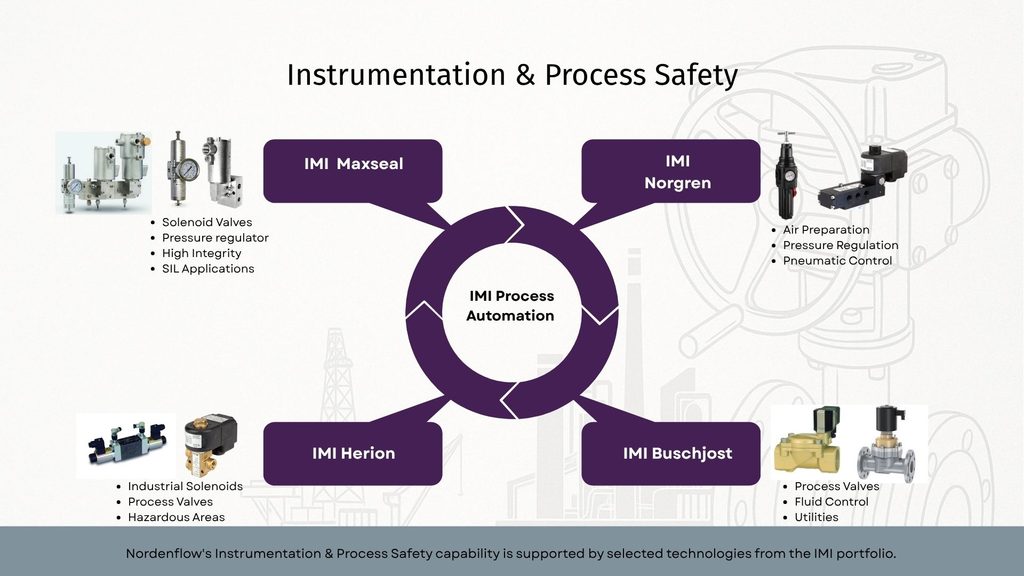
Core Instrumentation Technologies for Valve Automation and Process Control
Industrial instrumentation performs distinct engineering functions throughout a valve automation system. Each technology below addresses a specific requirement within signal transmission, fluid regulation, pneumatic architecture, equipment diagnostics, or instrument air preparation to improve process availability, response consistency, and lifecycle reliability.
Solenoid Valves
Electrical-to-pneumatic switching devices that initiate deterministic actuator movement for on/off control, emergency shutdown valves, and automated valve packages. Engineered for high switching reliability, severe-duty service, and rapid response across critical process applications.
Explore Solenoid Valves →Fluid Control Valves
Process isolation and media control valves designed for liquid, gas, steam, condensate, and utility services. Suitable for demanding industrial applications requiring reliable flow regulation, corrosion-resistant materials, and continuous operating performance.
Explore Fluid Control Valves →Redundant Valve Manifolds
Integrated pneumatic manifold assemblies that maintain actuator availability during inspection, proof testing, or component replacement. Engineered for high-integrity shutdown architectures where online maintenance and operational continuity are essential.
Explore RVM Solutions →Partial Stroke Testing & Smart Positioners
Intelligent valve diagnostics and position control technologies that verify actuator performance, monitor mechanical degradation, optimize valve travel, and support predictive maintenance throughout the operating lifecycle.
Explore PST & Positioners →Air Filters & Pressure Regulators
Pneumatic air preparation equipment that removes contamination, stabilizes supply pressure, and protects downstream instrumentation from moisture, oil carryover, and particulate ingress to maintain consistent actuator performance.
Explore Air Preparation →Signal Switching and Process Control Engineering
Reliable instrumentation begins with correct component selection rather than product substitution. Solenoid valves and fluid control valves perform different engineering functions within automated process systems, requiring evaluation against operating conditions, response objectives, media characteristics, and lifecycle requirements before integration into valve automation packages.
Engineering Considerations for Solenoid Valves
Solenoid valves determine how rapidly and consistently pneumatic or hydraulic actuators respond to electrical control signals. Device selection should consider response time, Cv capacity, direct-acting or pilot-operated configuration, operating pressure range, coil voltage, enclosure classification, switching frequency, manual override requirements, and hazardous-area certification for the intended application.
Typical applications include on/off automated valves, Emergency Shutdown (ESD) systems, process isolation valves, pneumatic actuator control, and high-cycle switching duties.
Engineering Considerations for Fluid Control Valves
Fluid control valve selection is governed by process media, operating pressure, temperature, flow characteristics, corrosion resistance, pressure class, body and seal materials, and required flow coefficient (Cv/Kv). Matching valve construction to process conditions improves operational reliability while reducing wear, leakage, and maintenance frequency throughout the equipment lifecycle.
Typical services include steam, condensate, compressed air, industrial gases, cooling water, chemical processing, utility systems, and severe industrial process applications.
High-Integrity Logic Layer for Safety Instrumented Valve Systems
Safety Instrumented Functions depend on more than certified field devices. Hardware architecture determines how instrumentation responds to component failures, proof testing, maintenance activities, and demand conditions. High-integrity pneumatic assemblies reduce single points of failure while preserving actuator availability throughout the equipment lifecycle in accordance with IEC 61508 hardware integrity principles.
Rather than adding redundant components individually, integrated Redundant Valve Manifold (RVM) assemblies consolidate pneumatic switching, isolation, testing, and maintenance functions into a single engineered hardware platform. This approach simplifies shutdown architecture while improving maintainability, diagnostic accessibility, and long-term operational continuity.
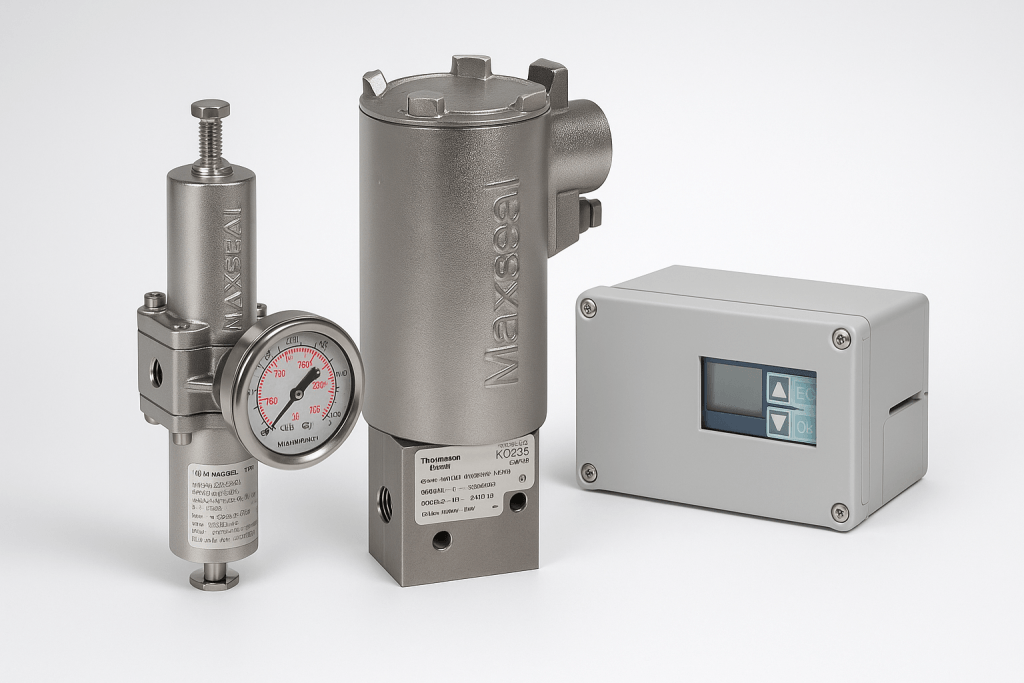
Smart Asset Management Through Valve Diagnostics and Partial Stroke Testing
Modern valve automation extends beyond command execution to continuous assessment of mechanical condition. Partial Stroke Testing (PST) and intelligent valve positioners provide diagnostic information that reveals performance degradation before it develops into functional failure. By monitoring valve movement, actuator response, and feedback consistency, maintenance decisions can be based on measurable equipment behaviour rather than fixed inspection intervals.
Diagnostic Information Supporting Predictive Maintenance
- Detection of increasing valve friction, stiction and actuator hysteresis before loss of operability.
- Performance trending through travel deviation, response repeatability and valve signature analysis.
- Optimization of proof-test planning using condition-based diagnostic information instead of calendar-based assumptions.
- Early recognition of analogue signal abnormalities and device status through NAMUR NE 43 fault signalling and NAMUR NE 107 standardized diagnostics.
- Improved maintenance planning by identifying developing mechanical wear while the valve remains available for process operation.
Rather than treating proof testing as a periodic compliance activity, modern diagnostic architectures transform valve automation into a continuously monitored asset. This approach improves maintenance efficiency, increases diagnostic confidence, and supports long-term lifecycle management across critical process facilities.
Infrastructure Protection Through Engineered Instrument Air Preparation
The quality of instrument air directly influences pneumatic response, actuator repeatability, and the operating life of downstream instrumentation. Moisture, oil aerosols, particulate contamination, unstable supply pressure, and inadequate air treatment introduce failure mechanisms that cannot be corrected through component replacement alone. Proper air preparation establishes the foundation for stable pneumatic control throughout the automation system.
Engineering Objectives
- Maintain stable pneumatic supply pressure under varying process demand.
- Remove condensate, oil aerosols, and particulate contamination before reaching pilot circuits.
- Protect regulators, solenoid valves, positioners, manifolds, and actuator control components from premature wear.
- Reduce pressure decay, regulator creep, and pneumatic response variation throughout the control system.
- Support long-term availability of instrument air infrastructure.
Engineering Design Considerations
- Instrument air quality should be specified according to ISO 8573-1 Class 1:4:1 or the requirements of the installed instrumentation.
- Filter capacity, pressure regulation range, and flow demand should be matched to actuator air consumption.
- Air preparation equipment should be positioned upstream of critical pneumatic devices to minimize contamination of pilot passages and precision control components.
- Periodic inspection of filter differential pressure and condensate drainage helps preserve stable pneumatic operation.
Instrument air should be treated as critical process infrastructure rather than an auxiliary utility. Well-engineered air preparation protects every downstream pneumatic component, improves response consistency, and establishes the operating conditions required for reliable valve automation and functional safety systems.
Engineering Support for Instrumentation and Valve Automation Projects
Successful instrumentation projects begin with engineering validation rather than component selection. Whether designing a new valve automation package, modernizing an existing shutdown system, or improving process reliability, instrumentation decisions should be based on operating conditions, functional objectives, maintainability, and lifecycle performance instead of individual product specifications.
Engineering Review
- Instrumentation architecture assessment
- Valve automation package review
- Shutdown system modernization strategy
- Pneumatic control network evaluation
- Redundant Valve Manifold (RVM) selection
Technical Validation
- Instrumentation datasheet verification
- Cv/Kv and actuator compatibility review
- Solenoid valve configuration
- Instrument air preparation assessment
- Functional safety hardware evaluation
Project Delivery
- Technology selection using the IMI portfolio
- OEM coordination and documentation support
- Technical support during procurement
- Retrofit and lifecycle optimization
- Support for industrial projects across Finland and the European Union
Nordenflow combines engineering expertise with integrated instrumentation technologies to help industrial facilities improve valve automation, functional safety, and process reliability before unnecessary equipment replacement is considered.
Request an Engineering ConsultationEngineering Questions Frequently Discussed During Instrumentation Projects
Instrumentation decisions are rarely driven by individual components. During engineering reviews, shutdown system upgrades, and valve automation projects, the discussion typically focuses on system behaviour, operational constraints, and lifecycle performance. The following questions reflect topics frequently raised by automation engineers, maintenance teams, EPC contractors, and plant operators.
Why is the shutdown valve no longer achieving its required stroke time?
The valve itself is only one element of the shutdown system. Solenoid performance, pneumatic supply pressure, tubing volume, actuator condition, friction, and pilot circuit design should all be evaluated before replacing the valve assembly.
Can the existing shutdown system be upgraded without replacing the valve?
Many modernization projects achieve measurable improvements through upgraded instrumentation, pneumatic architecture, diagnostics, or actuator accessories while retaining the existing valve body.
Why does the control loop continue hunting after PID retuning?
Loop instability may originate from valve friction, actuator hysteresis, inadequate position feedback, or inconsistent pneumatic response rather than controller tuning parameters.
When should a redundant pneumatic architecture be considered?
Applications requiring high availability, online maintenance, or reduced exposure to single-point hardware failures may benefit from integrated Redundant Valve Manifold (RVM) architectures instead of conventional pneumatic layouts.
Are proof tests detecting mechanical degradation early enough?
Diagnostic information obtained through Partial Stroke Testing and intelligent positioners can identify increasing friction, travel deviation, or mechanical wear before these conditions affect shutdown performance.
Can poor instrument air explain inconsistent actuator behaviour?
Moisture, oil contamination, pressure instability, and particulate ingress frequently influence pneumatic response long before component failure becomes visible during plant operation.
Which engineering data should be verified before selecting instrumentation?
Process conditions, actuator sizing, Cv/Kv requirements, available utilities, hazardous-area classification, response objectives, and maintenance philosophy should all be reviewed before selecting instrumentation components.
How is instrumentation evaluated within a Safety Instrumented Function rather than as individual devices?
Functional safety verification considers hardware architecture, diagnostics, proof-test strategy, common-cause failures, and subsystem interaction rather than individual component certification alone.