
Reliable Solutions
Hydraulic & Electro-Hydraulic Actuation
Hydraulic & Electro-Hydraulic Actuation for High-Force and Fail-Critical Valve Systems with Heavy-Duty Valve Automation
At Nordenflow, we engineer hydraulic and electro-hydraulic actuation systems for applications where pneumatic or electric solutions are no longer sufficient in terms of force or fail-safe performance.
In high-pressure, high-torque, or safety-critical environments, actuator sizing, response dynamics, and stored energy define whether the valve performs as required under worst-case conditions.
Incorrect actuation in these environments doesn’t reduce performance—it leads to non-closure, delayed shutdown, or system failure.
When Hydraulic or Electro-Hydraulic Actuation Becomes Necessary
Hydraulic actuation is selected when required torque, dynamic load conditions, or fail-safe performance cannot be achieved by pneumatic or electric systems.
In these cases, actuator performance depends on pressure stability, stored energy capacity, and system integrity. Incorrect design can result in slow response, incomplete valve stroke, or failure under emergency conditions.
Extreme Torque Requirements
Required when valve torque exceeds pneumatic capability, especially in large diameter valves or high differential pressure conditions.
Guaranteed Fail-Safe Under Load
Used when valve closure must be completed under full process load using stored hydraulic energy, independent of external power.
Dynamic Torque & Load Variations
Required where valve torque varies significantly during operation, including seating forces and transient pressure conditions.
Controlled Movement Under High Load
Hydraulic systems enable controlled stroke speed and damping, preventing shock loads and mechanical stress on valves.
System Integrity & Leakage Risk
Hydraulic performance depends on system sealing and pressure retention. Leakage or pressure drop can directly affect actuator response and fail-safe performance.
Dedicated Hydraulic Power Systems
Applied where hydraulic power units (HPU) or electro-hydraulic systems are required to deliver consistent force and controlled operation.
When Hydraulic May Not Be the Right Choice
Not suitable where system simplicity, low maintenance, or clean environments are critical, due to complexity of hydraulic circuits and potential leakage.
As a result, hydraulic and electro-hydraulic actuators are used in high-force, safety-critical applications such as pipelines, offshore systems, and heavy-duty industrial processes.
Engineering Scope
Hydraulic and electro-hydraulic actuation requires system-level engineering where force, pressure behavior, and stored energy must be matched to valve dynamics and operating conditions.
Unlike pneumatic or electric systems, performance depends on pressure retention, accumulator capacity, and system integrity. Incorrect design can result in incomplete valve stroke, delayed shutdown, or failure under emergency conditions.
Torque & Force Validation
Actuator force is defined by hydraulic pressure and piston area, aligned with breakaway torque, dynamic loads, and seating forces across the full stroke.
Undersizing leads to incomplete stroke; oversizing can create excessive mechanical stress and instability.
Accumulator Sizing & Stored Energy
Accumulators must provide sufficient energy to complete valve travel under worst-case conditions, including pressure drop and system losses.
Incorrect sizing can result in partial closure or failure during emergency shutdown.
Pressure Retention & Leakage Control
System sealing and pressure retention directly affect actuator reliability. Internal or external leakage reduces available force and response capability.
Pressure decay must be evaluated to ensure fail-safe performance over time.
Flow Control & Stability
Flow control valves and pressure regulators define actuator speed and damping behavior, preventing shock loads and unstable movement.
Response Time & Stroke Control
Actuation speed is determined by flow rate, accumulator discharge, and system resistance. Response time must match safety and process requirements.
System Integration & Redundancy
Integration with hydraulic power units, control panels, and safety systems must include redundancy and fail-safe logic where required.
Hydraulic actuator performance is defined by system integrity and stored energy behavior. Without proper validation of pressure, leakage, and accumulator capacity, fail-safe operation cannot be guaranteed.
What We Supply
We supply complete hydraulic and electro-hydraulic actuation systems — engineered to match valve behavior, operating conditions, and fail-safe requirements.
Hydraulic / Electro-Hydraulic Actuator
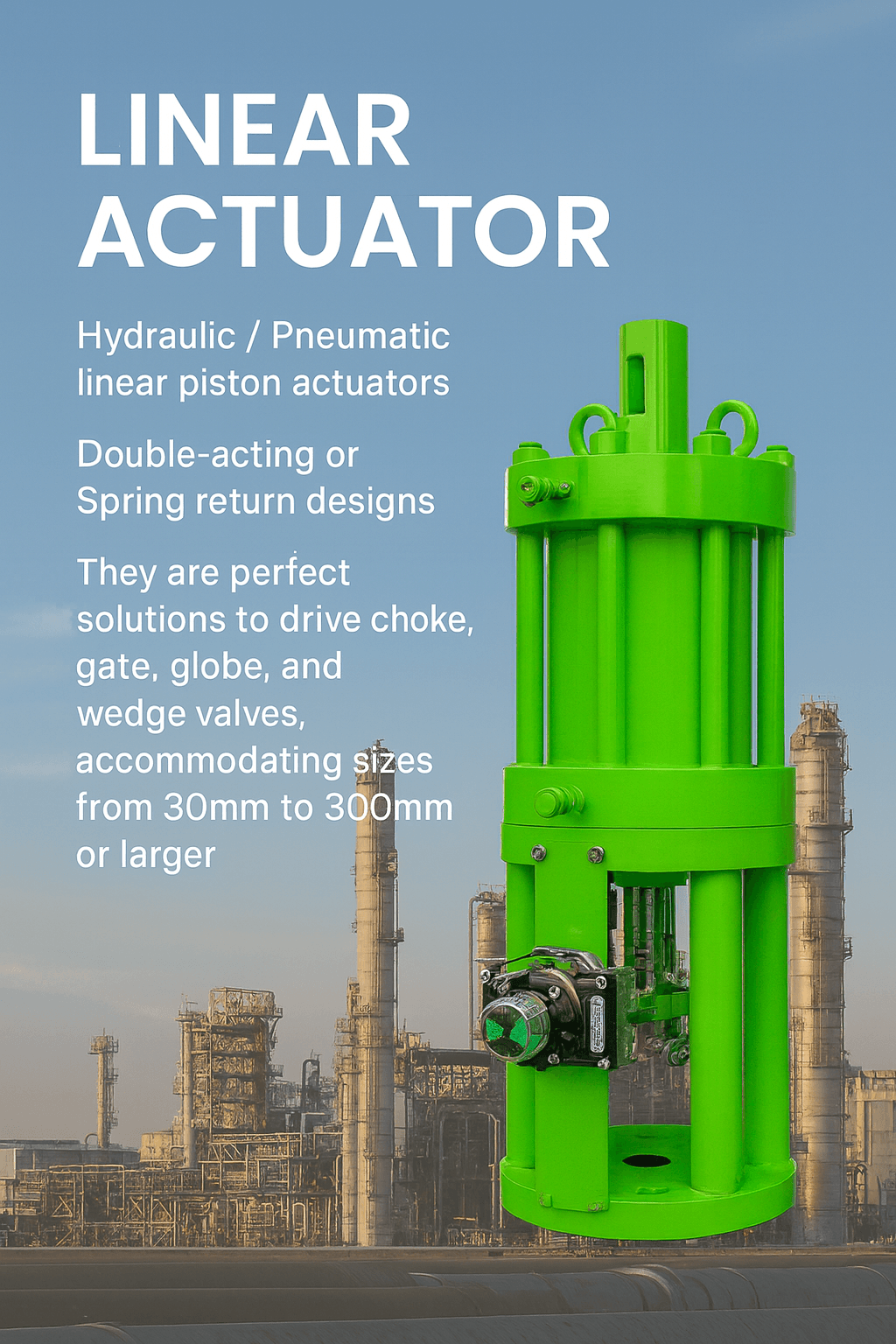
Cylinder or rotary actuators sized based on real torque requirements, including breakaway and dynamic load conditions.
Hydraulic Power Unit (HPU)
Centralized or self-contained systems providing controlled pressure, flow, and energy storage for reliable operation.
Control & Manifold System
Directional valves, pressure regulation, and flow control components ensuring stable, predictable actuator performance.
Fail-Safe Energy System
Accumulator-based solutions designed to guarantee full stroke movement under loss of power or pressure conditions.
Position Feedback & Monitoring
Limit switches and transmitters for accurate valve position indication and integration into control systems.
Mechanical Integration
Mounting kits, couplings, and interface adaptations ensuring proper alignment and torque transfer to the valve.
Applications
Hydraulic and electro-hydraulic actuation is used where valve operation is critical, loads are high, and failure is not an option.
Oil & Gas — Emergency Shutdown Systems
Actuation of ESD valves where fast, guaranteed closure under high pressure is required to prevent system escalation.
Offshore & Marine — Safety-Critical Valve Control
Reliable valve operation in corrosive, high-load environments where electric systems may not perform consistently.
Power Generation — High-Energy Isolation
Control of steam or high-energy fluid valves where precise force and fail-safe positioning are required.
Heavy Process Industry — High Torque Valves
Operation of large or high-resistance valves where pneumatic solutions cannot deliver sufficient torque.
Pipeline Systems — Remote Critical Isolation
Valve actuation in remote or unmanned locations where reliability and autonomous fail-safe operation are essential.
Refining & Petrochemical — Process Safety
Critical process valves requiring controlled movement under variable loads and strict safety requirements.
Pipeline Emergency Isolation
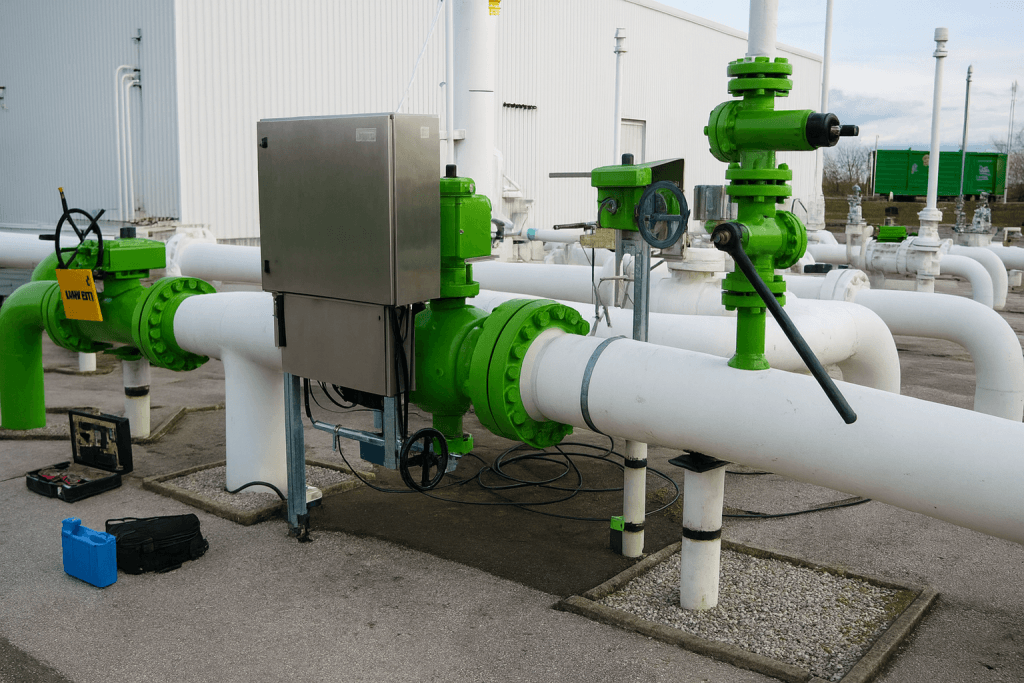
Electro-hydraulic actuation can be integrated into critical pipeline isolation systems where reliable shutdown and controlled actuator response are required. Where automatic isolation is initiated by abnormal pipeline conditions, electronic line break detection can provide the detection and decision layer for the shutdown function. Learn more about Electronic Line Break Detection in Pipelines .
Hydraulic vs Other Actuation Methods — What Actually Matters
Hydraulic systems are selected when force, load stability, and fail-safe performance cannot be achieved by pneumatic or electric actuators.
However, the choice is not only about force. It depends on system architecture, energy source, and reliability under real operating conditions.
When is hydraulic better than pneumatic?
When required torque exceeds pneumatic capability or when valve performance must remain stable under high differential pressure and dynamic load conditions.
Pneumatic systems may lose performance under pressure variation, while hydraulic systems maintain consistent force output.
When is hydraulic better than electric?
When fail-safe operation must be guaranteed under load and independent of power supply, especially in ESD or critical isolation systems.
Electric actuators rely on power continuity, while hydraulic systems can operate using stored energy.
Electro-Hydraulic vs Central Hydraulic (HPU)
Electro-hydraulic units are self-contained systems combining electric drive and hydraulic power locally, reducing dependency on centralized infrastructure.
Central HPU systems supply multiple actuators but increase complexity, piping, and potential single-point failure risk.
When hydraulic is not the right choice
Not suitable for applications requiring simple installation, low maintenance, or clean environments due to system complexity and leakage risk.
Hydraulic systems solve force and fail-safe challenges, but introduce complexity. The correct choice depends on balancing torque demand, system architecture, and reliability under failure conditions.
Define the Right Hydraulic Actuation Concept
Hydraulic actuator performance depends on correct torque sizing, accumulator capacity, and system design. Incorrect configuration can result in incomplete valve closure or failure during emergency shutdown.
Submit your valve data — we define the required actuator force, stored energy, and fail-safe behavior based on real operating conditions.
• Valve type, size, and differential pressure (or torque if available)
• Required fail-safe position and shutdown logic
• Required response time or stroke speed
• Available power or system architecture (HPU / electro-hydraulic)
• Any environmental or installation constraints
No complete data required — we support torque estimation, accumulator sizing, and fail-safe design.