
Reliable Solutions
Gas over Oil Actuators: Engineered for Pipeline Safety and Protection
Why Gas Over Oil Actuation Matters in Pipelines
Pipeline operators use gas-over-oil actuators when valves must operate independently without external power. In these conditions, the system responds automatically to pressure disturbances such as line break events.
However, actuation in pipeline systems is not just about control—it is a safety system. Therefore, the actuator must deliver reliable shutdown performance under real operating conditions.
As a result, proper system design helps protect the pipeline, reduce product loss, and limit environmental impact.
Nordenflow engineers gas-over-oil actuation systems based on pipeline behavior, ensuring reliable operation and proper integration.
When Gas-Over-Oil Actuation Is the Right Choice
Gas-over-oil systems are selected when valve operation must remain independent from external power and respond automatically to pipeline conditions such as pressure drop or flow deviation.
However, this technology is not universal. It is applied where autonomy and pressure-driven logic are more critical than centralized control or continuous monitoring.
No Reliable Power or Control Infrastructure
Used in remote pipeline sections where electrical or hydraulic supply is not available or cannot be guaranteed during emergency conditions.
Automatic Line Break Response Required
Actuation is triggered by pressure drop (rate-of-drop) or flow imbalance, enabling immediate valve closure without external command.
Independent Fail-Safe Operation
Stored gas energy drives the actuator, ensuring valve closure even in complete loss of power, signal, or system communication.
Long-Distance Pipeline Segmentation
Applied in block valve stations where fast isolation is required to limit product loss and protect pipeline integrity.
Not Ideal for All Conditions
In cold environments or where gas release is restricted, electro-hydraulic systems may provide more controlled and environmentally compliant operation.
Gas-over-oil is not selected for convenience, but for independence and automatic response. The decision depends on pipeline conditions, safety philosophy, and environmental constraints.
What We Supply
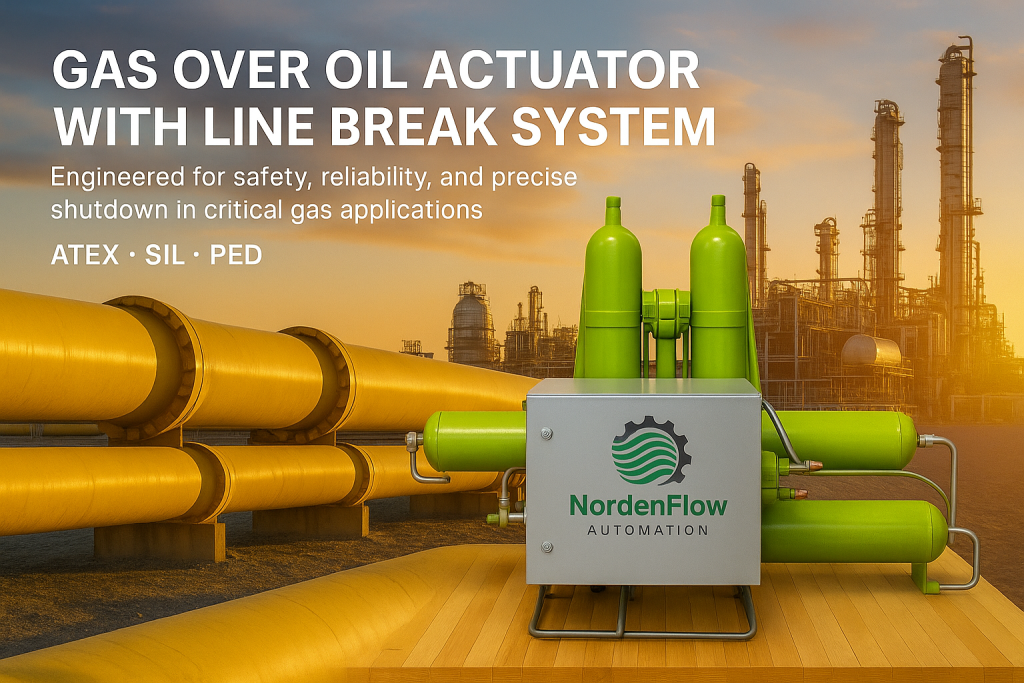
We supply gas-over-oil actuation systems configured for autonomous pipeline operation and safety-driven valve control.
Actuator System
Hydraulic actuator powered by stored gas energy, sized according to valve torque and pipeline conditions.
Gas Storage System
High-pressure gas reservoirs providing stored energy for emergency shutdown and fail-safe operation.
Detection & Control
Pressure and flow sensing systems triggering valve closure during abnormal pipeline conditions.
Line Break Systems
Mechanical or electronic detection systems enabling automatic response based on defined logic.
Each system is engineered based on pipeline pressure, valve torque, and shutdown requirements to ensure reliable performance under real operating conditions.
Engineering Scope
Gas-over-oil actuator performance is defined by the interaction between valve torque, stored energy, and pipeline dynamics under real operating conditions.
Incorrect sizing or trigger configuration can result in delayed shutdown, incomplete valve closure, or false activation during transient pressure events.
Valve Torque & Load Profile
Breakaway torque, dynamic load, and pressure-dependent forces are evaluated across the full stroke to ensure reliable valve closure under worst-case pipeline conditions.
Gas Volume & Energy Storage
Gas pre-charge pressure and volume are calculated to deliver sufficient hydraulic energy, accounting for temperature variation, pressure decay, and full stroke completion.
Trigger Logic & Detection
Rate-of-drop and pressure differential thresholds are defined to initiate shutdown, aligned with pipeline operating pressure and flow conditions.
Pipeline Dynamics & Response Time
Actuation speed is defined considering fluid inertia, pressure wave propagation, and pipeline length to minimize product loss and avoid surge effects.
False Trigger Prevention
System tuning avoids unintended shutdown caused by transient pressure fluctuations, while maintaining sensitivity to actual line break events.
Standards & Safety Requirements
Design and validation are aligned with pipeline safety standards such as EN and API specifications, including functional testing of shutdown performance.
In gas-over-oil systems, the actuator is part of the pipeline protection system. Performance is defined by energy availability, trigger accuracy, and response timing—not by actuator size alone.
Where Gas-Over-Oil Actuation Is Used in Pipeline Systems
Gas-over-oil actuators are applied in pipeline systems where valve operation must remain autonomous and respond immediately to abnormal pressure or flow conditions.
These applications are defined not only by location, but by the requirement for independent shutdown, pressure-driven actuation, and minimal reliance on external infrastructure.
Long-Distance Transmission Pipelines
Used where rapid isolation is required during rupture or pressure drop events, especially when centralized control systems cannot guarantee response time.
Block Valve Stations (Pipeline Segmentation)
Enables automatic closure based on line break detection to limit product loss and isolate pipeline sections during failure scenarios.
Remote Isolation Valves Without Infrastructure
Applied in locations where electrical or hydraulic power is unavailable, requiring fully autonomous actuator operation.
High Consequence Areas (HCA)
Used in environmentally sensitive or populated areas where immediate shutdown is critical to reduce safety risk and environmental impact.
Compressor and Metering Stations (Emergency Isolation)
Ensures fast and independent valve closure in critical nodes where pressure instability or flow imbalance must trigger immediate response.
Not Ideal for Controlled or Regulated Systems
In systems requiring continuous control, emission limitations, or stable performance in cold climates, electro-hydraulic solutions are often more suitable.
Gas-over-oil actuators are applied where shutdown must happen automatically and independently. The application is defined by response requirement and system constraints—not by location alone.
Electronic Line Break Detection
Gas-over-oil actuation can be integrated with mechanical or electronic line break detection systems to initiate automatic valve closure when abnormal pipeline conditions are detected. For a closer look at electronic detection logic and its role in pipeline isolation, see our guide to Electronic Line Break Detection in Pipelines .
Gas-Over-Oil vs Electro-Hydraulic — Pipeline Decision Guide
Choosing between gas-over-oil and electro-hydraulic actuation depends on infrastructure availability, environmental conditions, and required level of control.
The following comparison and answers reflect how each system performs under real pipeline operating conditions—not just theoretical capabilities.
| Criteria | Gas-over-Oil | Electro-Hydraulic |
|---|---|---|
| Power Requirement | Independent (stored gas energy) | Requires electrical supply |
| Fail-safe Operation | Autonomous shutdown | Engineered (accumulator / backup) |
| Cold Climate Performance | Affected by gas pressure variation | Stable and controllable |
| Environmental Impact | Possible gas release during actuation | Closed hydraulic system |
| System Complexity | Lower (pressure-based logic) | Higher (integrated control system) |
| Best Fit | Remote, autonomous pipelines | Controlled, monitored systems |
When is gas-over-oil the better choice?
When pipeline sections must operate independently without electrical infrastructure and require immediate shutdown based on pressure conditions.
When is electro-hydraulic more suitable?
When stable operation, environmental compliance, and integration with SCADA or control systems are required.
What happens in cold or emission-sensitive environments?
Gas pressure variation and release can limit gas-over-oil performance, making electro-hydraulic systems more predictable and compliant.
What is the main risk of wrong selection?
Incorrect actuator choice can lead to delayed shutdown, incomplete isolation, or failure under real pipeline conditions.
In Nordic and European pipeline systems, electro-hydraulic actuators are often preferred where temperature variation and environmental regulations limit the use of gas-based systems.
Define the Right Gas-Over-Oil Actuation Concept
In pipeline systems, incorrect actuation design can result in delayed shutdown, incomplete isolation, or failure during line break events.
Submit your pipeline and valve data — we define actuator sizing, stored energy, and trigger logic based on real operating conditions.
• Pipeline type, length, and operating pressure
• Valve type, size, and torque (or operating conditions)
• Required shutdown logic (line break / remote / manual)
• Trigger method (rate-of-drop, pressure, or control signal)
• Required response time or isolation requirement
• Environmental constraints (temperature, emission limits)
No complete data required — we support actuator sizing, trigger configuration, and fail-safe design.