
RELIABLE Solutions
Flow Control Valves for Industrial Process Applications
Select the right valve type based on flow behavior, pressure conditions, and control requirements
At Nordenflow, we provide control valve solutions engineered to regulate flow, pressure, and process conditions under real operating environments.
Control valve selection is not based on valve type alone—it depends on flow characteristics, pressure drop, control accuracy, and how the valve responds under changing operating conditions.
The right valve defines how your system responds under changing conditions—not just how it operates at a fixed point.
Choose the Right Control Valve Type for Your Application
Control valve selection directly affects process stability, pressure drop, and control performance. The right valve depends on flow behavior, media type, and control requirements.
Globe Control Valve
Precise control, stable modulation
Not suitable for slurry or dirty media
Segment Ball Valve
High flow, slurry, fibrous media
Limited precision control
Triple Offset Butterfly Valve
High temperature, pressure, tight shutoff
Not for precise modulation
How to Select a Control Valve Based on Application Conditions
For slurry or fibrous media, segment ball valves are typically selected due to their resistance to clogging and ability to handle high flow with low pressure drop.
For applications requiring precise flow control and stable control loops, globe control valves are preferred because of their accurate throttling performance.
In high temperature or severe service conditions where tight shutoff is critical, triple offset butterfly valves provide reliable sealing performance.
Cavitation can occur when pressure drops below vapor pressure, especially in high differential pressure applications, and must be considered during valve selection.
Selecting a control valve should always be based on process conditions, not valve type preference. Matching the valve to the application is essential for stable and efficient operation.
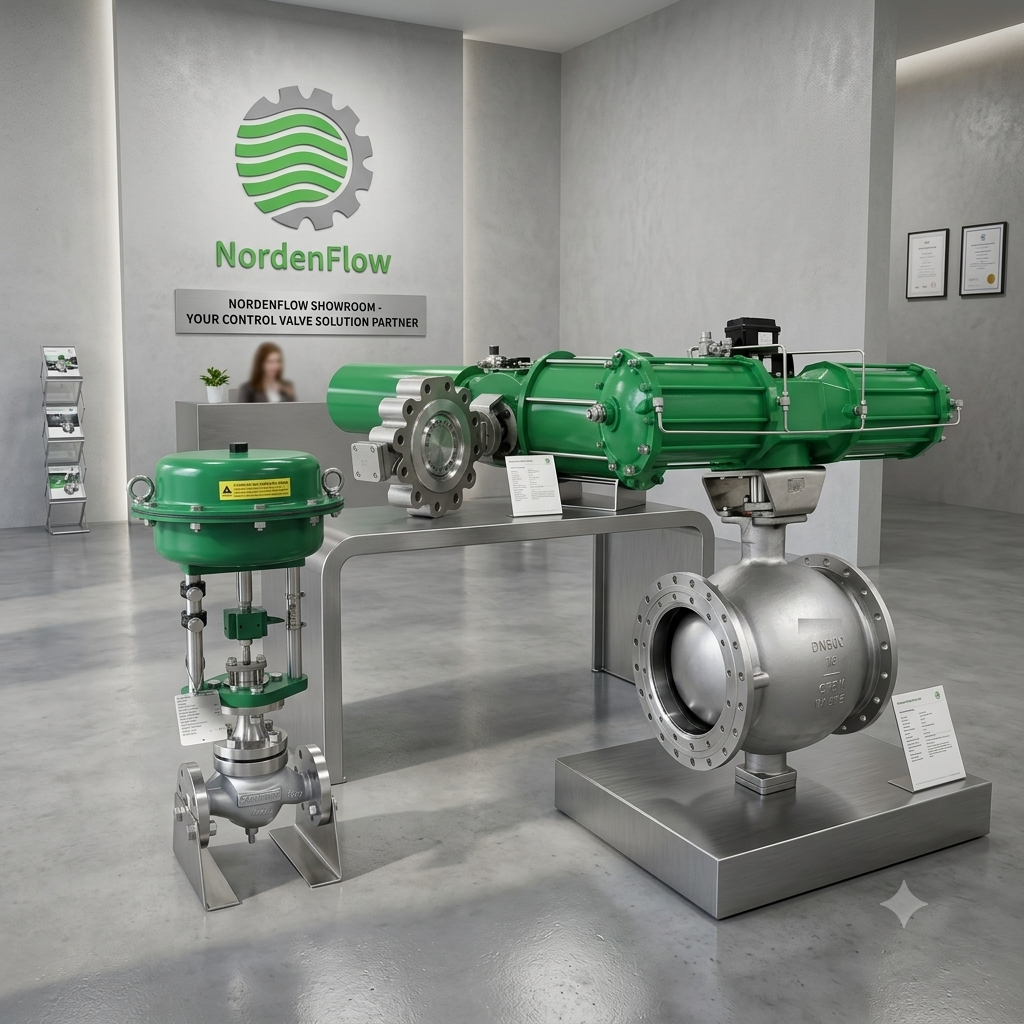
Engineering Approach to Control Valve Selection & Performance
Control valve performance is defined by how it behaves under real operating conditions. Incorrect sizing or parameter selection can lead to instability, cavitation, or poor control performance.
At Nordenflow, valve selection is based on evaluating key parameters together to ensure stable, predictable, and reliable operation.
Flow Coefficient (Cv)
Defines the required valve capacity to achieve target flow rates. Incorrect Cv sizing can lead to poor controllability or unstable operation.
Pressure Drop Management
Proper pressure drop allocation ensures stable control performance. Incorrect ΔP distribution can result in cavitation, noise, or control instability
Control Characteristic
Defines how the valve responds to changing process conditions. Selecting the wrong characteristic can reduce control accuracy and system responsiveness.
Rangeability
Determines how effectively the valve performs across varying operating ranges. Limited rangeability can lead to unstable control under low- or high-flow conditions.
Shutoff Performance
Leakage class defines sealing performance under shutoff conditions. Incorrect selection can lead to leakage, energy loss, or safety concerns.
Process Stability
Ensures interaction between valve behavior and system dynamics remains stable. Poor alignment can result in oscillation and control loop instability.
Not sure how these parameters apply to your system?
Get Valve Selection Support →Applications and Valve Selection Guidance
Control valve performance directly impacts process stability, efficiency, and product quality. Selecting the wrong valve type or configuration can lead to instability, cavitation, or inefficient operation.
Therefore, valve selection must be aligned with application conditions such as flow behavior, media characteristics, and control requirements—not just valve design.
High Flow, Slurry, and Fibrous Media
Segment ball valves are typically preferred in applications with high flow rates, fibers, or abrasive media where clogging and pressure drop are critical concerns.
In contrast, globe valves may suffer from clogging or excessive wear under these conditions.
Precise Flow Control and Stable Modulation
Globe control valves are selected when accurate flow regulation and stable control loop performance are required.
However, segment ball valves may not provide sufficient control accuracy in these applications.
High Temperature and Severe Service Conditions
Triple offset butterfly valves are used in applications requiring tight shutoff under high temperature and pressure conditions.
Soft-seated or standard control valves may not perform reliably under these severe service conditions.
In industrial process systems, valve selection should be based on application requirements rather than valve type preference. Matching the valve to the process conditions is essential to ensure stable operation and long-term reliability.
Why Engineers and Procurement Teams Work with Nordenflow
Selecting the wrong control valve leads to instability, cavitation, and operational risk. Our approach focuses on defining the right valve based on process behavior—not catalog selection.
Engineering-Driven Selection
We evaluate flow behavior, pressure drop, and operating conditions before defining valve type and configuration.
Clear Technical Output
You receive a defined valve concept including type, sizing logic, and application suitability—not generic product options.
Applied in Real Industrial Conditions
Supporting process industries including energy, chemical, and industrial automation across Finland and the EU.
Not Every Valve Fits Every Process
We highlight where a valve type should not be used to avoid instability, cavitation, or poor control performance.
Selecting the wrong control valve can lead to unstable operation, cavitation, or reduced process efficiency.
Get the Right Control Valve for Your Process
Selecting the wrong valve can lead to instability, cavitation, or inefficient operation. Our engineering team evaluates your process conditions, pressure requirements, and flow behavior to recommend the most suitable valve configuration.
Supporting industrial projects across Finland and the EU — submit your process data and receive a clear valve recommendation before detailed sizing and specification.
Request Valve Recommendation